我们正在努力尽快翻译此页面。感谢您的理解。

Search for Art

35 results for cross stitch
Sort by:
Show only
Images
Date
For BCE dates, enter a negative number. E.g. For 2000 BCE, enter -2000.
Artist / culture
Object type / material
Match
 
Show results matching
selected filters.
Geographic location
Match
 
Show results matching
selected filters.
Department
American or British
ca. 1860
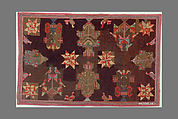
Embroidered Rug, Wool, embroidered in cross-stitch, American
American
ca. 1870s
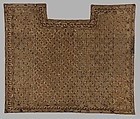
Carpet, Ann Moore  American, Wool, embroidered in cross-stitch, American
Ann Moore
Sophia Moore
Harriett Hicks
1808–12
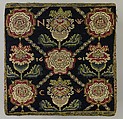
Cushion cover, Canvas embroidered with wool and silk thread; cross and long-armed cross stitches, British
British
1601
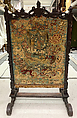
Fire screen, Carved walnut frame; cross-stitch embroidery, French
French
late 17th century
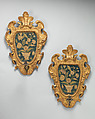
Sconce (one of a pair), Gilded pine and gesso, silver, silk, wool tent and cross stitch on canvas, British
British
ca. 1720
Sconce (one of a pair), Gilded pine and gesso, silver, silk, wool tent and cross stitch on canvas, British
British
ca. 1720
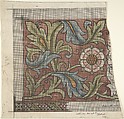
Design for Ecclesiastical Embroidery -- Cross Stitch Pattern, Ernest Geldart  British, Watercolor, pen and black ink over graphite
Ernest Geldart
late 19th–early 20th century
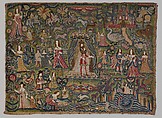
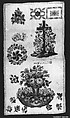
(?) Anonymous, German, 19th century
19th century
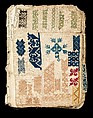
Booklet of embroidery and drawnwork, Linen, silk, leather, paper; techniques include cross stitch, reticello, drawnwork, satin stitch, knots, bullion stitch, probably Portuguese
probably Portuguese
early 17th century
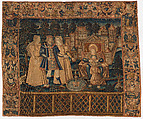
Ensemble, Silk, cotton, wool, metal wrapped thread
1875–1925
The Wayfarer Crowned by Happiness from The Table of Cebes, David Kandel  German, Wool and silk on canvas (cross-stitch, 48-56 per sq. in., 9 per sq. cm.; tent stitch, 156-190 per sq. in., 30-36 per sq. cm.), French
Designer Design based on a woodcut by David Kandel
1550–80
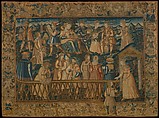
Blast 4, bioinformatica, X-Art Foundation
Publisher X-Art Foundation
1995
The Garden of False Learning from The Table of Cebes, David Kandel  German, Wool and silk on canvas (cross stitch, 48-56 per sq. in., 9 per sq. cm; tent stitch, 156-190 per sq. in., 30-36 per sq. cm.), French
Designer Based on a woodcut by David Kandel
1550–80
Blanket strip, Tanned leather and glass beads, Central Plains, probably Lakota/Teton Sioux, Native American
Central Plains, probably Lakota/Teton Sioux, Native American
ca. 1830
Purse, glass, metal, linen, Mexican
Mexican
late 19th century
Embroidered Sampler, Anne Chase  American, Silk embroidery on wool, American
Anne Chase
1721
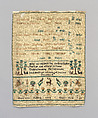
Sampler, Mary "Polly" Hodges  American, Silk embroidery on cotton, American
Mary "Polly" Hodges
ca. 1795
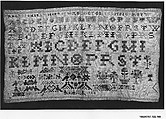
Sampler, Canvas worked with silk and metal thread; tent, cross, back, plaited braid, knots, laid work, and detached buttonhole stitches, British
British
mid-17th century
"I Love New York", Miguel Adrover, cotton, cotton/silk blend; synthetic, American
Designer Miguel Adrover
2000
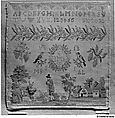
Sampler, Margaret Cassedy  American, Silk embroidery on linen, American
Margaret Cassedy
1826
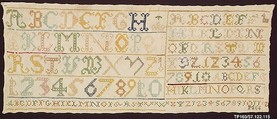
Sampler, Margret Barber, Linen worked with silk and linen thread: reticella, double running, eye, cross, satin, and Gobelin stitches, British
Margret Barber
1661–63
Arganonä Maryam (The Organ of Mary) prayer book, Baselyos, also known as "The Ground Hornbill Master"  Ethiopian, Parchment, pigment ink, wood, leather, fiber
Attributed to Baselyos, also known as "The Ground Hornbill Master"
late 17th century
Charles I, R. Hayes, Silk, British
Embroidered by R. Hayes
After a painting by Edward Bower
after 1649
Sampler, Catherine Cassady  American, Silk embroidery on linen, American
Catherine Cassady
1814
Embroidered quilt, Mildred  American, Linen embroidered with wool, cotton border, American
Mildred
ca. 1775
Prayer book with case (mahdar), Wäldä Maryam  African, Parchment (vellum), pigment (red, blue, ochre, and black), leather, wood, string
Wäldä Maryam
19th century
Embroidered bag with fringe, Nasca artist, Camelid hair, Nasca
Nasca artist
7th century