Dinner hat
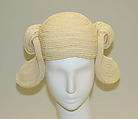
Sally Victor was asked to design hats for the Brooklyn Museum's "Inventions for Victory" exhibition in 1942, which featured products made in response to war shortages. The material used here, braided to imitate hair, is Bubblfil, composed of cellophane-wrapped air bubbles and produced by DuPont until 1943. It was developed to replace kapok, a buoyant material extracted from kapok seed pods and imported from Java. Kapok was used in floats and life preservers but also in situations where a shock absorber would be needed. The hat represents the trend in using industrial materials for decorative purposes, spurred on by wartime. Restrictions on materials encouraged innovation in new products that later became commonplace.
Artwork Details
- Title: Dinner hat
- Designer: Sally Victor (American, 1905–1977)
- Manufacturer: E. I. du Pont de Nemours & Company
- Date: 1942
- Culture: American
- Medium: plastic (cellophane), silk, rayon
- Credit Line: Brooklyn Museum Costume Collection at The Metropolitan Museum of Art, Gift of the Brooklyn Museum, 2009; Gift of Sally Victor, 1947
- Object Number: 2009.300.1440
- Curatorial Department: The Costume Institute
More Artwork
Research Resources
The Met provides unparalleled resources for research and welcomes an international community of students and scholars. The Met's Open Access API is where creators and researchers can connect to the The Met collection. Open Access data and public domain images are available for unrestricted commercial and noncommercial use without permission or fee.
To request images under copyright and other restrictions, please use this Image Request form.
Feedback
We continue to research and examine historical and cultural context for objects in The Met collection. If you have comments or questions about this object record, please contact us using the form below. The Museum looks forward to receiving your comments.
Content Notice
The Metropolitan Museum of Art presents over 5,000 years of art from around the world, and our online collection reflects ongoing work conducted over the course of our more than 150-year history. You may encounter objects or images that may be inappropriate for some viewers or information that may be outdated.