Stove
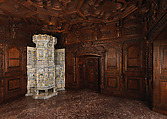
Made in Winterthur, an important Swiss center for faience, these tiles are painted on all sides with figures from the New Testament and stories from the Old Testament. In the lower section the faience painter used designs by Tobias Stimmer (1539–1584) published in Basel in 1576, while those decorating the upper sections were inspired by the etchings of Christoph Murer (1558–1614) published in Strasbourg in 1625. The painter added biblical references above each scene and commentaries below, finding a teaching or message for contemporary Christians in the biblical events. For example, the commentary beneath the scene of Samson and the lion reads, "As Samson's lion gave honey after his death, so Christ's death brings us sweet life." It has been suggested that the pottery of David II Pfau (1644–1702) of Winterthur may have designed and produced the stove with the help of his cousin Hans Heinrich III Pfau.
Artwork Details
- Title: Stove
- Maker: Attributed to the pottery of David II Pfau (1644–1702)
- Maker: Possibly assisted by Hans Heinrich III Pfau (1672–1714)
- Decorator: Decoration after designs by Tobias Stimmer (Swiss, Schaffhausen 1539–1584 Strasbourg)
- Decorator: and Christoph Murer (Swiss, Zurich 1558–1614 Winterthur)
- Date: ca. 1684–85
- Culture: Swiss, Winterthur
- Medium: Faience (tin-glazed earthenware)
- Dimensions: Overall (confirmed): 10 ft. 4 in. × 54 1/4 in. × 71 1/4 in. (315 × 137.8 × 181 cm)
- Classification: Ceramics-Pottery
- Credit Line: Rogers Fund, 1906
- Object Number: 06.968.2
- Curatorial Department: European Sculpture and Decorative Arts
More Artwork
Research Resources
The Met provides unparalleled resources for research and welcomes an international community of students and scholars. The Met's Open Access API is where creators and researchers can connect to the The Met collection. Open Access data and public domain images are available for unrestricted commercial and noncommercial use without permission or fee.
To request images under copyright and other restrictions, please use this Image Request form.
Feedback
We continue to research and examine historical and cultural context for objects in The Met collection. If you have comments or questions about this object record, please contact us using the form below. The Museum looks forward to receiving your comments.
Content Notice
The Metropolitan Museum of Art presents over 5,000 years of art from around the world, and our online collection reflects ongoing work conducted over the course of our more than 150-year history. You may encounter objects or images that may be inappropriate for some viewers or information that may be outdated.