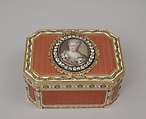
Snuffbox with portrait of a member of the French royal family, probably a daughter of Louis XV
Joseph-Étienne Blerzy (1735–1821) was one of the most prolific of all French gold box makers. He was a favored supplier of Au Petit Dunkerque, the famed emporium owned by the marchand mercier or luxury dealer Charles Raymond Grantchez. The Baronne d’Oberkirch (1754–1803) wrote in her diaries after a 1782 visit to the Paris shop that “nothing could exceed the beauty of this reservoir of jewelry; it was filled with trinkets of every kind, of which the original value was multiplied ten times by the beauty of the elaborate workmanship.”
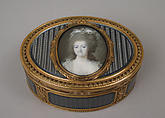
Many of Blerzy’s boxes are oval and decorated with a single enameled medallion on the cover, enameled engine-turned panels and borders resembling pearls. Several are set with royal portraits. On this box, the portrait, by an unidentified artist, may be one of the daughters of Louis XV: the sitter wears a blue mantle decorated with fleurs-de-lis indicating she is a member of the royal family. When given as a gift or to commemorate a specific event, it was tacitly understood that diamond-set gold boxes could be exchanged for their cash value. However, this does not seem to have been the case with boxes lacking jewels.
Blerzy was at the vanguard in the use of paillon decoration on gold boxes, such as seen here in the gold stars. Paillons are small pieces of gold or silver foil cut or stamped into different shapes and fired between two layers of translucent enamel.
Resembling pearls, white enamel beads are frequently found on boxes made by Blerzy. However, on some boxes, small actual pearls replace the enamel beads.
Daughter of one of the founders of the Weyerhaeuser Timber Company, Catherine D. Wentworth (1865–1948) was an art student and painter who lived in France for thirty years.She became one of the most important American collectors of eighteenth-century French silver and on her death in 1948 bequeathed part of her significant collection of silver, gold boxes, French furniture and textiles to the Metropolitan Museum.
Artwork Details
- Title: Snuffbox with portrait of a member of the French royal family, probably a daughter of Louis XV
- Maker: Joseph Etienne Blerzy (French, active 1750–1806)
- Artist: Miniature by French Painter
- Date: 1783–84
- Culture: French, Paris
- Medium: Gold, enamel, gouache on cloth, glass
- Dimensions: Box: 1 3/16 × 3 1/4 × 2 1/2 in. (3 × 8.3 × 6.4 cm);
Miniature (oval): 1 1/2 × 1 1/8 in. (3.8 × 2.9 cm) - Classifications: Metalwork-Gold and Platinum, Miniatures
- Credit Line: Bequest of Catherine D. Wentworth, 1948
- Object Number: 48.187.454
- Curatorial Department: European Sculpture and Decorative Arts
More Artwork
Research Resources
The Met provides unparalleled resources for research and welcomes an international community of students and scholars. The Met's Open Access API is where creators and researchers can connect to the The Met collection. Open Access data and public domain images are available for unrestricted commercial and noncommercial use without permission or fee.
To request images under copyright and other restrictions, please use this Image Request form.
Feedback
We continue to research and examine historical and cultural context for objects in The Met collection. If you have comments or questions about this object record, please contact us using the form below. The Museum looks forward to receiving your comments.
Content Notice
The Metropolitan Museum of Art presents over 5,000 years of art from around the world, and our online collection reflects ongoing work conducted over the course of our more than 150-year history. You may encounter objects or images that may be inappropriate for some viewers or information that may be outdated.