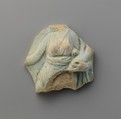
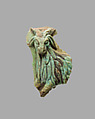
Gilt faience fragment of an oinochoe (jug)
Faience oinochoai depicting Ptolemaic queens were made in Alexandria, Egypt and served as ritual and commemorative vessels in ruler cults in cities throughout the Ptolemaic kingdom. The Athenian provenance of this fragment suggests that these jugs were also exported to places in the Mediterranean basin where the Ptolemies would have wished to assert their cultural position through the imagery on them, which functioned as visual disseminators of the Ptolemaic ideology.
Complete examples of these vases allow us to place this fragment in context. It is likely that the entire relief depicted the queen with her back to a pillar pouring a libation with a phiale in her outstrectched right hand, towards an altar. A cornucopia is a feature of all known examples of these oinochoai and alludes to the abundant richness of the Ptolemaic kingdom.
Artwork Details
- Title: Gilt faience fragment of an oinochoe (jug)
- Period: Hellenistic
- Date: 2nd century BCE
- Culture: Greek, Ptolemaic
- Medium: Faience
- Dimensions: h. 4 in. (10.2 cm)
- Classification: Miscellaneous-Faience
- Credit Line: Gift of J. Pierpont Morgan, 1917
- Object Number: 17.194.1697
- Curatorial Department: Greek and Roman Art
More Artwork
Research Resources
The Met provides unparalleled resources for research and welcomes an international community of students and scholars. The Met's Open Access API is where creators and researchers can connect to the The Met collection. Open Access data and public domain images are available for unrestricted commercial and noncommercial use without permission or fee.
To request images under copyright and other restrictions, please use this Image Request form.
Feedback
We continue to research and examine historical and cultural context for objects in The Met collection. If you have comments or questions about this object record, please contact us using the form below. The Museum looks forward to receiving your comments.
Content Notice
The Metropolitan Museum of Art presents over 5,000 years of art from around the world, and our online collection reflects ongoing work conducted over the course of our more than 150-year history. You may encounter objects or images that may be inappropriate for some viewers or information that may be outdated.