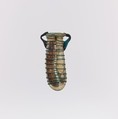
Glass double cosmetic flask (kohl tube)
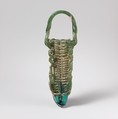
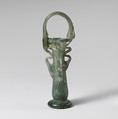
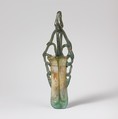
Everted tubular rim, folded over and in; body comprising two tubes, side by side, made from a single inflated gather by pinching sides vertically to make diaphragm; large, jagged pontil pad on very thick bottom; two ring handles attached to lower body in large, rounded pads, drawn vertically up sides in uneven loops, then turned up, out, and down, forming loops above rim, and pressed onto top edge of rim.
Single fine trail applied as a pad and wound in a spiral nine times around middle of body; two other thick trails, resembling the handles, attached to lower body over join of tubes in large, rounded pads, drawn vertically up sides, one in prominent loops, the other as a slightly sinuous rod, then turned in and pressed onto top of rim.
Body intact, but tops of handles chipped, and one missing part of loop; some pinprick bubbles and blowing striations; dulling, pitting, creamy weathering, and iridescence.
Artwork Details
- Title: Glass double cosmetic flask (kohl tube)
- Period: Late Imperial
- Date: 4th century CE
- Culture: Roman, Syrian
- Medium: Glass; blown and trailed
- Dimensions: Overall: 4 13/16in. (12.2cm)
- Classification: Glass
- Credit Line: Museum Accession
- Object Number: X.21.160
- Curatorial Department: Greek and Roman Art
More Artwork

Research Resources
The Met provides unparalleled resources for research and welcomes an international community of students and scholars. The Met's Open Access API is where creators and researchers can connect to the The Met collection. Open Access data and public domain images are available for unrestricted commercial and noncommercial use without permission or fee.
To request images under copyright and other restrictions, please use this Image Request form.
Feedback
We continue to research and examine historical and cultural context for objects in The Met collection. If you have comments or questions about this object record, please contact us using the form below. The Museum looks forward to receiving your comments.
Content Notice
The Metropolitan Museum of Art presents over 5,000 years of art from around the world, and our online collection reflects ongoing work conducted over the course of our more than 150-year history. You may encounter objects or images that may be inappropriate for some viewers or information that may be outdated.