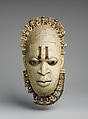
Kagle(?) face mask
Among the Dan, kagle is the mask of energetic disorder. It is said to come from the second-growth bush between cultivated fields and deep forest, where people, animals, and spirits meet and village rules do not apply. When it appears, it hurls sticks at spectators to clear a dancing ground, breaks up gatherings with sudden charges, and runs from one end of the village to the other (Fischer and Himmelheber 1984, 67–68). Its music comes from slit drums, and the masker’s energy follows their rhythm (Thompson 1974, 164).
The rough play of kagle also polices the occasion. In Côte d’Ivoire today, a kagle strikes people who photograph it without authorization and demands payment on behalf of its group from anyone who wishes to film. This behavior has a long history. In the mid-twentieth century the art anthropologist Hans Himmelheber and his son, the ethnologist Eberhard Fischer, recorded a kagle named Wuti at Gbanwie, Liberia. Wuti snatched Fischer’s hat as he tried to take a photograph, filled it with dirt, and pushed it into his face (Fischer and Himmelheber 1984, 68). Elders at Glekpleple told Himmelheber that their kagle punished the conceited and the overly inquisitive (Himmelheber 1972b, cited in Fischer and Himmelheber 1984, 69). The order it imposes is its own, and through it the mask and its group decide who may watch, who may record, and who must pay.
Yann Petit, 2026
Jane and Morgan Whitney Fellow
Artwork Details
- Title: Kagle(?) face mask
- Artist: Dan artist
- Date: 19th–mid-20th century
- Geography: Côte d'Ivoire or Liberia, northeastern region, Liberia or western region, Côte d'Ivoire
- Culture: Dan peoples
- Medium: Wood, iron, animal skin, cord
- Dimensions: H. 9 7/8 x W. 6 3/8 x D. 4 7/8 in. (25.1 x 16.2 x 12.4 cm)
- Classification: Wood-Sculpture
- Credit Line: Gift of Mr. and Mrs. Bernard Leyden, 1982
- Object Number: 1983.558
- Curatorial Department: The Michael C. Rockefeller Wing
More Artwork
Research Resources
The Met provides unparalleled resources for research and welcomes an international community of students and scholars. The Met's Open Access API is where creators and researchers can connect to the The Met collection. Open Access data and public domain images are available for unrestricted commercial and noncommercial use without permission or fee.
To request images under copyright and other restrictions, please use this Image Request form.
Feedback
We continue to research and examine historical and cultural context for objects in The Met collection. If you have comments or questions about this object record, please contact us using the form below. The Museum looks forward to receiving your comments.
Content Notice
The Metropolitan Museum of Art presents over 5,000 years of art from around the world, and our online collection reflects ongoing work conducted over the course of our more than 150-year history. You may encounter objects or images that may be inappropriate for some viewers or information that may be outdated.