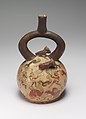
Bowl
Stylized sea-related motifs, like the waves represented in a symmetrical arrangement on this bowl, along with geometric and other schematic designs, became part of a corpus of iconographic motifs shared across northern Peru between the fourth and seventh centuries A.D., a period of intensive regional interaction and stylistic exchange. Based on the distribution of the coveted Cajamarca-style vessels, this economic network included the highland Cajamarca Basin, the coastal Moche and Lambayeque valleys, Huamachuco and the Callejón de Huaylas in the highlands, and even Chachapoyas on the eastern slopes of the Andes. Although the distribution of Cajamarca pottery eventually became far more ubiquitous, reaching the south and central highlands between the eighth and eleventh centuries A.D., Coastal Cajamarca pottery across the Andes seems to have been limited primarily to the north coast and highlands. Most well-known examples of this type of vessel come from the ceremonial centers at Chornancap and Huaca de La Luna on the Peruvian north coast.
While few of their original contexts of use have been thoroughly investigated, these bowls seem to have been commonly—and actively— used in feasts and rituals, and particularly designed to be manipulated. The emphasis on the interior surface requires a direct engagement between the user and the object, rather than contemplation from afar. It is also likely that these vessels were part of communal feasts, social events designed to help summon and organize local labor.
Patricia Chirinos-Ogata, Department of Anthropology, University of California, Santa Barbara, 2021
Further reading and references
Bernuy, K., and Bernal, V. (2008). La tradición Cajamarca en San José de Moro: Una evidencia de interacción interregional durante el Horizonte Medio. In L. J. Castillo, H. Bernier, G. Lockard, & J. Rucabado (Eds.), Arqueología Mochica: Nuevos enfoques (pp. 67-80). Lima: Pontificia Universidad Católica del Perú.
Toohey, J. L., and Chirinos, P. (2018). La tradición Cajamarca y la sierra norte del Perú. In L. J. Castillo & E. Mujica (Eds.), Perú prehispánico: Un estado de la cuestión (pp. 185-208). Cusco: Ministerio de Cultura-DDC Cusco.
Tsai, H. I. (2019). The "Coastal Cajamarca" Style Did Not Come from the Coast. Ñawpa Pacha, 39(1), 121-144.
Wester La Torre, C. (2018). Personajes de élite en Chornancap. Una nueva visión de la cultura Lambayeque. Lima: Ministerio de Cultura / Museo Arqueológico Brüning.
Artwork Details
- Title: Bowl
- Date: 4th–7th century
- Geography: Peru
- Culture: Cajamarca
- Medium: Ceramic, pigment
- Dimensions: H. 1 1/2 in. (3.8 cm)
- Classification: Ceramics-Containers
- Credit Line: Gift of Arthur M. Bullowa, 1989
- Object Number: 1989.314.29
- Curatorial Department: The Michael C. Rockefeller Wing
More Artwork
Research Resources
The Met provides unparalleled resources for research and welcomes an international community of students and scholars. The Met's Open Access API is where creators and researchers can connect to the The Met collection. Open Access data and public domain images are available for unrestricted commercial and noncommercial use without permission or fee.
To request images under copyright and other restrictions, please use this Image Request form.
Feedback
We continue to research and examine historical and cultural context for objects in The Met collection. If you have comments or questions about this object record, please contact us using the form below. The Museum looks forward to receiving your comments.
Content Notice
The Metropolitan Museum of Art presents over 5,000 years of art from around the world, and our online collection reflects ongoing work conducted over the course of our more than 150-year history. You may encounter objects or images that may be inappropriate for some viewers or information that may be outdated.