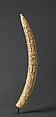
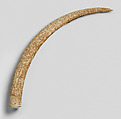
Tusk with figurative relief
This tusk can be specifically dated to the early 1880s. In the middle register, a suit worn by a European figure sitting at a table reflects fashion trends from that period. Notably, the trans-Atlantic slave trade was outlawed in 1850, but human trafficking continued for several decades. Moreover, the Belgian colonial period in the Kongo is remembered for its brutality and violence against indigenous, black populations. English missionary Alice Seeley Harris photographed the brutal conditions of forced labor, enslavement, and exploitation at least as late as 1905.
Artwork Details
- Title: Tusk with figurative relief
- Artist: Vili-Kongo artist(s)
- Date: ca. 1880–1890
- Geography: Democratic Republic of the Congo, Loango Coast; Republic of the Congo; Cabinda, Angola
- Culture: Vili-Kongo peoples
- Medium: Ivory
- Dimensions: H. 31 x W. 4 3/4 x D. 2 1/2 in. (H. 78.7 x W. 12.1 x D. 6.4 cm.)
- Classification: Bone/Ivory-Sculpture
- Credit Line: Gift of Marian Malcolm, in loving memory of her husband, Daniel Malcolm, 2022
- Object Number: 2022.516.1
- Curatorial Department: The Michael C. Rockefeller Wing
More Artwork

Related Content
Publications
Books, guides, and catalogues published by The Met.
 Free to download
Research Resources
The Met provides unparalleled resources for research and welcomes an international community of students and scholars. The Met's Open Access API is where creators and researchers can connect to the The Met collection. Open Access data and public domain images are available for unrestricted commercial and noncommercial use without permission or fee.
To request images under copyright and other restrictions, please use this Image Request form.
Feedback
We continue to research and examine historical and cultural context for objects in The Met collection. If you have comments or questions about this object record, please contact us using the form below. The Museum looks forward to receiving your comments.
Content Notice
The Metropolitan Museum of Art presents over 5,000 years of art from around the world, and our online collection reflects ongoing work conducted over the course of our more than 150-year history. You may encounter objects or images that may be inappropriate for some viewers or information that may be outdated.