Beaker
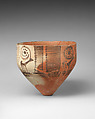
This cup was excavated at Tepe Hissar, near the modern city of Damghan in northern Iran. Tepe Hissar was primarily an agricultural settlement, with buildings made of mudbrick or simply mud walls. Archaeobotanical remains from the site indicate that the people living there grew wheat, barley, olives, grapes, lentils and other legumes. This cup probably belongs to the Hissar IIIB period, dating to ca. 2400-2170 B.C. on the basis of radiocarbon dating. During this period there was a technically proficient ceramic industry at the site, producing well-formed vessels with thin walls. Although they featured no painted decoration like the earlier vessels from the site, they were burnished to create a glossy, almost shiny surface. But it is not known what these vessels were used for. Similar cups were found in graves, and indeed most of the graves at Tepe Hissar contained cups, suggesting that drinking played a significant role in life, or death, there.
Artwork Details
- Title: Beaker
- Period: Early Bronze Age
- Date: ca. 2400–2170 BCE
- Geography: Iran, Tepe Hissar
- Culture: Iran
- Medium: Ceramic
- Dimensions: 4.87 in. (12.37 cm)
- Credit Line: Gift of Museum of Tehran, 1939
- Object Number: 39.60.4
- Curatorial Department: Ancient West Asian Art
More Artwork
Research Resources
The Met provides unparalleled resources for research and welcomes an international community of students and scholars. The Met's Open Access API is where creators and researchers can connect to the The Met collection. Open Access data and public domain images are available for unrestricted commercial and noncommercial use without permission or fee.
To request images under copyright and other restrictions, please use this Image Request form.
Feedback
We continue to research and examine historical and cultural context for objects in The Met collection. If you have comments or questions about this object record, please contact us using the form below. The Museum looks forward to receiving your comments.
Content Notice
The Metropolitan Museum of Art presents over 5,000 years of art from around the world, and our online collection reflects ongoing work conducted over the course of our more than 150-year history. You may encounter objects or images that may be inappropriate for some viewers or information that may be outdated.