Cylinder seal and modern impression: cultic banquet scene
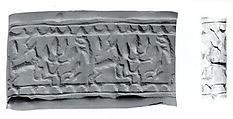
This cylinder seal is made of faience. The modern impression of the seal is shown so that the entire design can be seen. The image depicts two attendants before a seated figure, who is poorly preserved; between them is a table, and above the table is a horned animal. The attendants wear triangular garments, probably skirts. The scene is framed at the top and bottom by a row of boxes.
The banquet scene on this seal is a common feature of Middle Elamite glyptic, yet the pointed headdresses and beak-like profiles of the attendants are quite unusual. Possibly these are meant to be supernatural creatures or demons – such figures are common in the bronzework of the first millennium B.C. commonly attributed to Luristan. The box border is also attested on Elamite seals of the 10th to 9th centuries B.C. Thus this seal probably dates no later than the 9th century, but possibly as early as the late 2nd millennium B.C.
This seal was excavated at Surkh Dum, a settlement site in Luristan in the Zagros Mountains of western Iran. It was part of a large hoard of objects buried beneath a doorjamb in a structure interpreted as a sanctuary; thus the objects were probably offerings made for a god.
Artwork Details
- Title: Cylinder seal and modern impression: cultic banquet scene
- Period: Late Middle or Neo-Elamite
- Date: late 2nd millennium or 10th–9th century BCE
- Geography: Iran, Luristan, Surkh Dum
- Culture: Elamite
- Medium: Faience
- Dimensions: 1.18 in. (3 cm)
- Credit Line: Rogers Fund, 1943
- Object Number: 43.102.36
- Curatorial Department: Ancient West Asian Art
More Artwork
Research Resources
The Met provides unparalleled resources for research and welcomes an international community of students and scholars. The Met's Open Access API is where creators and researchers can connect to the The Met collection. Open Access data and public domain images are available for unrestricted commercial and noncommercial use without permission or fee.
To request images under copyright and other restrictions, please use this Image Request form.
Feedback
We continue to research and examine historical and cultural context for objects in The Met collection. If you have comments or questions about this object record, please contact us using the form below. The Museum looks forward to receiving your comments.
Content Notice
The Metropolitan Museum of Art presents over 5,000 years of art from around the world, and our online collection reflects ongoing work conducted over the course of our more than 150-year history. You may encounter objects or images that may be inappropriate for some viewers or information that may be outdated.