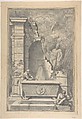
A Shepherd under a Ruined Arch with the Farnese Hercules
Johannes Antiquus, a lesser known Dutch artist from the eighteenth century, was born in the Northern city of Groningen, where he was trained as a portrait painter. Around 1732 Antiquus travelled to Paris and then to Florence, where he was employed at the Medici court, before settling in Rome for five years. During his stay in Italy, Antiquus, like his fellow colleagues, would have made extensive study of the classical and renaissance art and architecture.
In this drawing, the artist carefully constructed a fantastic amalgam of architectural and artistic elements that in reality never existed together – a kind of composition also known as a capriccio. This genre became en vogue in the eighteenth century, with Gian Paolo Panini (1691–1756) and Giovanni Battista Piranesi (1720–1778) as its most important precursors.
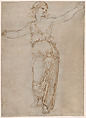
Only a hand full of drawings by Antiquus are known.[1] A second drawing, of a Woman at a Fountain (2003.96), also in the Museum’s collection, shows a similar capriccio, interestingly again featuring the Farnese Hercules.
[1] The Groninger Museum is in possession of the third known capriccio by Antiquus (Capriccio with Classical Ruins, inv. no. 1965-95).
Artwork Details
- Title: A Shepherd under a Ruined Arch with the Farnese Hercules
- Artist: Johannes Antiquus (Dutch, Groningen, 1702–1750)
- Date: 1726–50
- Medium: Black chalk, pen and gray and some brown ink, with gray wash; framing lines in black ink
- Dimensions: 14 1/4 x 9 3/8 in. (36.2 x 23.8 cm)
- Classification: Drawings
- Credit Line: Harry G. Sperling Fund, 2003
- Object Number: 2003.97
- Curatorial Department: Drawings and Prints
More Artwork
Research Resources
The Met provides unparalleled resources for research and welcomes an international community of students and scholars. The Met's Open Access API is where creators and researchers can connect to the The Met collection. Open Access data and public domain images are available for unrestricted commercial and noncommercial use without permission or fee.
To request images under copyright and other restrictions, please use this Image Request form.
Feedback
We continue to research and examine historical and cultural context for objects in The Met collection. If you have comments or questions about this object record, please contact us using the form below. The Museum looks forward to receiving your comments.
Content Notice
The Metropolitan Museum of Art presents over 5,000 years of art from around the world, and our online collection reflects ongoing work conducted over the course of our more than 150-year history. You may encounter objects or images that may be inappropriate for some viewers or information that may be outdated.