English
DonateMembershipTickets

Gunibri

late 19th century
Not on view
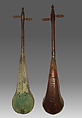
This small gunibri is heavily embellished. The back of its small, circular resonator is adorned with cowrie shells, which frame both its width and a mirror. The sound board is made from parchment on which a hamsa–a palm-shaped symbol that, broadly speaking, signifies unity and protection from evil, in North Africa and the Middle East–has been drawn. The neck pierces the top and bottom of the resonator and is also decorated in a similar fashion to the resonator. It is adorned with a line of cowrie shells at the back, and topped with a leather tassel, the ends of which also have cowrie shells. The instrument has two strings that are made from the gut of an animal. They are attached high on the neck and at the very bottom of the neck with leather rings. The instrument’s very small size, along with its embellishments, suggests that it was not meant to be played, but was rather built for a touristic market. In scholarship up through the twentieth century, lutes like these across the African continent have been described with the blanket Arabic Moroccan term gunbri or gunibri, which has been cause for much confusion, particularly since each ethnic group across North Africa and northern sub-Saharan Africa has their own kind of lute with its own name. (Althea SullyCole, 2022)

Artwork Details

Object Information
  • Title: Gunibri
  • Date: late 19th century
  • Geography: Possibly Algeria or Tunisia
  • Culture: Possibly Algerian or Tunisian
  • Medium: Gourd, leather, cloth, parchment, shells
  • Dimensions: W. 10.2 x L. 40.6cm (4 x 16in.)
  • Classification: Chordophone-Lute-plucked-unfretted
  • Credit Line: The Crosby Brown Collection of Musical Instruments, 1889
  • Object Number: 89.4.3488
  • Curatorial Department: Musical Instruments
More Artwork
Gunibri, Wood, goat hide, metal, horn, possibly Egyptian
possibly Egyptian
19th century
Guenbri, Gourd, wood, parchment decorated with floral designs, Saudi Arabian
Saudi Arabian
late 19th century
Guenbri, tortoise shell, parchment, polychrome, Algerian or Moroccan
Algerian or Moroccan
late 19th century
Single-string fiddle, Wood, gourd, leather, Cape Verdean
Cape Verdean
ca. 1850–1903
Jinghu (京胡), Shinsai, "Katsu" Tajima  Japanese, Bamboo, snakeskin, parchment, silk, horsehair, Japanese/Chinese
Shinsai, "Katsu" Tajima
19th century

Research Resources

The Met provides unparalleled resources for research and welcomes an international community of students and scholars. The Met's Open Access API is where creators and researchers can connect to the The Met collection. Open Access data and public domain images are available for unrestricted commercial and noncommercial use without permission or fee.

To request images under copyright and other restrictions, please use this Image Request form.

Feedback

We continue to research and examine historical and cultural context for objects in The Met collection. If you have comments or questions about this object record, please contact us using the form below. The Museum looks forward to receiving your comments.

Send feedback

Content Notice

The Metropolitan Museum of Art presents over 5,000 years of art from around the world, and our online collection reflects ongoing work conducted over the course of our more than 150-year history. You may encounter objects or images that may be inappropriate for some viewers or information that may be outdated.