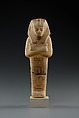
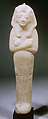
Shabti of Siptah
Theodore M. Davis, who discovered the tomb of Siptah (KV 47) in 1905, found there hundreds of fragments of Egyptian alabaster. Many of these belonged to between 40 and 50 shabtis inscribed with the names of Siptah. Some were sections of funerary vessels. The rest belonged to at least three sarcophagi and two canopic chests, one belonging to Siptah, the other to a Queen Tiye, who has not yet been identified with certainty.
Artwork Details
- Title: Shabti of Siptah
- Period: New Kingdom, Ramesside
- Dynasty: Dynasty 19
- Date: ca. 1300–1200 BCE
- Geography: From Egypt, Upper Egypt, Thebes, Valley of the Kings
- Medium: Travertine (Egyptian alabaster)
- Dimensions: H. 19.5 × W. 7.8 × D. 6.2 cm (7 11/16 × 3 1/16 × 2 7/16 in.)
- Credit Line: Theodore M. Davis Collection, Bequest of Theodore M. Davis, 1915
- Object Number: 30.8.65
- Curatorial Department: Egyptian Art
More Artwork

Research Resources
The Met provides unparalleled resources for research and welcomes an international community of students and scholars. The Met's Open Access API is where creators and researchers can connect to the The Met collection. Open Access data and public domain images are available for unrestricted commercial and noncommercial use without permission or fee.
To request images under copyright and other restrictions, please use this Image Request form.
Feedback
We continue to research and examine historical and cultural context for objects in The Met collection. If you have comments or questions about this object record, please contact us using the form below. The Museum looks forward to receiving your comments.
Content Notice
The Metropolitan Museum of Art presents over 5,000 years of art from around the world, and our online collection reflects ongoing work conducted over the course of our more than 150-year history. You may encounter objects or images that may be inappropriate for some viewers or information that may be outdated.