English
DonateMembershipTickets

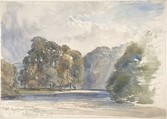
Temple of Mars Ultor, Rome

1840–45
Not on view
Holland first visited Italy in 1835 and would thereafter return often. He here responds to the ruined Temple of Mars Ultor (Mars the Avenger), which stands in a corner of the Forum of Augustus. Three Corinthian columns, at left, survive from a temple colonnade erected by the emperor Augustus. A sunken arch at center, built by the emperor Tiberius in 19 ce was known locally as the Arco dei Panani (Italian for "fen," a water-covered lowland), referring to the swampy site. The artist shows it spanning the Via di Tor de’ Conti with oxcart in the foreground to demonstrate that life continues among the ruins. The restrained tonality of Holland’s washes indicates a date before 1845.

Artwork Details

Object Information
  • Title: Temple of Mars Ultor, Rome
  • Artist: James Holland (British, Burslem, Staffordshire 1799–1870 London)
  • Date: 1840–45
  • Medium: Watercolor over graphite
  • Dimensions: Sheet: 17 5/8 × 9 3/16 in. (44.8 × 23.3 cm)
  • Classification: Drawings
  • Credit Line: Gift of James David Draper, from the Robert Isaacson Collection, 2014
  • Object Number: 2014.643.4
  • Curatorial Department: Drawings and Prints
More Artwork
The orange market, with the Rialto Bridge beyond, Venice, James Holland  British, Watercolor and gouache (bodycolor) over graphite
James Holland
1867
On the Wharfe, Bolton Abbey, William Callow  British, Watercolor
William Callow
September 30, 1858
Eastern Coast of Rügen with Shepherd, Caspar David Friedrich  German, Pen and brown ink, brush and brown wash, over graphite, with white opaque watercolor; partial framing lines in pen and brown-black ink
Caspar David Friedrich
1805–6
Flowers (from McGuire Scrapbook), James Holland  British, Watercolor on off-white wove paper, American
James Holland
1800–1870
Stroh Violin, George Evans & Co.  English, Mahogany and aluminum, British
George Evans & Co.
first quarter 20th century

Research Resources

The Met provides unparalleled resources for research and welcomes an international community of students and scholars. The Met's Open Access API is where creators and researchers can connect to the The Met collection. Open Access data and public domain images are available for unrestricted commercial and noncommercial use without permission or fee.

To request images under copyright and other restrictions, please use this Image Request form.

Feedback

We continue to research and examine historical and cultural context for objects in The Met collection. If you have comments or questions about this object record, please contact us using the form below. The Museum looks forward to receiving your comments.

Send feedback

Content Notice

The Metropolitan Museum of Art presents over 5,000 years of art from around the world, and our online collection reflects ongoing work conducted over the course of our more than 150-year history. You may encounter objects or images that may be inappropriate for some viewers or information that may be outdated.