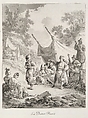
The Russian Dance, in Oeuvres de Jean-Baptiste Le Prince, peintre du Roi
The novelty of Le Prince’s prints lay not only in their subjects but also their technique. While Le Prince did not invent the process of aquatint, which uses a resin to produce a pitted texture on the printing plate that reads as a uniform wash of tone when printed, he developed a unique means of applying this resin only to areas that he had previously painted with a brush. He could thereby work in aquatint much as one uses ink washes and capture details such as the various tones in the trees and the range of shading in the figures’ clothing. The Russian Dance was included among the prints Le Prince sent to the French Salon in 1769 to demonstrate his perfection of the aquatint technique. This later impression, however, comes from a series of Le Prince’s prints that were posthumously reprinted from the original plates and published by Basan Frères in 1782.
Artwork Details
- Title: The Russian Dance, in Oeuvres de Jean-Baptiste Le Prince, peintre du Roi
- Author: Jean-Baptiste Le Prince (French, Metz 1734–1781 Saint-Denis-du-Port)
- Publisher: Basan Frères , Paris
- Date: 1782
- Medium: Etching and aquatint
- Dimensions: Plate: 15 1/8 × 12 1/16 in. (38.4 × 30.7 cm)
Sheet: 22 1/16 × 15 3/16 in. (56 × 38.5 cm) - Classification: Books
- Credit Line: Purchase, Jacob H. Schiff Bequest, 1922
- Object Number: 22.64.1(59)
- Curatorial Department: Drawings and Prints
More Artwork




Research Resources
The Met provides unparalleled resources for research and welcomes an international community of students and scholars. The Met's Open Access API is where creators and researchers can connect to the The Met collection. Open Access data and public domain images are available for unrestricted commercial and noncommercial use without permission or fee.
To request images under copyright and other restrictions, please use this Image Request form.
Feedback
We continue to research and examine historical and cultural context for objects in The Met collection. If you have comments or questions about this object record, please contact us using the form below. The Museum looks forward to receiving your comments.
Content Notice
The Metropolitan Museum of Art presents over 5,000 years of art from around the world, and our online collection reflects ongoing work conducted over the course of our more than 150-year history. You may encounter objects or images that may be inappropriate for some viewers or information that may be outdated.