Design for a Gold, Diamond, and Pearl Demi-Parure of Earrings, Brooch, and Necklace in a Scrapbook with Jewelry Designs in Watercolor and Gouache
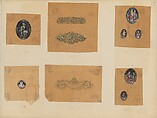
Like most of the drawings in the album, this design is fully rendered with gouache, showing not only the styles for the jewelry designs, but also suggesting choices of precious metals, stones, and other materials to be used in the creation of the jewels. It is also possible that these designs are real-sized, allowing the customer to visualize the jewel fully from this presentation drawings before commissioning its manufacture.
The design for a brooch is made out of a circumference of diamonds set on gold, surrounded by a circumference of white pearls, with a princess-cut diamond surrounded by smaller diamonds, all set on gold, placed at the top-center of the circumference.
The design for a necklace contains three similar diamond-and-pearl circumferences with the square-motif changed to a diamond hasp that holds the three circular motifs to the body of the necklace. This is made out of a gold cable decorated with small rosettes with gold petals and a central small white pearl, from which hang alternating thinner gold cables, decorated with smaller rosettes in the intersections between them.
The design for an earring contains once more the diamond-and-pearl circumference, but this time it is held by a diamond oval-shaped hasp to a smaller diamond circumference that hangs from a gold hook.
Artwork Details
- Title: Design for a Gold, Diamond, and Pearl Demi-Parure of Earrings, Brooch, and Necklace in a Scrapbook with Jewelry Designs in Watercolor and Gouache
- Date: ca. 1870–1930
- Medium: Gouache and gold pigment
- Dimensions: Sheet: 8 5/16 × 7 1/2 in. (21.1 × 19 cm)
- Classifications: Albums, Drawings, Ornament & Architecture
- Credit Line: Gift of Leon Grinberg, 1953
- Object Number: 53.626.2(7)
- Curatorial Department: Drawings and Prints
More Artwork
![Drawn title page inscribed "Alfred Crowquill [Alfred Henry Forrester, 1804–1872], Original Designs for Pottery and Porcelain, ca. 1845–1855," with Drawing of Lily Cup, Alfred Henry Forrester [Alfred Crowquill] British, Pen and ink, watercolor and gouache (bodycolor)](https://images.metmuseum.org/CRDImages/dp/web-additional/DP827013.jpg)
Research Resources
The Met provides unparalleled resources for research and welcomes an international community of students and scholars. The Met's Open Access API is where creators and researchers can connect to the The Met collection. Open Access data and public domain images are available for unrestricted commercial and noncommercial use without permission or fee.
To request images under copyright and other restrictions, please use this Image Request form.
Feedback
We continue to research and examine historical and cultural context for objects in The Met collection. If you have comments or questions about this object record, please contact us using the form below. The Museum looks forward to receiving your comments.
Content Notice
The Metropolitan Museum of Art presents over 5,000 years of art from around the world, and our online collection reflects ongoing work conducted over the course of our more than 150-year history. You may encounter objects or images that may be inappropriate for some viewers or information that may be outdated.