English
DonateMembershipTickets

Design for a Brooch with a Female Figure, a White Dove, and Ocean Waves

ca. 1900
Not on view
Drawing with a design for a brooch, designed around 1900, part of an album of drawings by various artists for individual pieces of jewelry, containing a variety of designs in the Art Nouveau style of the late nineteenth and early twentieth century, as well as some pieces in historic period styles. The brooch in the drawing consists of a round shell-like frame of cream color, containing the upper part of a female figure, standing with her back to the viewer, her hands pulling her long hair up, and her head turning towards the viewer. The frame is flanked above by a round white pearl surrounded by green scrolling leave motifs, and with two round rings to its sides, which hold a thin chain from which the brooch hangs. On the lower part of the shell frame, under the female body, are several white, scrolling ocean waves, and a white dove with the wings slightly open stands to their left. There is a second sketch, executed with pencil, underneath the first design, which consists of a similar design for a brooch, but replacing the waves and the dove by a simpler scrolling motif that flanks the frame under the female figure. This design reveals the aesthetic of late Art Nouveau jewelry style, designed, among others, by Rene Lalique, which drew inspiration from antiquity and japonism, abandoning the exclusive use traditional precious stones in the manufacture of jewels, and using, instead, a combination of gold, gemstones, semi-precious stones, mother-of-pearl, ivory and horn, enamel, and glass, to create colorful, powerful, and sinuous designs, often presenting animal and other figurative motifs.

Artwork Details

Object Information
  • Title: Design for a Brooch with a Female Figure, a White Dove, and Ocean Waves
  • Artist: Anonymous, French, 19th century
  • Date: ca. 1900
  • Medium: Graphite, pen and black ink, watercolor, and gouache on buff paper
  • Dimensions: Sheet: 9 3/4 × 6 3/8 in. (24.8 × 16.2 cm)
    Album: 14 3/16 in. × 11 in. × 9/16 in. (36 × 28 × 1.5 cm)
  • Classifications: Albums, Drawings, Ornament & Architecture
  • Credit Line: The Elisha Whittelsey Collection, The Elisha Whittelsey Fund, 1953
  • Object Number: 53.670.17
  • Curatorial Department: Drawings and Prints
More Artwork
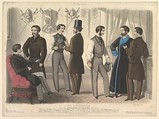
Jacques Caillot
ca. 1830–1920
Le Progrès, for the Bulletin of Fashion, New York, No. 110, from Modes de Paris, Anonymous, French, 19th century  French, Steel engraving with hand coloring
Anonymous, French, 19th century
Printer Imprimerie Digeon, Paris
February 1859
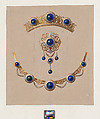
Parure of diadem, brooch and necklace with lapis lazuli and enamel, Alexis Falize  French, Graphite, pen and black ink, watercolor and gouache on brown paper
Alexis Falize
ca. 1830–70
Portrait of Ferdinand Lesseps, Anonymous, French, 19th century  French, Etching
(?) Anonymous, French, 19th century
Former Attribution Félix Bracquemond
Sitter Ferdinand Lesseps
1850–1914
Scrapbook with Textile Patterns on Transfer Paper, Anonymous, French, 19th century  French, Pen and ink, graphite, and gouache over transfer paper
Anonymous, French, 19th century
19th century

Research Resources

The Met provides unparalleled resources for research and welcomes an international community of students and scholars. The Met's Open Access API is where creators and researchers can connect to the The Met collection. Open Access data and public domain images are available for unrestricted commercial and noncommercial use without permission or fee.

To request images under copyright and other restrictions, please use this Image Request form.

Feedback

We continue to research and examine historical and cultural context for objects in The Met collection. If you have comments or questions about this object record, please contact us using the form below. The Museum looks forward to receiving your comments.

Send feedback

Content Notice

The Metropolitan Museum of Art presents over 5,000 years of art from around the world, and our online collection reflects ongoing work conducted over the course of our more than 150-year history. You may encounter objects or images that may be inappropriate for some viewers or information that may be outdated.