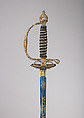
Saber of Archduke Carl Joseph of Austria (1745–1761) as a Boy
Apart from its historical significance, this sword is a rare documented child’s weapon. It was commonplace since at least the Middle Ages for the sons of aristocracy and prominent military men to received weapons as a symbol of their coming adulthood and entry into the chivalric order. While a few medieval swords of diminutive size are preserved, the majority of boys’ weapons date to the eighteenth century. The Met’s Department of Arms and Armor has a fine group of eighteenth-century smallswords for boys (acc. nos. 34.57.1–.18), which, like that for Archduke Carl Joseph, served more as status symbols and costume accessories than practical weapons.
Artwork Details
- Title: Saber of Archduke Carl Joseph of Austria (1745–1761) as a Boy
- Date: dated 1751
- Geography: Vienna
- Culture: Austrian, probably Vienna
- Medium: Steel, gold, bloodstone
- Dimensions: L. 18 1/2 in. (46.9 cm); L. of blade 14 1/8 in. (36 cm); W. 2 ¾ in. (7 cm); Wt. 6.2 oz. (176 g)
- Classification: Swords
- Credit Line: Gift of Irene Roosevelt Aitken, in celebration of the Museum's 150th Anniversary, 2026
- Object Number: 2026.267.12
- Curatorial Department: Arms and Armor
More Artwork
Research Resources
The Met provides unparalleled resources for research and welcomes an international community of students and scholars. The Met's Open Access API is where creators and researchers can connect to the The Met collection. Open Access data and public domain images are available for unrestricted commercial and noncommercial use without permission or fee.
To request images under copyright and other restrictions, please use this Image Request form.
Feedback
We continue to research and examine historical and cultural context for objects in The Met collection. If you have comments or questions about this object record, please contact us using the form below. The Museum looks forward to receiving your comments.
Content Notice
The Metropolitan Museum of Art presents over 5,000 years of art from around the world, and our online collection reflects ongoing work conducted over the course of our more than 150-year history. You may encounter objects or images that may be inappropriate for some viewers or information that may be outdated.