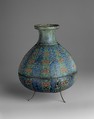
Horse bit with the arms of Rasse van Gavere (de Gavre), Lord of Eksaarde
The two enamels on the sides of the horse bit each feature a shield bearing the arms of a branch of the Flemish Van Gavere/de Gavre family, the Lords of Eksaarde (gules with three gold lions, with a label with five pendants azure) surrounded by three dragons standing out against a blue background.
In the late 13th and 14th centuries, horse bits made entirely of bronze or gilt copper, with enamel decoration, were luxury items. They were generally reserved for leisure or ceremonial riding, due to the relative fragility of their material compared to the iron that made up the majority of medieval bits.
Medieval works of art depict a wide variety of exquisitely decorated horse tack used by members of the aristocracy. Saddles, bridles, and trappings made of leather and textiles were frequently enriched with embroidery, paint, or decorated metal fittings. A metal horse bit complemented the rich horse harnesses adorned with pendants and other enameled plates, often with heraldic decoration, which were particularly fashionable in Europe at the time.
Only three comparable works are known, such as the two large Neapolitan bits of a slightly different type and slightly later date at The Met (Franco-Neapolitan, second quarter 14th century, 04.3.478a, b) and the Armeria Reale in Turin (Franco-Neapolitan, ca. 1340–50, D.58). The only other known ornate bit corresponding to the (shorter) type presented here is in the collection of the Musée de Cluny in Paris (CL.11461).
The horse bit was made in a time when the medieval chivalric culture was at a peak. The ideal qualities of chivalry such as honor, loyalty, courage, and generosity were expressed not just in a military context but transcended all aspects of life. A key component of the medieval chivalric culture was heraldry. The appearance of armorial bearings can be traced back to the High Middle Ages, when it became a challenge to identify the increasingly well protected (i. e. hidden by their armor) horsemen on the field of battle. These identifying signs were also used as a form of social distinction. Often they were intrinsically linked to weapons, but increasingly frequently they were placed on a wide variety of both secular and ecclesiastic objects including luxury horse bits for leisure or ceremonial riding.
Flanders, the home of the Van Gavere/de Gavre family, had a tumultuous history in the early 14th centuries. Weakened by French military success during the 13th century, Flanders was invaded by King Philipp IV of France in 1300 and threatened by the possibility of long-term occupation. But at its weakest, Flanders was able to turn the tide in one of the most famous battles of the Middle Ages––the Battle of the Golden Spurs on the outskirts of Kortrijk (now in Belgium) on July 11, 1302. This victory saved Flanders from French dominance, and a few years later, in 1305, the King of France had to recognize Flemish independence. The Flemish victory near Kortrijk initiated the political ascent of the urban weavers’ guild heralding the rise of Flanders as one of the economic and cultural powerhouses of the late Middle Ages. The Battle of the Golden Spurs also marked the beginning of the infantry revolution, i.e. the growing dominance of foot soldiers on the European battlefields particularly during the Renaissance.
Artwork Details
- Title: Horse bit with the arms of Rasse van Gavere (de Gavre), Lord of Eksaarde
- Date: early 14th century
- Culture: French or Flemish
- Medium: Bronze, gold, copper, champlevé enamel
- Dimensions: H. 7 3/4 in. (19.5 cm); W. 6 3/4 in. (17 cm); D. 2 1/4 in. (5.7 cm)
- Classification: Equestrian Equipment-Bits
- Credit Line: Louis V. Bell Fund, 2026
- Object Number: 2026.243
- Curatorial Department: Arms and Armor
More Artwork
Research Resources
The Met provides unparalleled resources for research and welcomes an international community of students and scholars. The Met's Open Access API is where creators and researchers can connect to the The Met collection. Open Access data and public domain images are available for unrestricted commercial and noncommercial use without permission or fee.
To request images under copyright and other restrictions, please use this Image Request form.
Feedback
We continue to research and examine historical and cultural context for objects in The Met collection. If you have comments or questions about this object record, please contact us using the form below. The Museum looks forward to receiving your comments.
Content Notice
The Metropolitan Museum of Art presents over 5,000 years of art from around the world, and our online collection reflects ongoing work conducted over the course of our more than 150-year history. You may encounter objects or images that may be inappropriate for some viewers or information that may be outdated.