Audio Guide
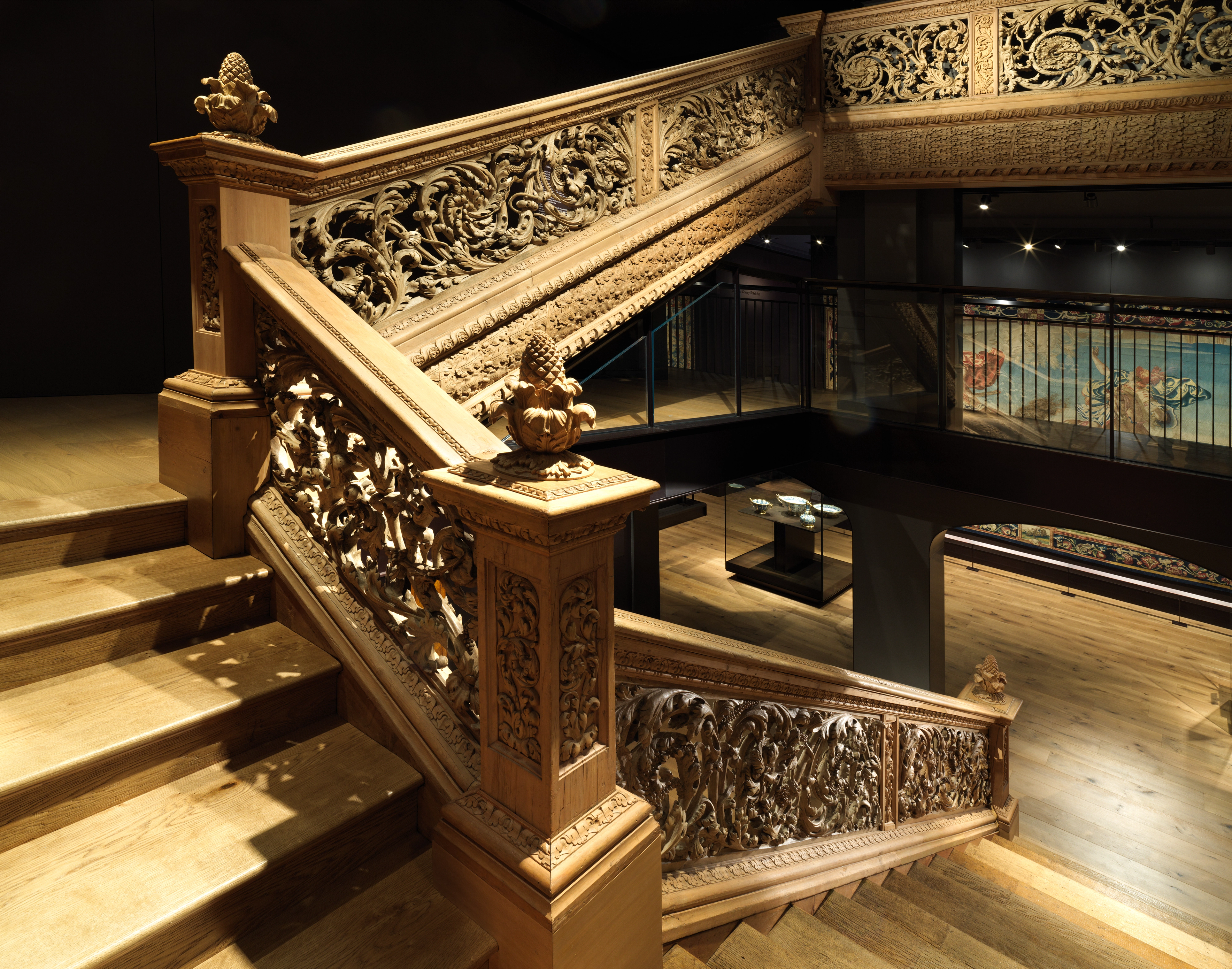
403. The Staircase from Cassiobury Park
Gallery 509
NARRATOR: Craftsmanship. Today, the word gets tossed around a little too casually. But in the seventeenth century, it was reserved to describe marvels of skill and training – like this grand baroque staircase from the 1680’s.
Consider that this is the first time we’ve been allowed to ascend since the 1930’s when Museum acquired the staircase from Cassiobury Park. Notice–but please don’t touch!–the elegantly-carved wood railing and balustrade. Mecka Baumeister, a conservator at The Met who knows these carvings inch by inch:
MECKA BAUMEISTER: What is amazing are these friezes that decorate the balustrade. They are carved out of one continuous board of Elm. And that’s a tour-de-force. You take a board of wood that is about, like, five inches thick and then you remove so much of the carving process that it’s still structurally sound. And that for the time when the staircase was built, which is around 1680s, is a major accomplishment.
You have the same amount of detail on either side. But what is very nice are the birds… they have a double-sided head, so to get the perception that you have a bird on either side, the carver actually duplicated the head.
NARRATOR: These stairs were salvaged after a fire in the Hertfordshire home of the parliamentarian Sir Henry Capel. Note the wooden finials (the carvings topping the posts) shaped like ears of corn:
MECKA BAUMEISTER: The finial pieces on top of the newer posts are modern replacements, but they are based on the original finials. We did 3D laser scanning, had them milled out of a solid block of oak, in this case, and then hand-finished by a carver. The idea is to experience it, respect it, to pause and take it in because it’s really a masterpiece of carving. And we hope that this architectural highlight will be preserved for future generations, and that visitors will not touch it.