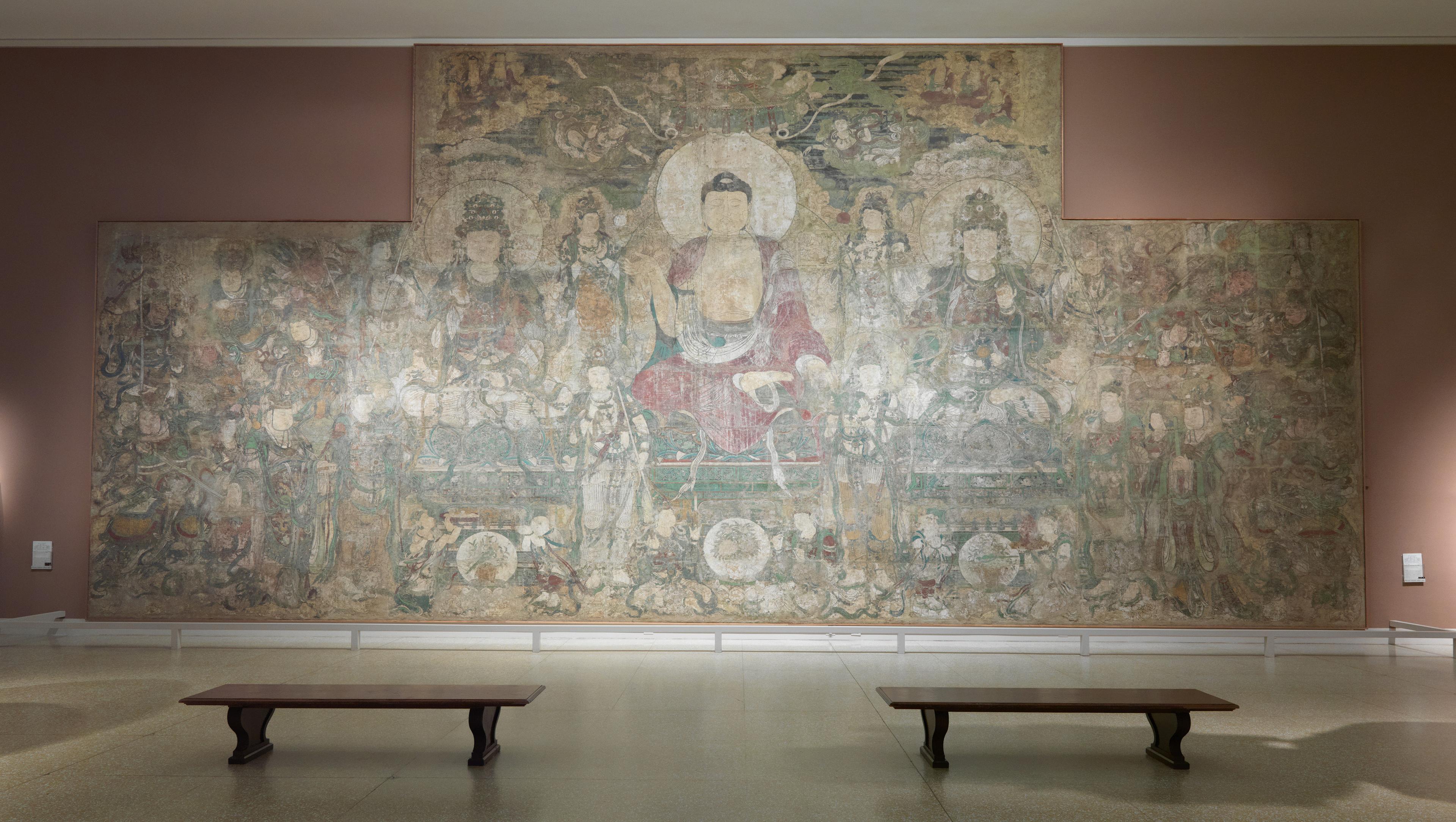
Conservation allows The Met to learn more about the collection and ensure that future generations can enjoy it. Since 2024, the Museum has collaborated with the Chinese National Academy of Arts to prepare for a comprehensive restoration of the monumental mural known as the Buddha of Medicine. The partnership combines curatorial research with advanced scientific analyses to investigate traditional mural techniques. Staff members of the two institutions also studied the mural’s structure, plaster ground, pigments, and historical repairs to identify errors in the 1964 installation of this artwork, which can now be addressed.
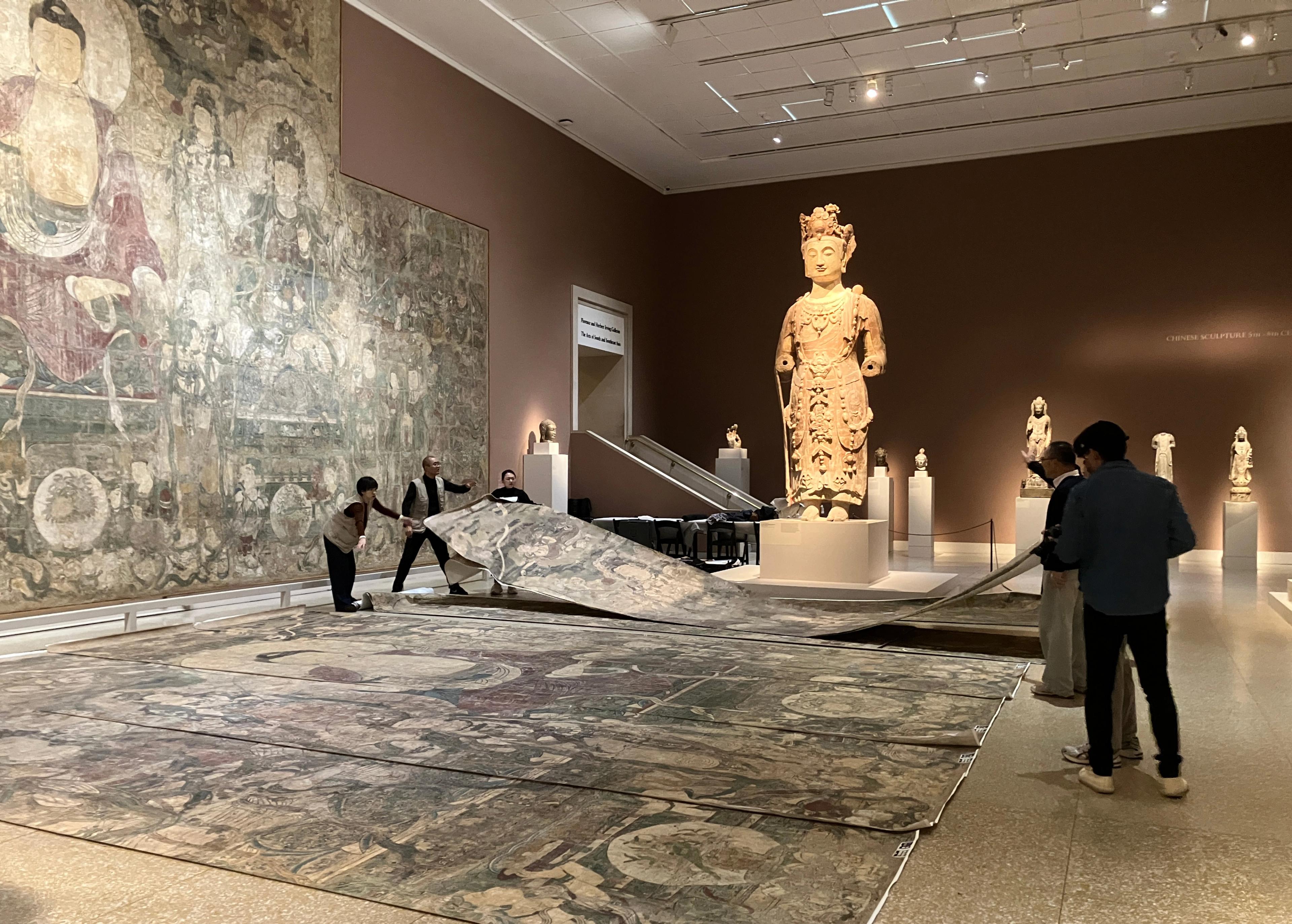
Artists from the Chinese National Academy of Arts compare a life-size facsimile they produced with the mural to ensure the accuracy of their work.
Originally from a monastery in northern China, the work was reassembled in 1964 from 274 pieces. Conservators are now undertaking a two-year project to reverse decades of discoloration and correct areas of infill on this painting. While its structure is sound, the surface has darkened and yellowed due to an adhesive that was applied in the 1960s to stabilize the pigments. Research has also shown that the initial installation made errors in aligning and filling in some of the fragments.
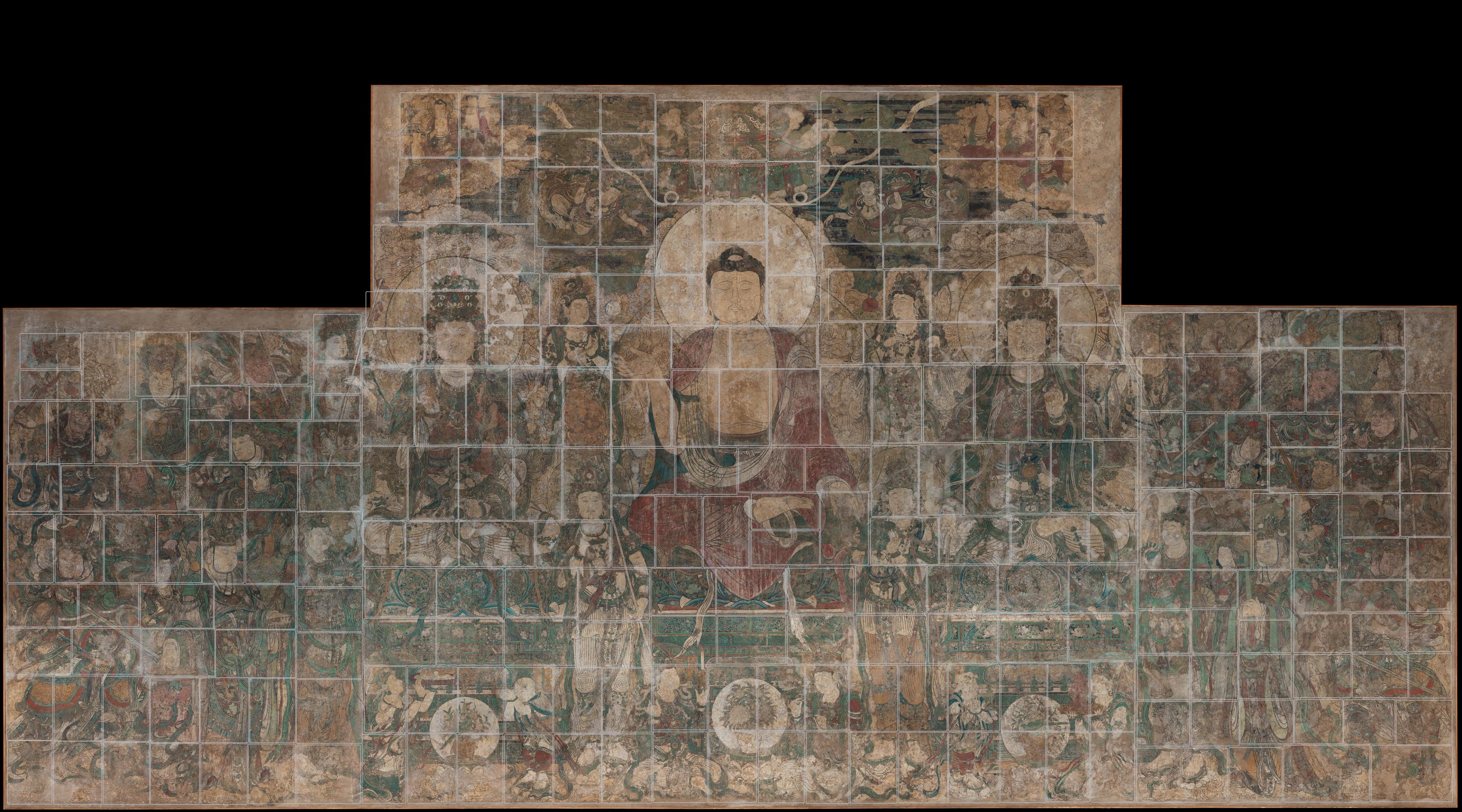
Reconstruction of the 274 fragments that comprise the mural. When it was installed in 1964, some sections were misaligned or filled incorrectly. Diagram courtesy the Chinese National Academy of Arts
This mural once adorned the main hall of the Guangsheng Monastery in Hongtong County, Shanxi Province, in North China. After a devastating earthquake in 1303, the monastery was rebuilt and decorated with imagery (including this mural, completed between 1319 and 1324) to protect from future calamities. The Buddha of Medicine, at center, presides over deities who personify his vows to cure illness, ensure safe childbirth, and help those in need. Painted on plaster and a ground of clay and straw, the composition was laid out with thick black outlines then filled using vibrant vegetable and mineral pigments.
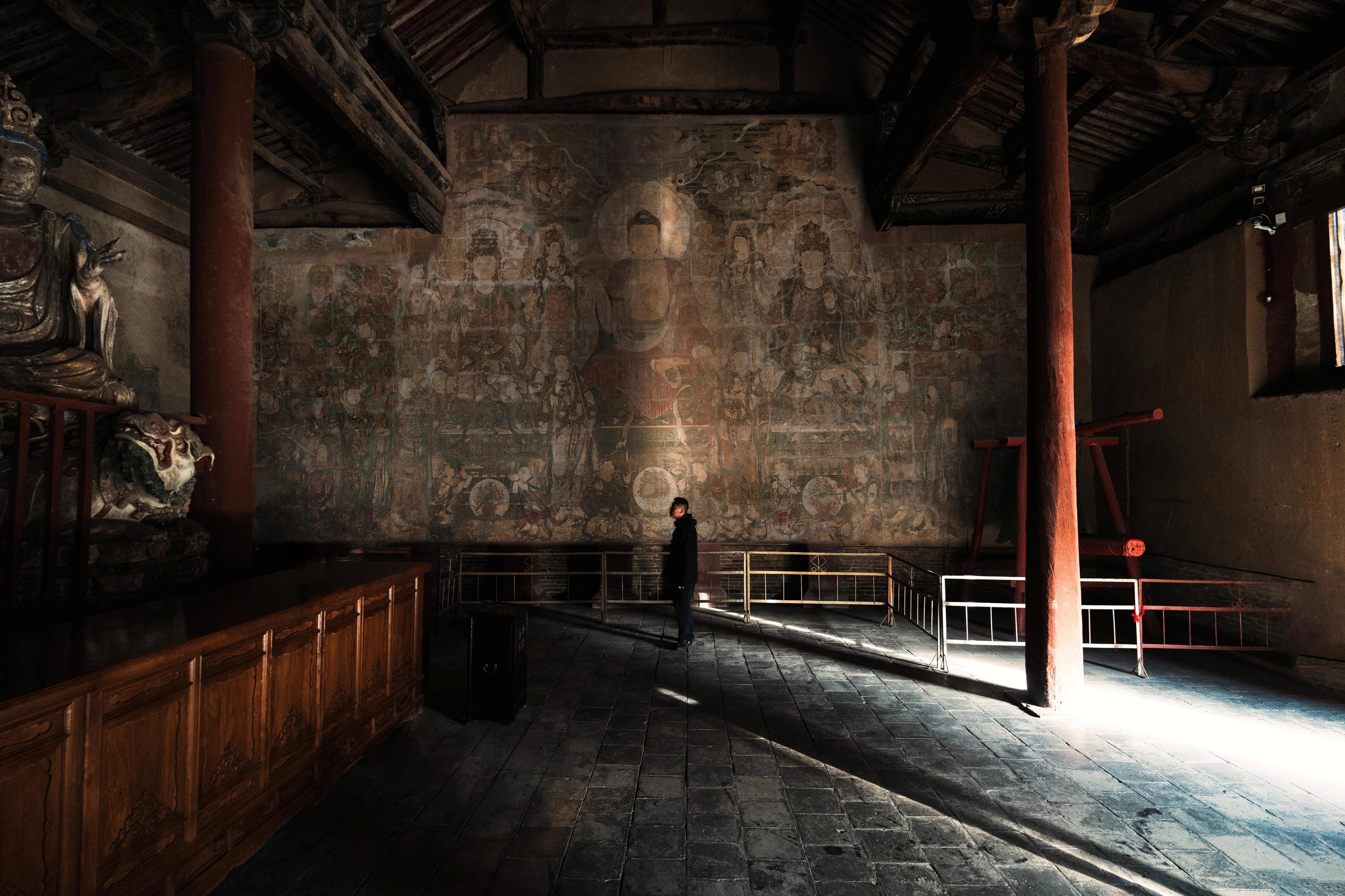
A digital projection on the wall of the Guangsheng Monastery recreates the Buddha of Medicine mural in its original position. Image courtesy the Chinese National Academy of Arts
This mural comes from the east wall of the monastery’s main hall. The mural from the west wall is now in the Nelson-Atkins Museum of Art in Kansas City. Mural fragments from the north and south walls of the main hall are now in the Detroit Institute of Arts and the Cincinnati Art Museum, respectively.
A stele erected at the temple in 1929 records that the abbot and local community leaders agreed to sell the murals in the main and front halls to raise funds for their repair. The mural in the Nelson-Atkins Museum was purchased from the Chinese art dealer C. T. Loo in 1927. The fragments in the Cincinnati Art Museum and Detroit Institute of Arts were donated by C. T. Loo in 1950 and 1951. In 1954, Frank Caro Co., successor to C. T. Loo, sold this mural to The Met.
Murals from the east and west walls of the front hall, which were completed around 1476, were sold to the University of Pennsylvania by C. T. Loo in 1927.
Meet the team
Three objects conservators are undertaking treatment of the Buddha of Medicine from May 2026 to May 2028, in collaboration with Met curators, scientists, and imaging specialists.
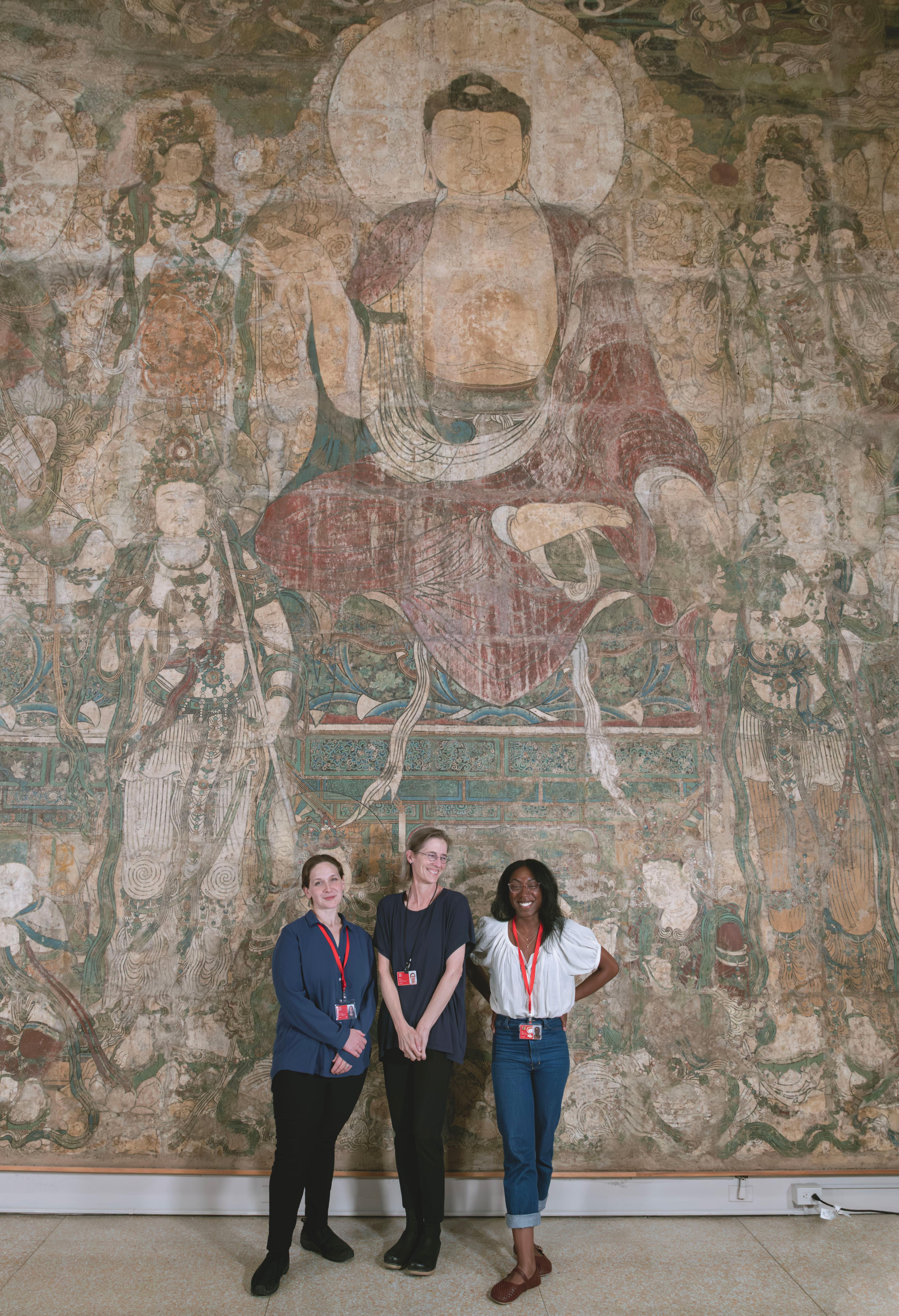
From left: Cassia Balogh, Vicki Parry, and Ameya Grant
Cassia Balogh
Cassia came to The Met at the start of the mural project. She has experience in the conservation of a wide range of materials from working at a number of institutions in the United States. She was part of a team conserving murals from the same monastery as The Met’s paintings, now in the Penn Museum, which gives her insight into the materials, techniques, and aging processes encountered here.
Vicki Parry
Vicki specializes in conservation of ceramics and stone sculptures and decorative objects. Since joining The Met in 2002, she has contributed to the renovations of the Greek and Roman and Islamic Art galleries and, since 2012, she has been responsible for conservation of Asian ceramics and stone objects. Although she has treated painted surfaces in the past, this is the largest painting Vicki has encountered in her long career.
Ameya Grant
Since joining The Met in 2023, Ameya has been working on a variety of materials, including archaeological objects for the reinstallation of the Ancient West Asian and Cycladic Art galleries, as well modern and contemporary works for the Oscar L. Tang and H.M. Agnes Hsu-Tang Wing. While she has experience working with Roman mural paintings prior to her Met stint, this is her first foray into Asian mural painting.
This project is made possible by Lilly Endowment Inc.