Americans remember Thomas Jefferson as “the sage of Monticello,” the red-haired founder, slim and tall; the Virginia revolutionary with good teeth (but heavy debts), who wrote the Declaration of Independence and lived in a mountaintop plantation home filled with artifacts, books, and gadgets. Images of Jefferson are best known through seeing his likenesses by Jean-Antoine Houdon, Charles Willson Peale, Gilbert Stuart, and John Trumbull. The earliest known representations of Jefferson portray him in his forties, during the autumn of his life. A young Jefferson is hard to countenance. Our cloudy view into Jefferson’s early life not only obscures the founder’s most revolutionary period, leading to when he wrote the nation into existence at age thirty-three in 1776; it also threatens to make his self-determination and commitment to public service far less likely to be emulated by the very generations to which he sought to impart civic virtues and entrusted the future. By contextualizing Jefferson’s life, especially in the years leading to the American Revolution, we can look at depictions of him with a more robust understanding of the “apostle of liberty.”
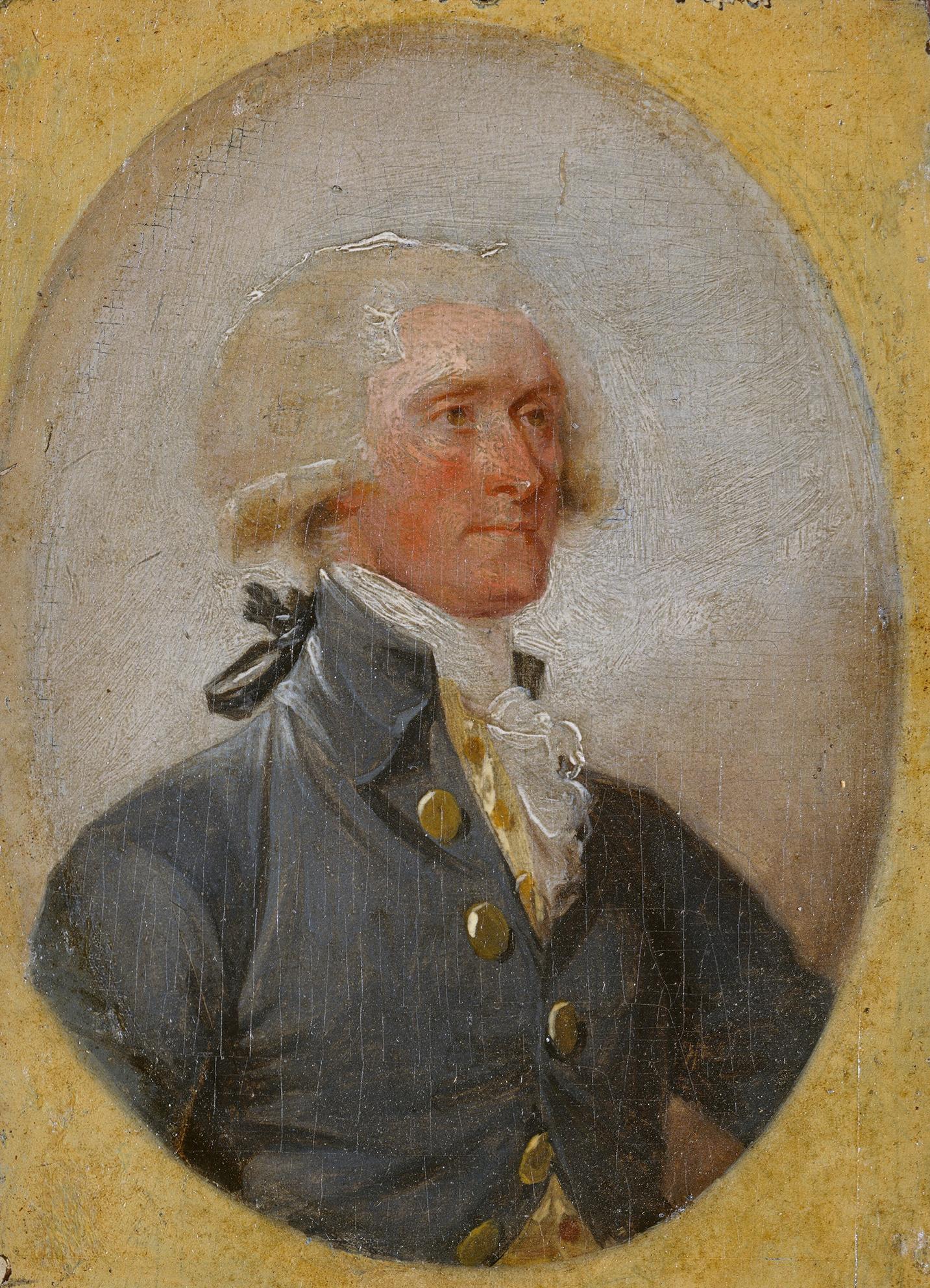
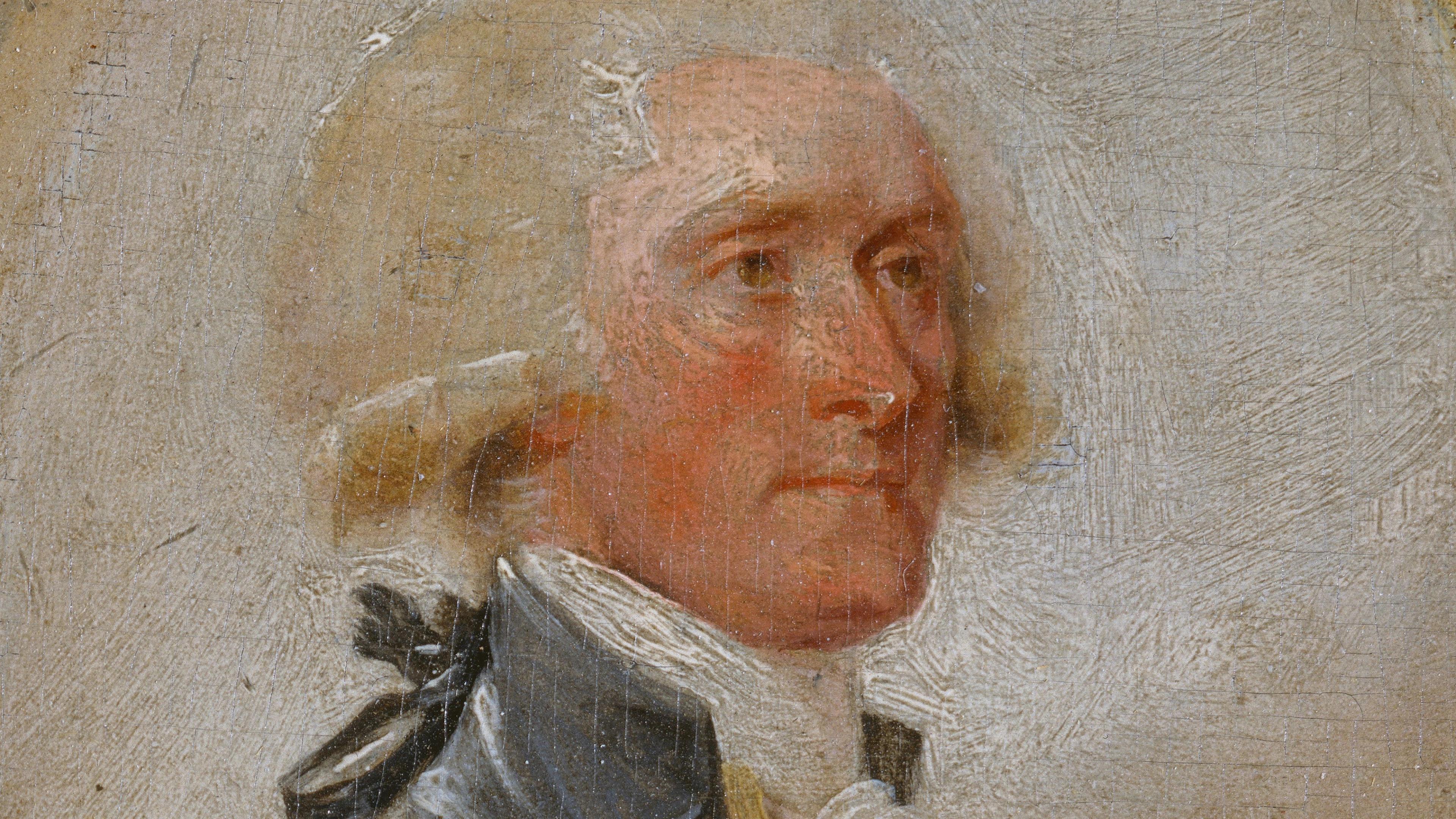
John Trumbull (American, 1756–1843). Thomas Jefferson, 1788. Oil on mahogany, 4 1/2 x 3 1/4 in. (11.4 x 8.3 cm). The Metropolitan Museum of Art, New York, Bequest of Cornelia Cruger, 1923 (24.19.1)
While Jefferson is justly celebrated, Americans in his day and ours also heap some of the blame for societal ills at his feet. Alexander Hamilton set the tone in the 1790s when he complained that Jefferson, his political opponent, the philosopher-slaveholder-abolitionist, was “a contemptible hypocrite.” Still, it is unlikely that these and other brickbats would have urged Jefferson toward further introspection. He had already, in his youth, published the opinion that the “abolition of domestic slavery is the great object of desire,” and he knew that he and all slaveholders would be judged for their actions and complicity in the system, however legal.
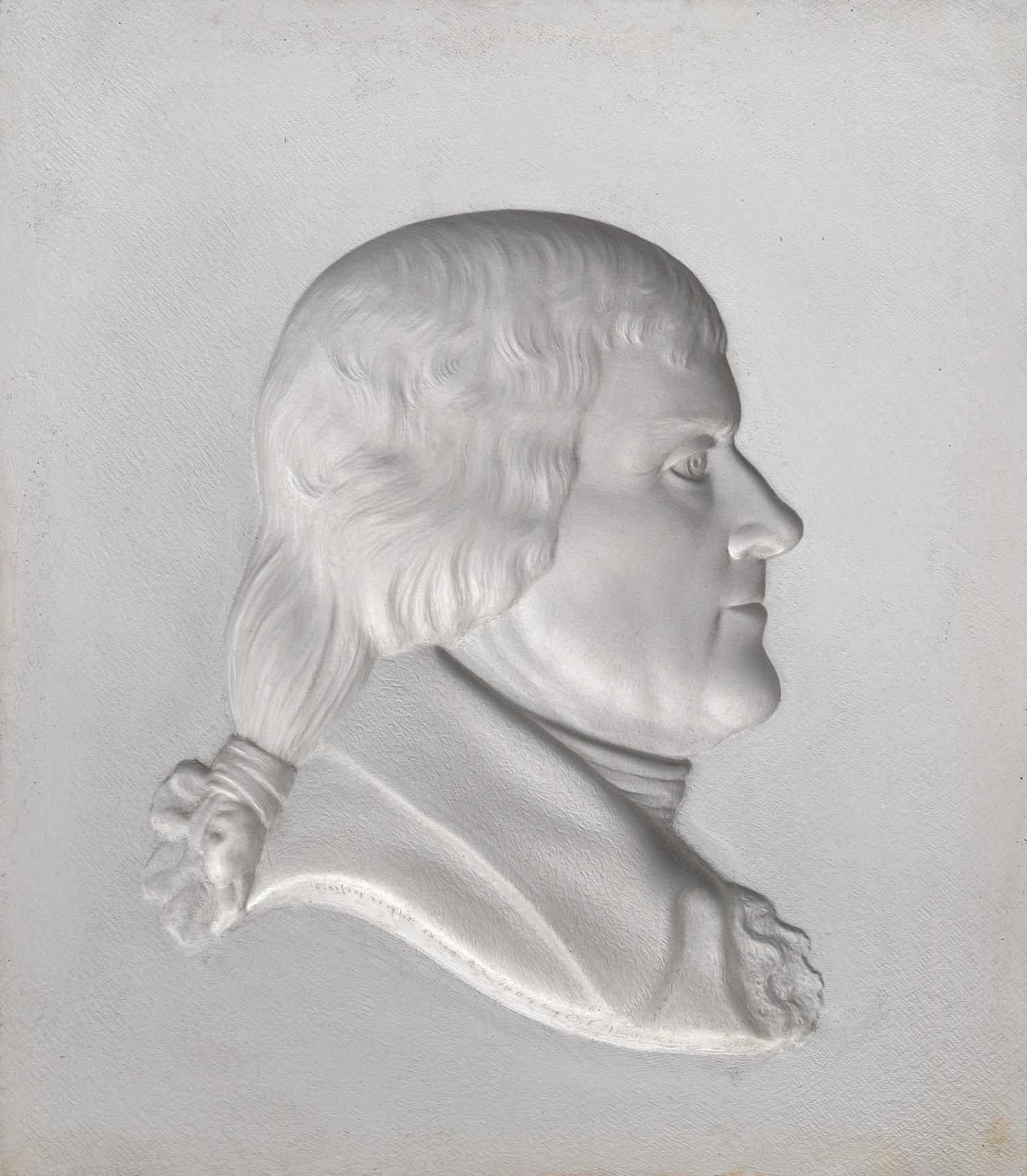
Charles L. Hogeboom (American, 1827–1895). Thomas Jefferson, by 1884. Plaster, 18 1/2 × 16 1/4 × 2 3/16 in. (47 × 41.3 × 5.6 cm). The Metropolitan Museum of Art, New York, Gift of the sculptor, 1885, 1923 (85.16.2)
Nothing in Jefferson’s early history suggests that he was destined to become the paragon of the American Enlightenment. In 1743, Thomas Jefferson entered the world in his parents’ plain, weatherboarded starter home, soon to be replaced by an elegant brick manse. He was the second of eight children, the firstborn son. Jefferson’s earliest memory, from the age of two or three, was of being lifted onto horseback by a slave carrying him on a pillow. The Jeffersons were temporarily relocating to Tuckahoe plantation, on the border of Goochland and Henrico counties. There at what Jefferson called “the English school,” he received private lessons in the basics of English grammar, rhetoric, and writing. His earliest education, undertaken amid a blended family of siblings and orphaned cousins, cannot be said to have been very distinguished. When Jefferson was about nine, he returned with his family to Shadwell.
By the mid-1750s, Jefferson’s boyhood home sat on the edge of a war zone. Continuous conflict waged between the British, French, and Native nations just beyond the mountains to the west. The pitched fighting in the Virginia backcountry represented one of many theaters of the Seven Years’ War, fought across five continents and seven seas. And while Jefferson was too young to fight, he knew men who did. Joshua Fry, the short-lived commander-in-chief of colonial forces, was the Jeffersons’ friend and neighbor; he died while on an expedition to capture Fort Duquesne, near what is now Pittsburgh, Pennsylvania. The upstart who succeeded him as the leader of the Virginia regiment was a twenty-one-year-old named George Washington. One day, Jefferson would come to see that the land over the horizon represented an “empire of liberty.”
In summer 1757, Peter Jefferson took sick and died. Jefferson deeply felt the loss of his father at such a formative period in his own life. The elder Jefferson, who had overcome a “neglected” education through committed autodidacticism, left a dying wish for his eldest son to receive excellent schooling. Thereafter, Thomas Jefferson forged his moral and philosophical sensibility through a daunting regimen of reading and writing. After a stint at a nearby “Latin school,” where he learned “the rudiments” of Greek, Latin, and French, Jefferson enrolled at James Maury’s boarding school, in the northern portion of his home county, where he studied with the man he called “a correct classical scholar.” Complementing Maury’s lessons with his own studies, Jefferson set his eyes on the peerless education on offer at the College of William & Mary, in the colonial capital of Williamsburg: the second-oldest college in British America, and the only one south of Pennsylvania.
Jefferson’s education flourished under the instruction of his professors and mentors in Williamsburg. At twenty-one, the age of legal maturity, Jefferson inherited half of his father’s vast estate. He held dominion over some three thousand acres, including what is now Monticello mountain, and approximately fifty slaves. He passed Virginia’s bar exam at twenty-two years old in 1765, and at least one of Jefferson’s early legal cases shows that this scion of the planter class sought to protect the rights guaranteed to free people, regardless of their color. In Howell v. Netherland (1770), Jefferson represented the mixed-race indentured servant Samuel Howell, a grandson of a white woman and a black man, punished for his grandparents’ indiscretion against the mores of Virginia society. Howell was to be indentured until the age of thirty-one, but Jefferson argued that he should have been considered freeborn. Moreover, “everyone comes into the world with a right to his own person,” Jefferson espoused, and this “is called personal liberty, and is given him by the author of nature.” This is not merely an example of an attorney taking a case for the sake of profit or intellectual exercise. Jefferson felt a sense of obligation to use his legal training in defense of another, however castigated by society. Plenty of other Anglo-Virginian attorneys, more mindful of their social standing, did no such thing.
Rather than practicing at the bar, Jefferson found his calling in influencing and making law as a legislator. First elected to public office in 1769, at the age of twenty-six, he tried to improve his society through lawcraft. Late in life, Jefferson remembered his efforts as a young legislator to champion a bill allowing slaveholders, not the courts, greater control over manumission. The legislature did not regularly record failed measures, so no record survives, but this reform would have been consistent with Jefferson’s attitudes at the time. “[D]uring the regal government, nothing liberal could expect success,” he recalled of the dead-on-arrival bill in his 1821 autobiography. Jefferson soon found solidarity with many other colonists who became frustrated by the empire’s restrictions against territorial expansion, newly direct taxation, and threats to self-governance, but initially believed King George III could be reasoned with.
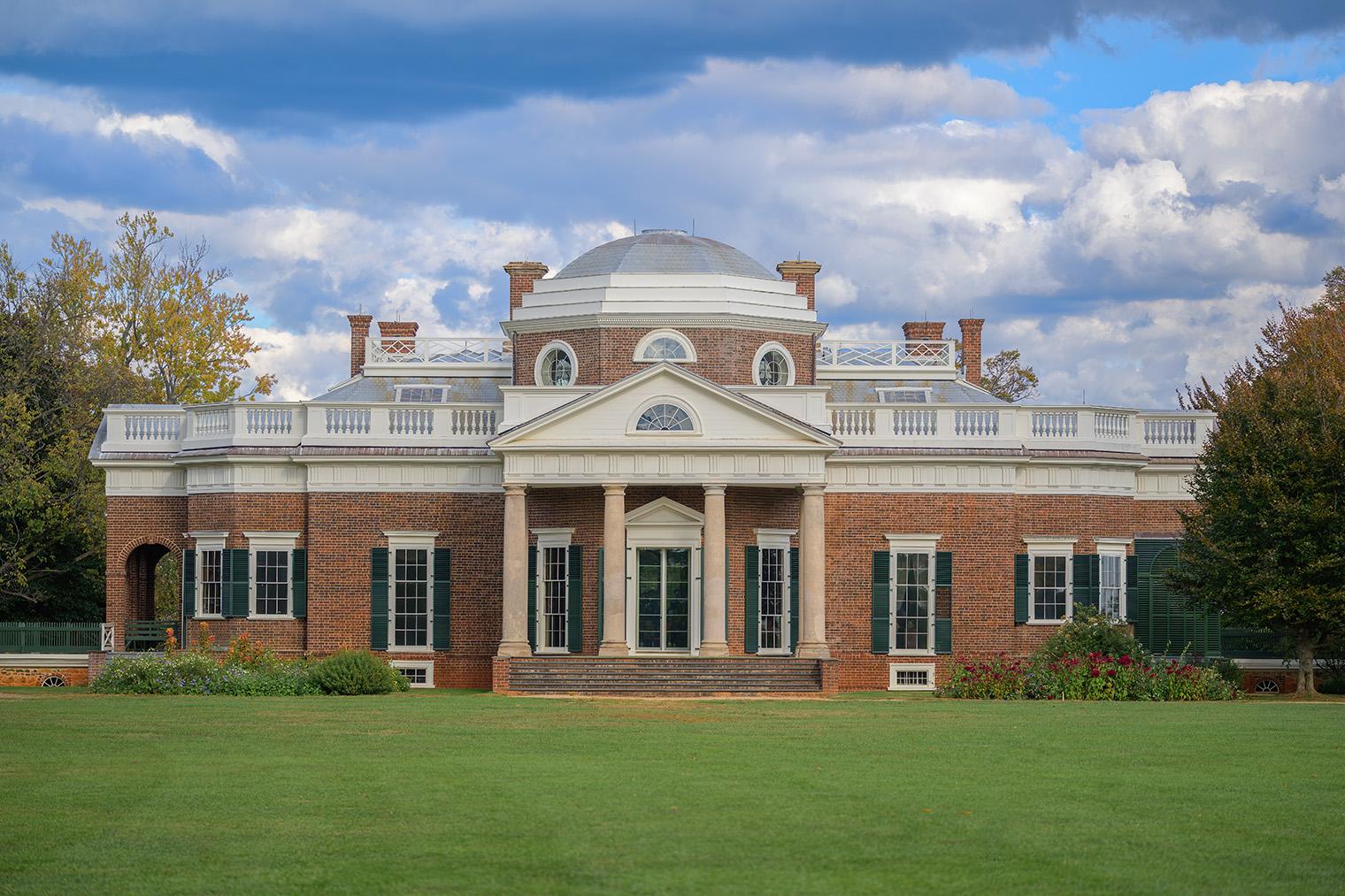
Exterior of Monticello, Thomas Jefferson’s home. Courtesy of the Thomas Jefferson Foundation, Inc
As Jefferson represented his constituents, he also oversaw the design and construction of his dream home atop Monticello mountain. Two miles from Shadwell and 860 feet high in the Southwest Mountains, Monticello would become Jefferson’s “autobiographical masterpiece.” A French visitor later reflected that Jefferson placed his home, like his mind, on an elevated station from which he could contemplate the universe. Jefferson’s architectural drawings for Monticello belied the harsh reality of plantation life. The fingerprints of the enslaved children who formed the bricks for his home can still be touched today.
Despite his varied personal and professional accomplishments, Jefferson proved an awkward hand at the game of love until he met a young widow named Martha Wayles Skelton. They married on the first day of the year in 1772. Young Martha Jefferson, just twenty-three years old when she became the fledgling mistress of the fledgling Monticello, led the life of a revolutionary, too. Jefferson admired his wife’s political acumen and confided in her as the fight to reform the British Empire became the “common cause” of American independence. By the revolutionary year of 1776, only the dining room of the main house had been completed, Martha had been struggling with her health, and the couple had just given birth to a child.
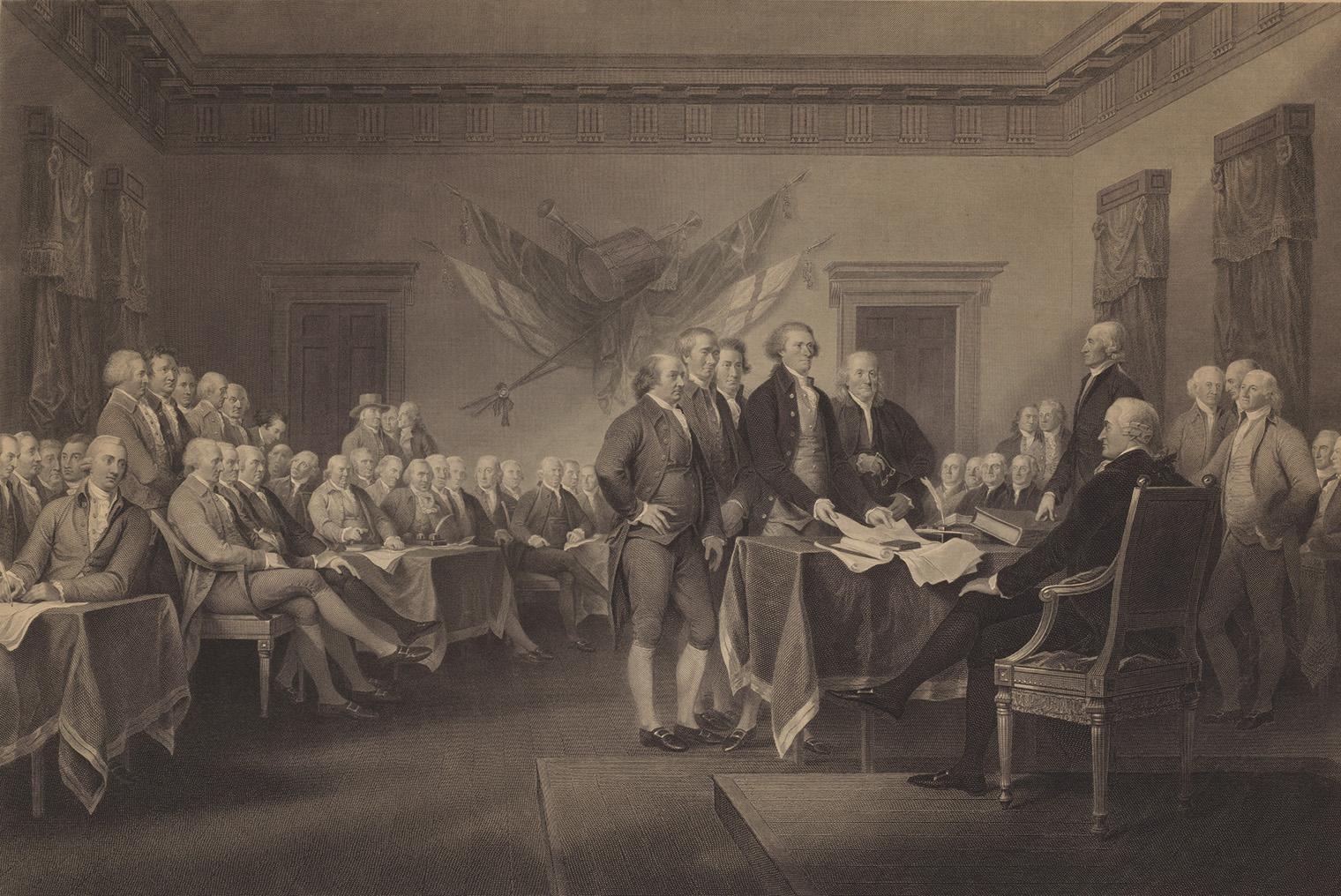
Asher Brown Durand (American, 1796–1886), after John Trumbull (1756–1843). Declaration of Independence, 1820–23. Etching and engraving, fifth state of six, 20 1/8 × 30 1/4 in. (51 × 76.7 cm). The Metropolitan Museum of Art, New York, NY, Gift of Morrison H. Heckscher, 2022 (2022.29)
With an ill wife, a small child, a recently buried mother, and a new Virginia state constitution to be prepared, Jefferson was reluctant to leave Monticello for Philadelphia in the spring of 1776. But then, as he would so many times in the future, he followed the path of duty. John Adams volunteered Jefferson for the task of drafting the Declaration of Independence; Jefferson did not lobby for it but nevertheless seems to have written a draft within a day or two. (It was submitted seventeen days after being assigned.) What emerged, he later said, was “an expression of the American mind.” Jefferson made no claims to the originality of the document’s soaring rhetoric. Its authority, he wrote, “rests then on the harmonizing of the sentiments of the day.” Far from being a “very conservative” document, as one historian has recently charged, it did no less than overthrow monarchical rule and set the United States on the path to a government derived, as the document said, from “the consent of the governed,” which would come to be ruled by “we the people.” The Declaration did not solve all of Americans’ problems, far from it, but instead gave citizens of the new nation a chance to do so themselves.
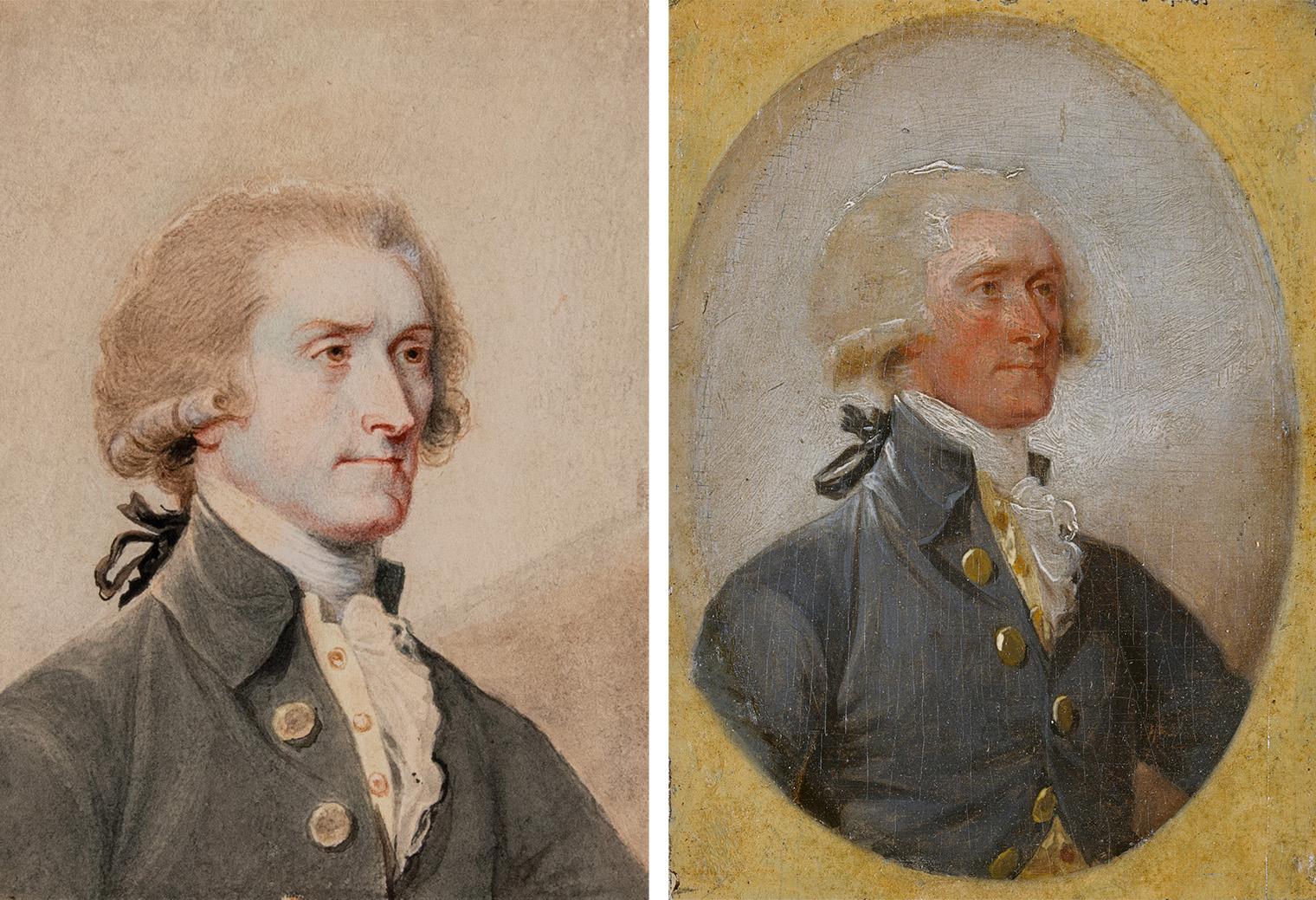
Left: Attributed to the Studio of Adélaïde Labille-Guiard (1749–1803). Miniature painting, Thomas Jefferson (1743-1826), late 18th century. Watercolor on paper, 3 1/8 × 2 1/2 in. (7.7 cm × 6.35 cm). The Virginia Museum of History and Culture (VMHC 1978.22). Right: John Trumbull (1756–1843). Thomas Jefferson, 1788. Oil on mahogany, 4 1/2 x 3 1/4 in. (11.4 x 8.3 cm). The Metropolitan Museum of Art, New York, Bequest of Cornelia Cruger, 1923 (24.19.1)
As he aged, Jefferson went to great lengths to instill the lessons of the American Revolution in future generations. He invited students at the University of Virginia, which he founded and designed in his retirement from public office, to converse and dine with him at Monticello, and wrote magnificent, if predictably pedantic, letters about education to a wide range of correspondents. Representations of Jefferson at this point in his life harken back to his days as a revolutionary decades earlier, including John Trumbull's late 1780s miniature oil portrait, now in The Met collection. According to pioneering research by Laura Auricchio and Diane C. Ehrenpreis, Trumbull likely modeled his Jefferson portrait after a 1786 miniature from the studio of Adélaide Labille-Guiard, a distinguished French woman artist. While Trumbull’s version of the French miniature seems to lack immediacy, as he included that likeness of Jefferson in his famous easel painting The Declaration of Independence, July 4, 1776 (1786–1820), the small portrait—of which three variants are known—carries particular significance. Clearly, Jefferson, who collaborated with Labille-Guiard and Trumbull (among others) to commemorate his role in American independence, played an important role in self-fashioning his image as a revolutionary.
Jefferson’s accomplished life, so much of it devoted to rolling the “ball of liberty . . . round the globe,” begs the question of what Americans can do with the revolutionary legacy bequeathed to us. With a clear-eyed view of what Jefferson succeeded in doing, as well as what he did not, Americans today can see themselves not only in the story of the United States that Jefferson first wrote into being, but in the example of the young Jefferson himself. The lanky, red-headed, optimistic, and, above all, bold youth had no business effecting world change; he pressed quill pen to paper and did so anyway. Jefferson’s life teaches us that progress is possible, if rarely complete and never inevitable.
This essay is adapted from Declare: A Civic Gospel, on the occasion of the exhibition Revolution!, on view through September 7, 2026.


