The beauty about working in clay is that it’s versatile and malleable. I can’t think of any other material that has that capacity.
I am a ceramic artist. Having learned a whole lot of techniques from throwing to concave and convex making, slip casting, and all the techniques within the ceramic world, I discarded most and decided to build on the traditional techniques that I had gathered from places I had visited and people I had worked with around the world. I have found with ceramics in general, there was a universality in the way people approached handling clay and material, even though the actual materials were localized and had different constituent ingredients.
I think the embellishments that come with the tradition and norms that exist in a country will affect the details in the work more than the fact that what they’re making is a vessel. In the end, the differences were very much to do with the approach one took and the type of work one wanted to make—whether one’s in Nigeria, Burkina Faso, China, or elsewhere. Even in China and Turkey, I found that the techniques that are used in pottery, whether it’s throwing or hand-building, are techniques that nobody needs to explain, or they don’t defy explanation. Everybody understands what it is to make a pot.
A universal vessel
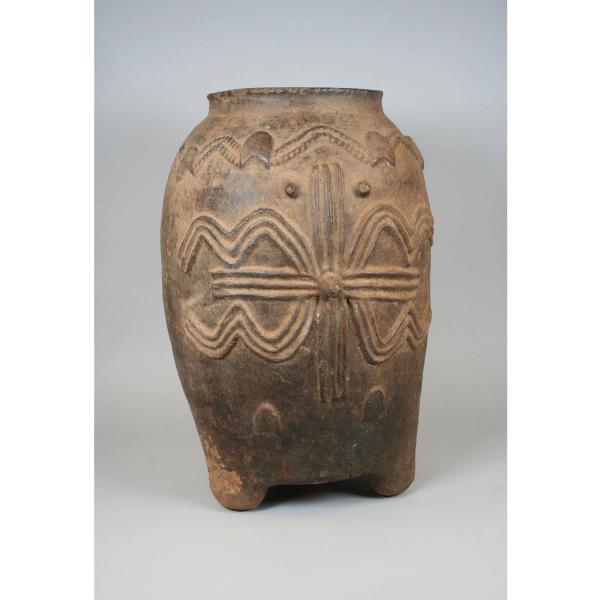
If you showed this Kurumba vessel to a first-year student at college and asked them to identify it in terms of location, you would get so many different answers: American Southwest, Aztec, Egyptian, Chinese, African. This piece exudes the universality that I talk about.
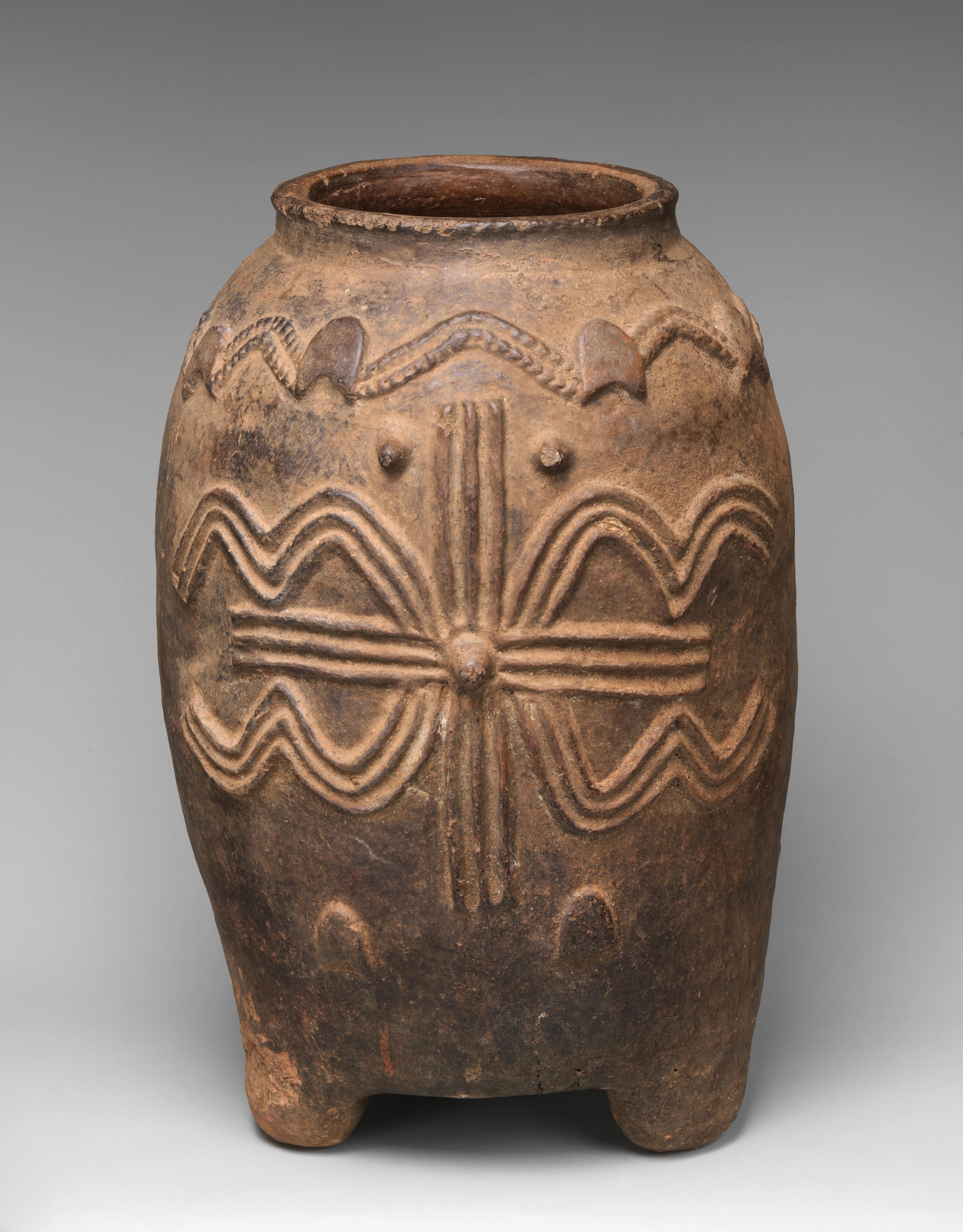
Vessel, 19th–20th century. Burkina Faso. Kurumba peoples. Terracotta, 25 x 17 in. (63.5 x 43.2 cm). The Metropolitan Museum of Art, New York, Gift of Dr. and Mrs. Karl G. Klinges, 1994 (1994.301)
It has such a global feel to it. It cannot be mistaken as anything other than a pot or a vessel, but it’s a very sculptural piece of work as well. It looks strong, it’s expansive in its reach in terms of appeal, but at the same time, this piece has a very specific surface decoration that can pinpoint its location. And I think ceramics throughout the ages have done that. If you look at some of the Azande and early IsiKongo pieces, the boldness of decoration defines what the piece is. For example, this Kurumba vessel is obviously a storage piece of work. I have seen containers from Sudan called ibrigs that also have this kind of feet. You know that it’s a storage jar as opposed to a water container because it stands on its feet as if it’s a granary.
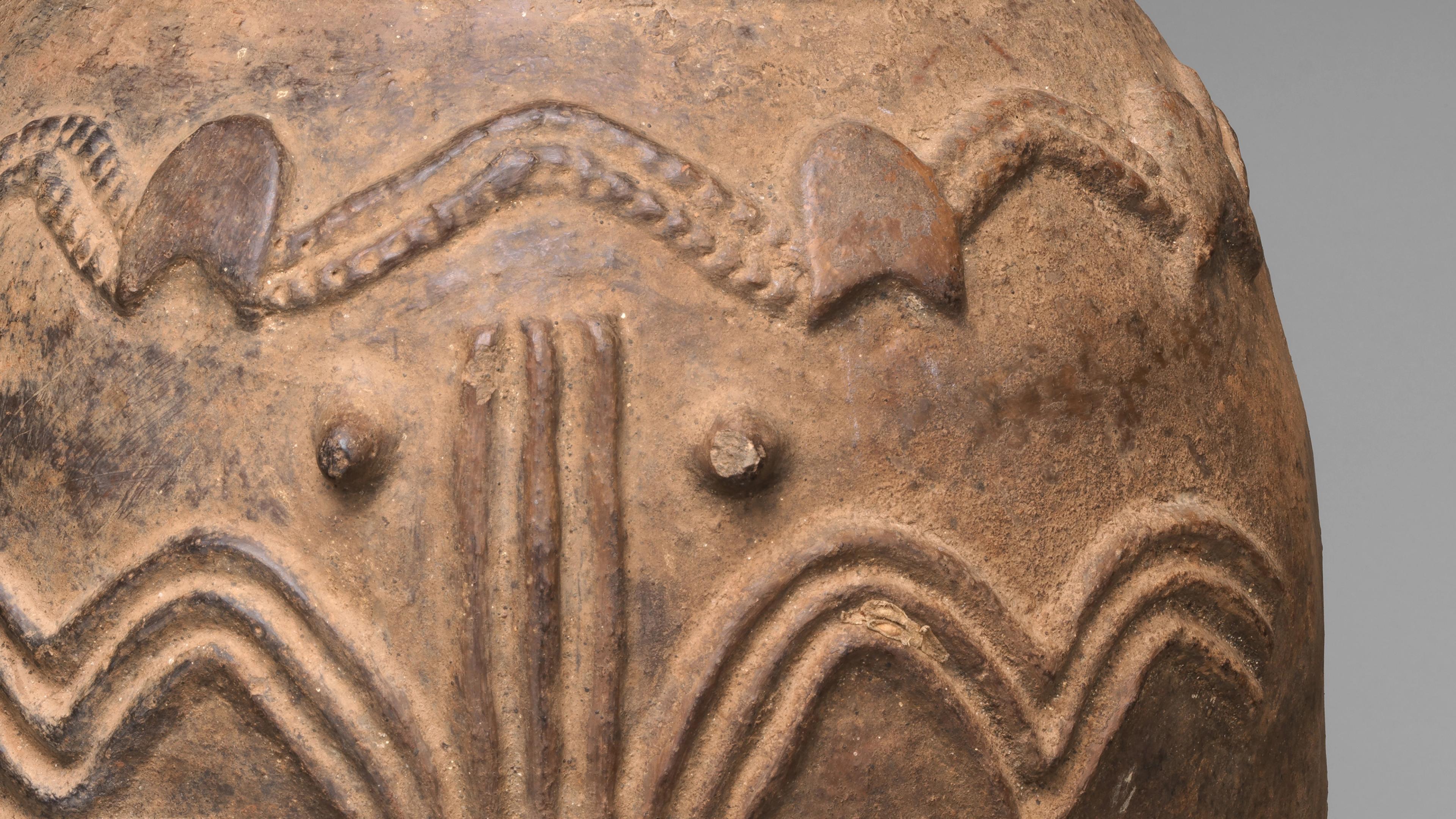
Detail of the Kurumba vessel.
This piece is just so unique and powerful. You can look at it. It stands there. It’s like a human being, like a sentinel. It’s guarding, but it’s giving at the same time. I wish I could make a piece of work like that. It’s so complete. And I think the completeness is also because this is a vessel that would be recognized as being a well-made, very creative piece of work wherever you are in the world. It’s beautiful.
Making marks: Women as artists
Some of the nodules that appear on this Kurumba vessel resemble scarification on the belly of a woman. You can find those sorts of nodules in South African and Zulu ceramics as well. The markings on this piece remind me very much of markings that my mother and my aunts had. I remember on my mother, what was exciting was her back, where she had markings from the nape of her neck to just below her waist. Within our community, we had a tradition of such scarifications: starting when a woman reached puberty, the decoration on her body would increase as she got married and as she had her children.
I find a woman’s ability to carry life when she’s pregnant embodies the qualities of a pot that contains life and sustains in all sorts of manners. When a pregnant woman is sitting, waiting to give birth, it is that life inside of her that is breathing. The exterior tells us what is happening or gives us the notion or the emotion of what to expect. But the preciousness of the interior is what is so, so important.
If we are talking about traditions like this Kurumba piece, I think where pieces were so elaborate, I found that they were mostly made by women. In places like Morocco, Tunisia, and Nigeria, men made very beautiful pots. Occasionally you’ve got the Baganda pieces, where the king had his own group of potters who lived in the palace and made pieces. In other places, sometimes there was a collaboration between men and women where the women made pots, men decorated them, and vice versa. I often resist attributing specific gendered roles in the traditions of makers. But I think we’ve gone past making assumptions. All I can say is that I think the best pots have always been made by women on the continent.
It’s significant that pots or ceramics offered a canvas in which the maker was able to be creative—they created individual work for that particular time, but also for themselves. This Kurumba storage jar was made first and foremost as a storage jar, and then the individual extemporized and made the decoration as an emotional response and for aesthetic reasons. To an outsider, the parts might look the same, but in pottery tradition, we have stamps, or we sign our pieces.
These markings were a way of identifying the ownership of whoever was making the work, which was especially important because they often had communal firings. When the pieces went to market or when they were being sold, everybody would know whose work belonged to whom, as opposed to the notion that all these pots were the same and could be classified as village pottery. Right through the ceramic tradition, and particularly West African ceramics, vessels like these had an identity and individuality, and I think that’s why these pieces are so appealing to us.
The story of humankind
Throughout history, ceramics have always been an identifier of particular traditions and communities. You can go to classical Greek and Roman pieces and classical Baganda pieces, and you can decipher from the style what community and what purpose the pieces were made for. Each community had their own tradition and notions of decoration that emphasized and identified the pieces to the local community. There were norms that people followed, and they still exist. And so, people make and sculpt and create pieces that uniquely identify where they come from.
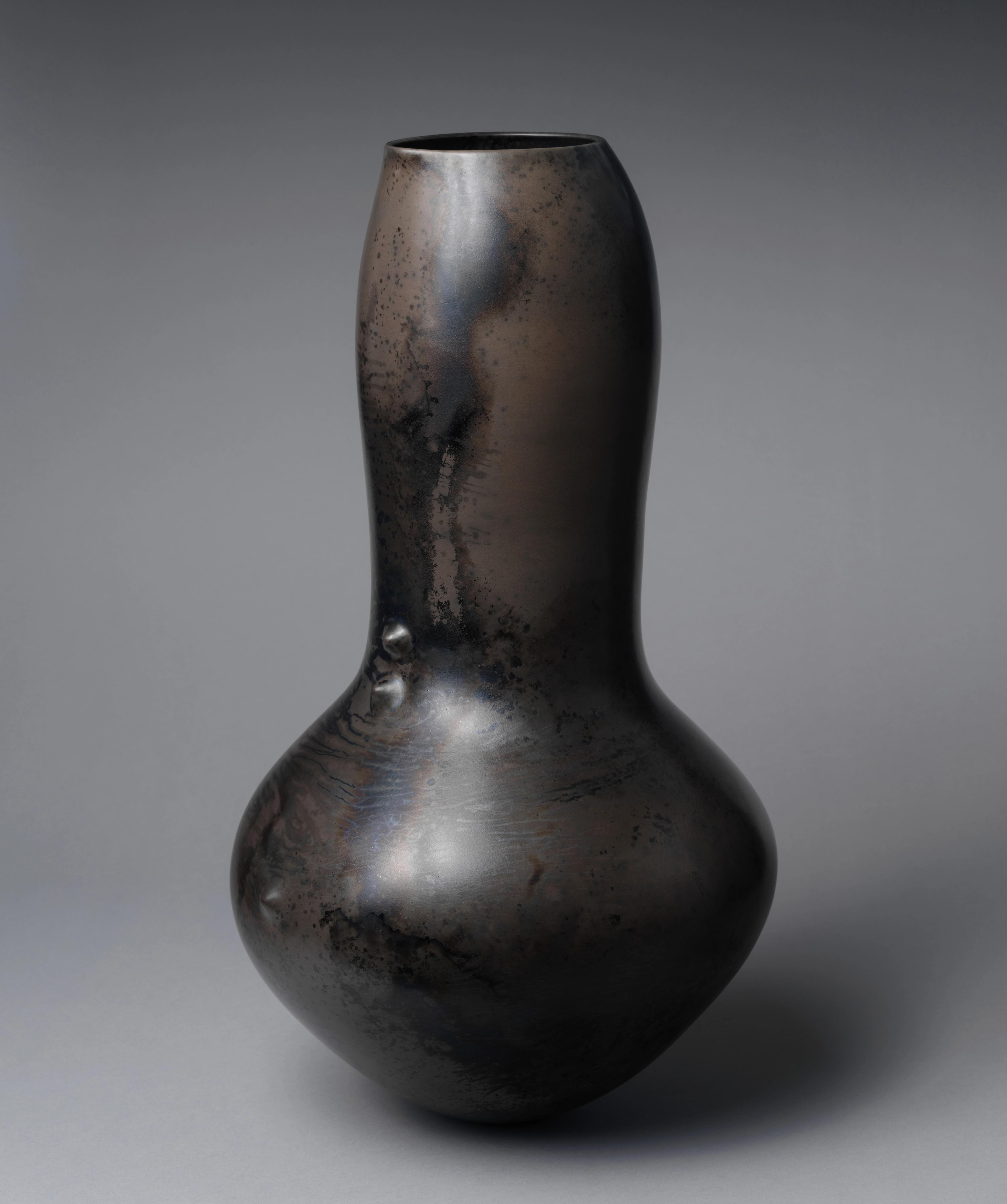
Magdalene Odundo (British [born Kenya], 1950). Untitled, 1997. Red clay, 19 3/4 x 13 x 10 1/2 in. (50.2 x 33 x 26.7 cm). The Metropolitan Museum of Art, New York, Purchase, The Katcher Family Foundation Inc. Gift, and Gift of Susan Dwight Bliss, by exchange, 1998 (1998.328)
We all have strong traditions, and we all have this need to have a communal identity. But there’s also a competitive nature in human beings to want to make different pieces, to want to embellish things, to create objects that tell their own history and their own stories. And that goes for Greek, Mesopotamian, Peruvian, African, and Asian pieces—and beyond. The pieces that we all love in museums were always the special pieces, because the utilitarian pieces did not survive. They would’ve been like any mug, bowl, and pitcher—used and broken. So what we see in museums are pieces that were kept and stored and cherished because they were special.
Of all the arts and crafts, ceramics is one of the most human and natural. I think pots were the first invention when fire was discovered to preserve and to cook food. Biblical notions of creation quote the existence of life within clay—the molding of clay breathed life into our humanity. I don’t think there’s any other material that has that universality and that humanity and the capacity to tell the story of humankind as simply as the clay material itself.
Hear from Odundo in the Arts of Africa audio guide.
1541. Vessel, Kurumba artist
Magdalene Odundo
MAGDALENE ODUNDO: It has such a global feel to it. It cannot be mistaken as anything other than a pot or a vessel, but it's a very sculptural piece of work as well. It's expansive in its reach in terms of appeal, but it has a very specific surface decoration that can pinpoint its location at the same time.
ANGELIQUE KIDJO (NARRATOR): This vessel would have been used for storing life-sustaining grain. Both its practical function and rounded forms celebrate fertility. Here is Dame Magdalene Odundo, a premier ceramic artist born in Kenya.
MAGDALENE ODUNDO: Some of those nodules that appear there—they’re a bit like scarification on the belly of a woman. The markings remind me very much of markings that my mother had, because we had the tradition within our community of such scarifications when a woman reached puberty, and the decoration on the body would be added as they got married and had their children.
I find a woman’s ability to carry life embodies the qualities of a pot that contains life and sustains in all sorts of manners. The inside has this capacity to contain. The exterior tells us what is happening or gives us what to expect. But the preciousness of the interior is what is so, so important.
ANGELIQUE KIDJO: The clay medium uniquely gives shape to human history.
MAGDALENE ODUNDO: I think of all the arts, ceramics is one of the most human and natural, and has existed throughout the history of mankind. I think pots were the first invention when fire was discovered. So the molding of clay breathed life into our humanity, and it is the most human material there is. I don't think there's any other material that has the capacity to tell the story of humankind as simply as clay itself.
This essay is adapted from an interview with Magdalene Odundo that took place in 2024 as part of collaborative research for the new Arts of Africa galleries in The Michael C. Rockefeller Wing.