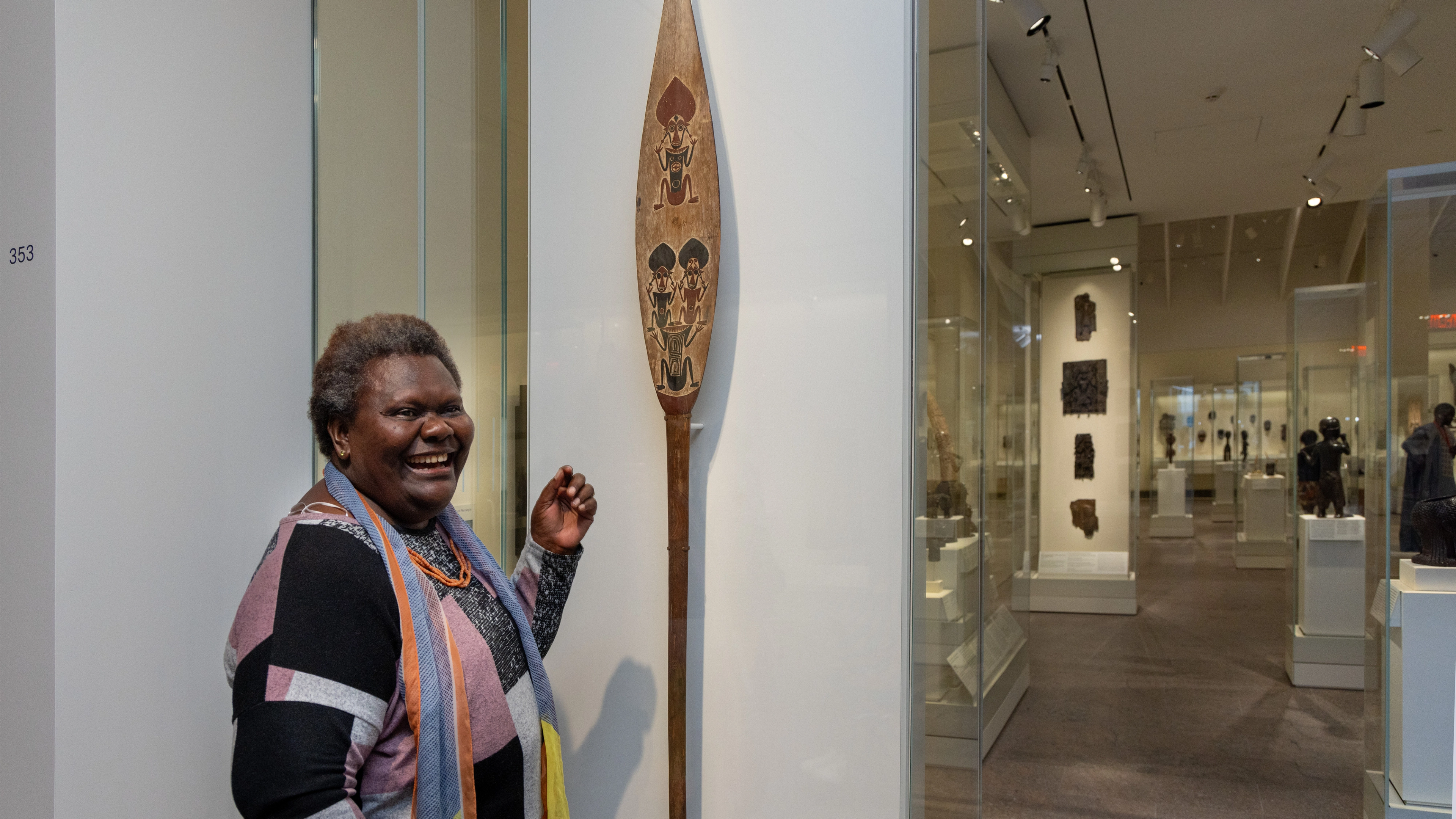
Sana Reana Tangere Balai is a curator and the daughter of a patu, the highest chief of the Nakaripa clan of Buka Island.
For the Nakaripa and Naboen clans, canoe paddles like this one played an important ceremonial role, marking transitions at key stages of life. On both sides of the paddle, squatting figures decorate the surface. According to Balai, “It’s called kokorra, and kokorra represents a fetus. One of the main functions of this paddle is the beginning of life.”
Life’s beginning is not the only major transition represented. At the bottom of the paddle is a three-part kokorra figure. “It’s actually one person transitioning between two lives, from life to death, and making a journey to the top.”
At the top of the paddle, the red-and-black figure represents a woman and a chief. “The structure of the clan system in Buka or Bougainville has a matriarchal system. The woman is the head of the family. The woman is a chief.” Today, Balai’s elder sister, Paula Doreen Ngasi Balai Kenneth, is the Tohe Kau Mal Ngasi (Paramount Woman Chief) of the Nakaripa clan—a patu like her mother before her.
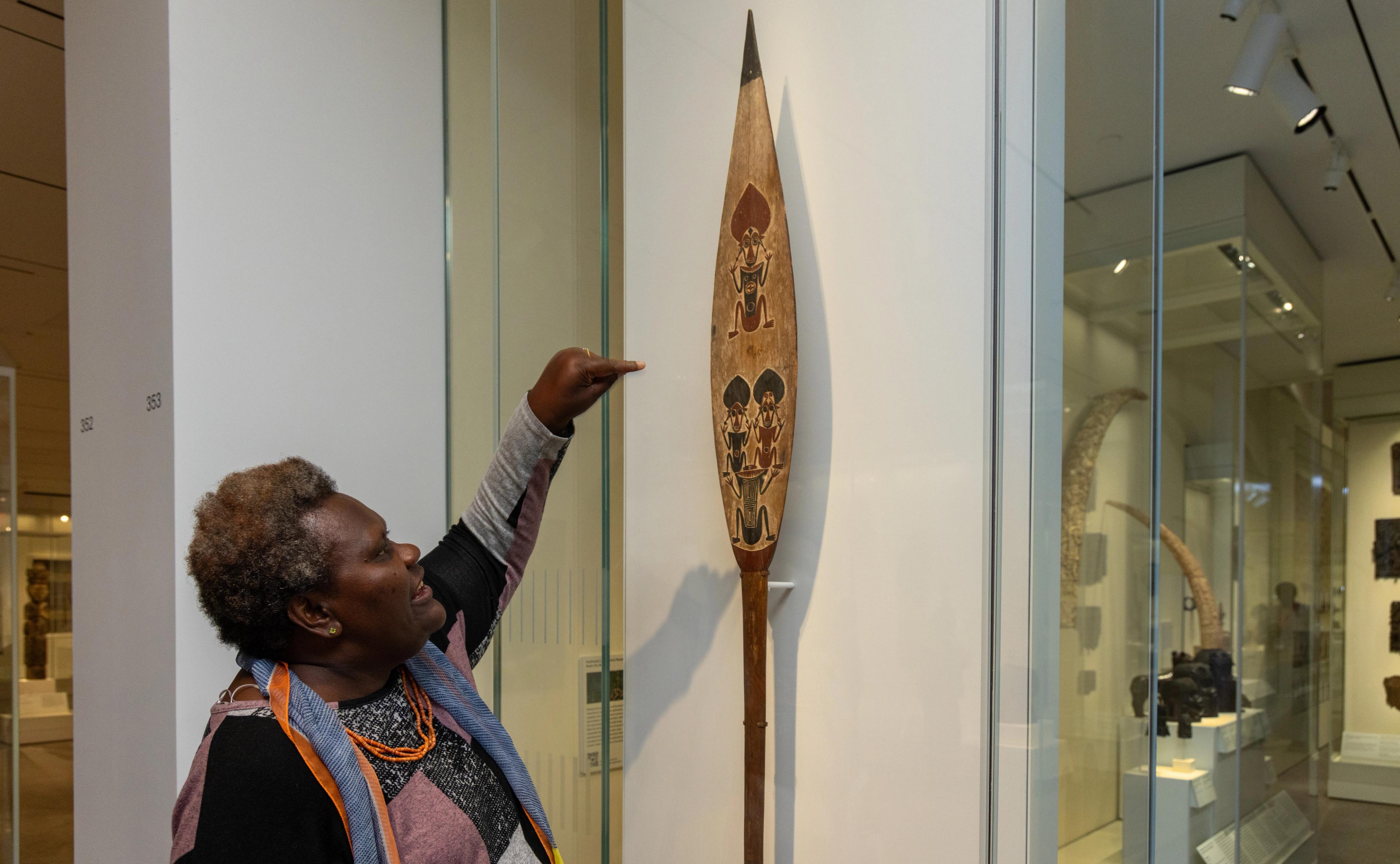
Sana Balai in the Arts of Oceania galleries. Photographs by Anna-Marie Kellen
At The Met, Balai examines a paddle similar to one used in her sister’s marriage ceremony in the 1960s. “The paddle has many functions. I’m just describing one of them.”
“The name of the ceremony is called sole. It means ‘I’m taking my daughter to her future husband.’ So, on her wedding day, she was carried high up by four people and surrounded by our warriors, our singers, and our dancers. And on the platform, she will be holding the paddle.”
“Both parties will be dancing, and the woman’s family will sing a song that says, ‘We’re looking for a husband. We’re looking for a husband,’ and the husband’s family will respond and will say, ‘We’re fishing for a wife.’”
The husband’s family pretends to shake the bride off her platform, and she falls. “If the husband’s people catch her, then the wedding goes ahead, but if the woman’s family catch her, then it all starts again from scratch. After that, the woman then hands the paddle to the aunty. And then that one is kept until when she has a baby.”
According to tradition, this is not the final time the paddle makes an appearance. “If she finds out she’s pregnant, she goes and tells the aunty, and then before everyone wakes up, the aunty will go and place the one in front of the woman’s house to announce that the woman is pregnant.”
After that, the paddle is kept in a tsuhana (clan meeting house) until such a time when the chief passes to the afterlife. “When my sister dies, that [paddle] is there when she dies. The one will be then taken and put on the cemetery.” There, it will be left to gradually decay.
“That represents the whole life cycle, and then the thing starts again.”
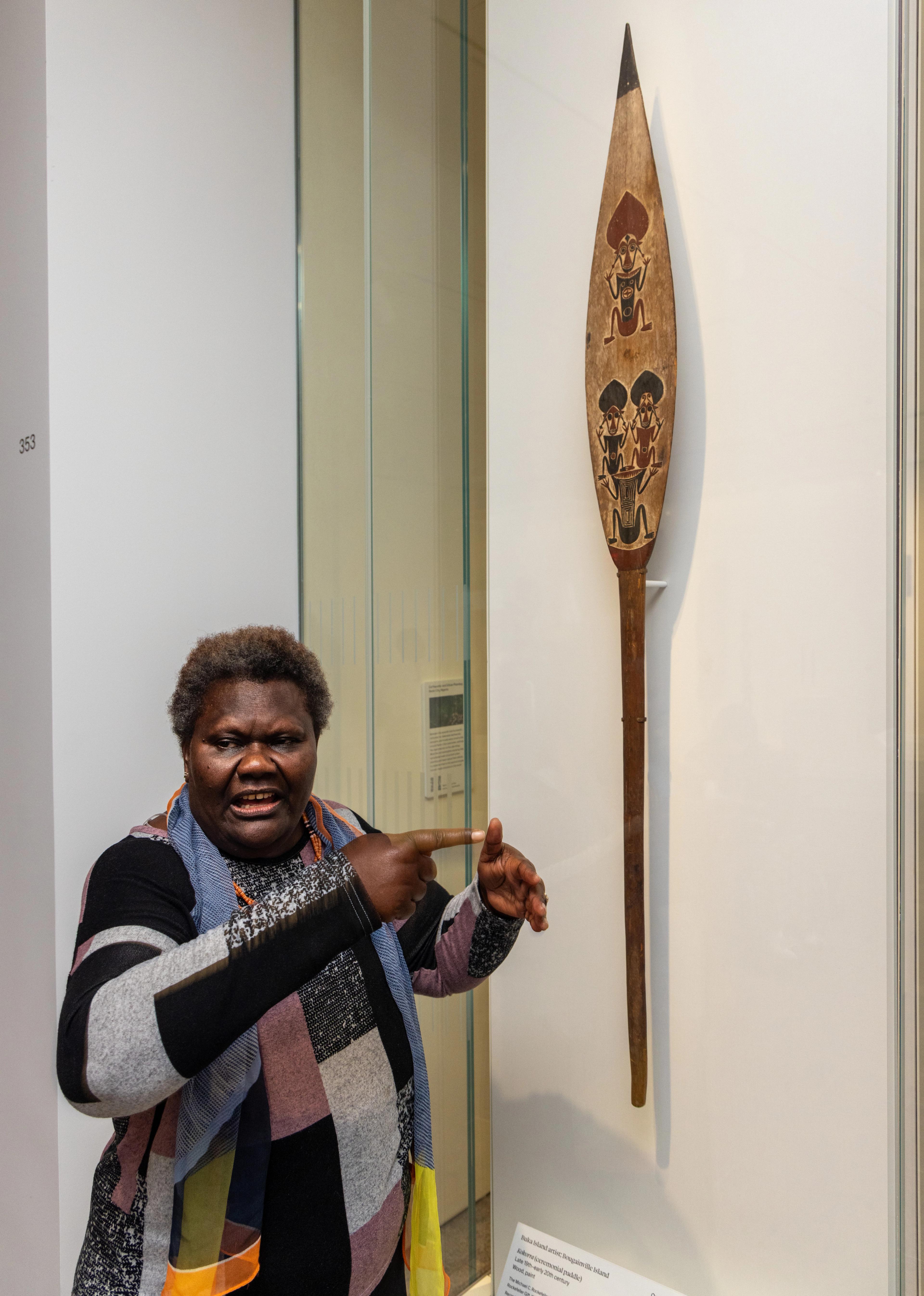
Many ceremonial paddles were destroyed in the ten-year civil war in Bougainville during the 1990s, and paddles such as this are no longer produced. “The traditional one no longer is done. I don’t think there are many people left that can do it. The last one that I know of was carved by my uncle for my sister’s wedding, and it was done in 1965. Since then, I have not seen it. So those ones are very rare and very important because no one knows about them or what they mean anymore.”
As the second in line, Balai fulfils the role of voice and knowledge holder, acting as a bridge between the chiefs, clan members, and the general public. “Before my aunty passed away, the one that I inherited the role from, I had a conversation with her, and I said, ‘Look. We have a choice. We either die with the knowledge, and that will deprive the next generation of whatever we had, or we pass it on, and how we pass it on, it’s up to us,’ and she goes, ‘Look. I authorize you to do anything as long as it’s done with respect.’”
In her role, Balai balances both the protection and the transmission of cultural knowledge. “I’m trying to pave a way for those coming after me, so at least, if we record this thing, if we have the knowledge out there, they can be freer.”
Reflecting on the key transitions and stages of her own life, Balai’s professional journey was somewhat unexpected. “I am not from an artistic background. My background is applied science. When I came to Australia, I couldn’t get a job in my field, so I reinvented myself and went into art as the most unqualified, unskilled person. But what I had was 30,000 years of qualification that got injected in my DNA, and I’m grateful to the people who did that.”
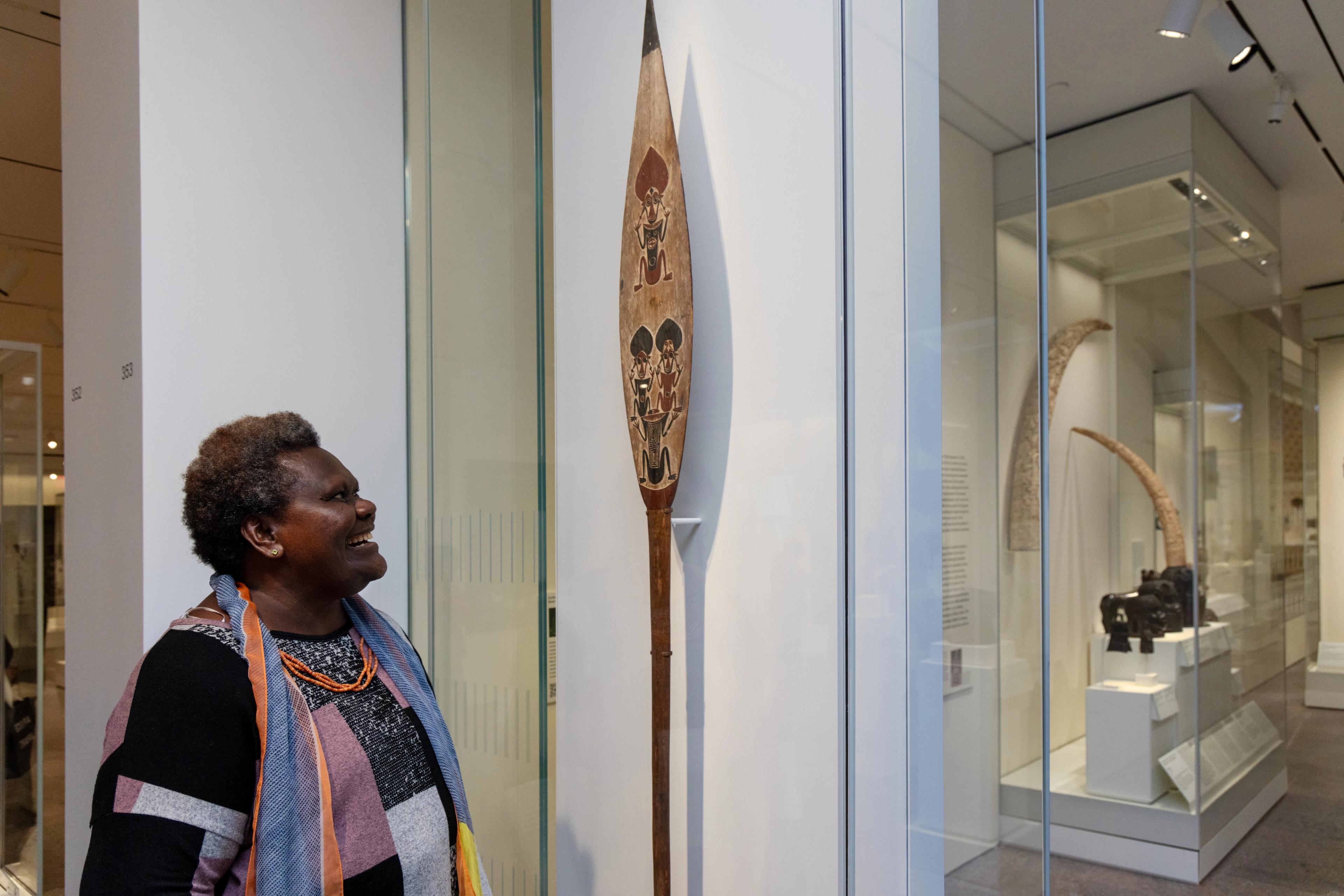
Balai shares that in Bougainville, art practices don't exist on a linear path from traditional to contemporary, but rather ancestral knowledge coexists with the present and future in time and space. “In our culture, we have this saying that the present looks to the past to see the future. We take our ancestors with us.”
Hear from Balai in the Arts of Oceania Audio Guide.
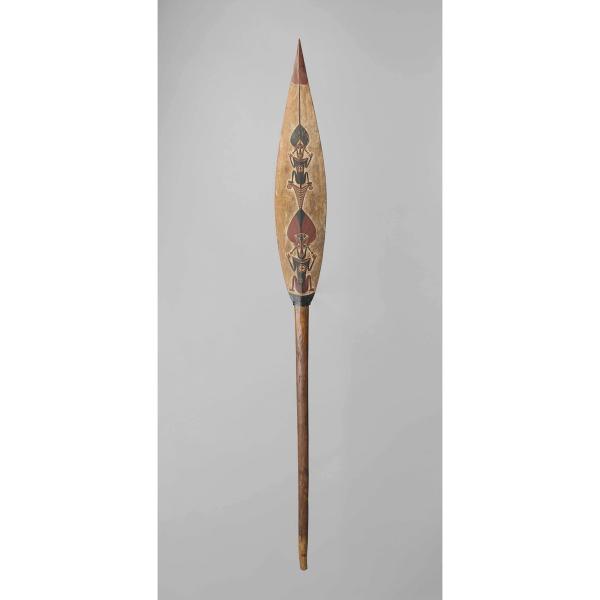
1778. Kokorra (ceremonial paddle), Buka Island artist
Sana Balai
SANA BALAI: In our culture, we have this saying that the present looks to the past to see the future. My name is Sana Reana Tangere Balai. I am a daughter of a patu, which is the highest chief of the Nakaripa clan.
KATERINA TEAIWA (NARRATOR): For the Nakaripa and Naboen clans of Buka Island, canoe paddles like this one played an important ceremonial role, marking transitions at key stages of life.
The squatting figures that decorate the paddle…
SANA BALAI: …it’s called “kokorra.”
KATERINA TEAIWA: The kokorra represents a fetus, and refers to the beginning of life, or journeys within life. Look at the three-part kokorra figure on the bottom.
SANA BALAI: It’s actually one person. It’s transitioning from life to death.
KATERINA TEAIWA: The red and black figure on top also represents a woman… and a chief.
SANA BALAI: The structure of the clan system in Buka or Bougainville has a matriarchal system. The woman is the head of the family. The woman is a chief.
KATERINA TEAIWA: Sana Balai’s older sister is now the patu, the chief, of the Nakaripa clan. When she was married in the 1960s, she and her future husband each held paddles like these as their families carried them on platforms to the ceremony.
SANA BALAI: The name of the ceremony is called sole, s-o-l-e. It means I’m taking my daughter to her future husband.
So on her wedding day, she was carried high up by four people and surrounded by our warriors, singers, and our dancers. And on the platform, she will be holding the paddle.
Both parties will be dancing, and the woman’s family will sing a song that says, “We’re looking for a husband. We’re looking for a husband,” and the husband’s family will respond and will say, “We’re fishing for a wife.”
KATERINA TEAIWA: The husband’s family pretends to shake the bride off her platform, and she falls.
SANA BALAI: If the husband’s people catch her, then the wedding goes ahead, but if the woman’s family catch her, then it all starts again from scratch. Anyway, after that, the woman then hands the one or the paddle to the aunty. And then that one is kept until when she has a baby.
KATERINA TEAIWA: Traditionally, the paddle is placed in front of her house to announce her pregnancy. And when a woman passes to the afterlife, the paddle is called upon again.
SANA BALAI: The one will be then taken and put on the cemetery. And that represents the whole lifecycle, and then the thing starts again.
###
Music: Sole (wedding) song for woman chief courtesy of Sana Balai.


