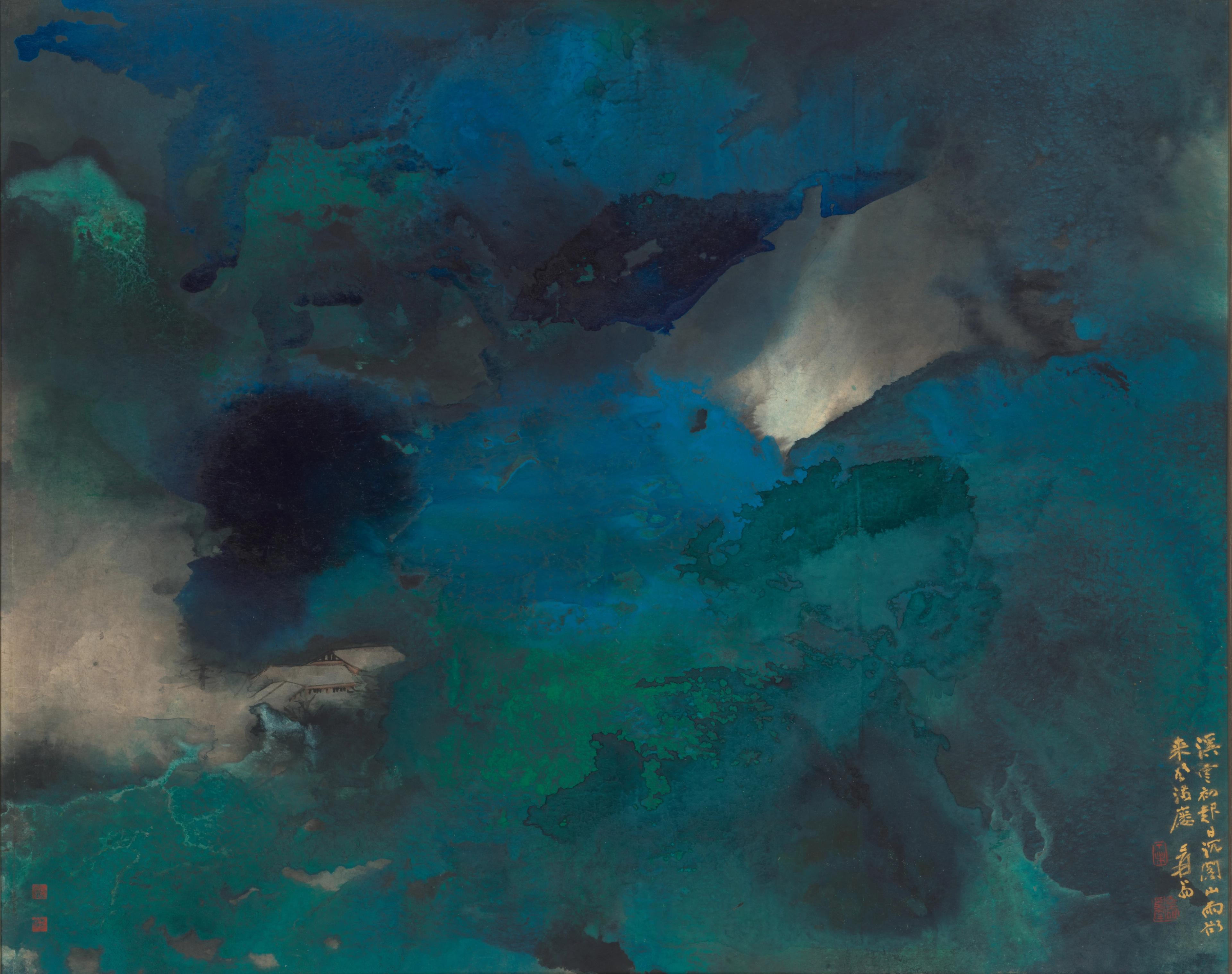
(Image: Chang Dai-chien (Zhang Daqian), Approach of the Storm, 1967. Purchase, Sing Sheng Chang Gift, in memory of Chang Hsu Wen-po, 2024 and 2025 Benefit Funds, and funds from various donors, 2026)
(New York, September 17, 2026)—The Metropolitan Museum of Art announced today an acquisition of 38 paintings by preeminent Chinese ink painter Chang Dai-chien (Zhang Daqian; 1899–1983) from the collection of the artist’s daughter, Sing Sheng Chang. Chang Dai-chien left China in 1949 and spent the following decades moving between Hong Kong, Japan, India, Argentina, Brazil, California, Europe, and Taiwan, crafting along the way a transnational style that combined his early training with ideas and currents encountered along the way. The landmark acquisition spans all phases of the artist’s career, from his early works of the 1930s–40s to his breakthrough abstract paintings of 1965–68 to a selection of unfinished works, providing a deep and concentrated view of his singular career as an essential figure of modern art. A selection of works from the acquisition will be on view later this year, and further works will be included in a forthcoming 2028 exhibition on 20th century Chinese ink painting.
This acquisition is made possible by Sing Sheng Chang Gift, in memory of Chang Hsu Wen-po, with additional major gifts in support of the acquisition from Oscar L. Tang and H.M. Agnes Hsu-Tang, The Vincent Astor Foundation, Mary and James G. Wallach Foundation, Kristine Johnson and Timothy Dattels, Eugenia Ames, Jane DeBevoise and the Calello Family, Friends of Asian Art, The Hao Family, and Andrew Solomon and John Habich Gifts; Florence and Herbert Irving Acquisitions, Douglas Dillon, Rogers, Denise and Andrew Saul, The Miriam and Ira D. Wallach Foundation, and Philippe de Montebello Funds; Robert Hatfield Ellsworth and Brooke Russell Astor Bequests; and allocations from the Museum’s general art acquisitions funds.
“Chang Dai-chien stands as one of the most important painters of the modern era. He combined a deep knowledge of classical Chinese culture with a transnational perspective to fashion a style of ink painting that was both locally rooted and connected to a wider global outlook,” said Max Hollein, The Met’s Marina Kellen French Director and Chief Executive Officer. “This major acquisition will allow for a thorough understanding of Chang Dai-chien through career-defining works that span the range of his creativity, presenting a panoramic view of the artist’s life. We are grateful to Sing Sheng Chang for entrusting The Met with her father’s legacy, making The Met a leading center for the study of this important artist.”
The paintings span Chang’s career from the 1930s to the 1980s, covering the artist’s exceptionally broad range of styles and genres, from the classicist experiments of his youth to his abstract breakthrough of the 1960s to his later works that synthesize both currents. Each phase is represented by major works, such as the “splashed-color” and “splashed-ink” breakthrough period of 1965–68. Other periods and categories of painting in Chang Dai-chien’s career—figure painting, gestural lotus painting, meticulous flower painting, and even self-portraiture—are represented by examples of high quality. Taken as a group, these works represent 20th-century ink painting—its dynamism and modernity—at the highest level and through the story of its most celebrated practitioner.
The Sing Sheng Chang Collection provides an unusually intimate look into the home and heart of Chang Dai-chien. It contains eye-opening gems from the artist’s early period, including several works made at the Buddhist cave temple site of Dunhuang in the 1940s, very few of which exist outside of museum collections in Asia. Unfinished works, semi-completed experiments, and paintings lovingly inscribed to his daughter all make this collection unique. This allows for a richness in narrating the artist’s story that will present him in dynamic dimensionality. All the paintings in the collection were passed down to Sing Sheng Chang by her father and her mother, Chang Hsu Wen-po, the artist’s wife.
In the 1960s, Chang’s interest in abstraction blossomed in his “splashed-color” and “splashed-ink” works, which sought to locate the roots of modern abstraction within the theory and practice of Chinese ink painting.
The acquisition will bolster The Met’s collection of works by Chang Dai-chien, which includes the 2021 promised gift of a dozen works by the artist from Jack and Susy Wadsworth as well as the Museum’s trove of classical Chinese painting and calligraphy formerly in the collection of the artist. These works came to the Museum in 1989 as part of the bequest of John M. Crawford, Jr., who bought extensively from Chang in the 1950s. These ancient artworks fueled Chang’s search for his own innovative modern voice. Connecting them with such a rich selection of Chang’s own artworks—in the galleries, in publications, and on the Museum’s website—will allow for a rich case study on the inspiration of the past in 20th-century ink painting. For more information on the acquisition, visit The Met website.
Joseph Scheier-Dolberg, Oscar Tang and Agnes Hsu-Tang Curator of Chinese Painting at The Met, said: “Chang Dai-chien is the most consequential modern ink painter from China. His early commitment to mastering the classical tradition and his two years of diligent study at the Dunhuang caves gave him a unique understanding of Chinese painting history, which he parlayed into decades of pathbreaking exploration from the 1940s to 1980s. Chang has long been recognized as an essential modern artist in East Asia, but he has been insufficiently understood in Europe and the Americas. This acquisition will allow The Met to tell Chang’s quintessentially modern, transnational story and to position his contribution within a larger narrative of entangled global modernity.”
Lesley Ma, Ming Chu Hsu and Daniel Xu Curator, Department of Modern and Contemporary Art at The Met, said: “Chang Dai-chien defined modernity on his own terms through a tirelessly experimental and virtuosic career. This tremendous group of paintings highlights Chang's innovative expressions in ink on paper that underscore the significance of an East Asian aesthetic in 20th-century art. We are honored to further his legacy as we deepen our research and commitment to rethinking global modernity in the future Tang Wing for Modern and Contemporary Art.”
About Chang Dai-chien (Zhang Daqian)
Chang Dai-chien (Zhang Daqian; 1899–1983) was an essential figure of Chinese ink painting of the 20th century as well as of modern art. Born a decade before the fall of the Qing dynasty, Chang lived through two world wars and tracked a path through Japan, Hong Kong, India, Argentina, Brazil, and California before returning to Asia to spend his final years in Taiwan. Celebrated in his own lifetime, Chang's fame has only grown in the years since, as he has come to be recognized as one of the defining figures of twentieth century art.
Born in Neijiang, Sichuan, Chang spent much of the 1920s and 1930s in and around the eastern cities of Shanghai and Beijing, where he painted prolifically and committed himself to mastering the classical tradition through collecting and study. After the Japanese invasion of eastern China, Chang retreated inland, eventually spending two years (1941–43) at the Gansu desert oasis of Dunhuang, where he dedicated himself to studying the unparalleled trove of ancient paintings preserved in the caves there. The ancient cave paintings of Dunhuang had not been studied by painters of the preceding Yuan, Ming, or Qing dynasties, and Chang saw them as a revelation for 20th-century artists who wished to discover kernels of modernity within the Chinese past. The insights gained from this period of intensive study would affect the rest of Chang’s career. Following Chang’s pioneering work at the site, Dunhuang has continued to be an inspiration for artists to the present day.
Chang left China in 1949, beginning a transnational journey that would continue until his death in 1983. After sojourns in Hong Kong, Japan, India, Taiwan and Argentina, Chang settled in Brazil in 1954 and lived there until the mid- to late 1960s, when he moved to California. It was during his time in Brazil and California that Chang made his abstract breakthrough, refining his famed “splashed-color” and “splashed-ink” modes, which are represented by several works in the Sing Sheng Chang Collection. This period also saw Chang travel extensively in Europe, including several trips to Switzerland, where the mountain vistas had a significant effect on Chang’s approach to landscape. Chang’s California period continued until 1978, when he moved to Taiwan, where he would spend his final years.
Chang's unparalleled command of historical Chinese painting styles brought with it a complex legacy that scholars have examined at length. His ability to work in the manner of the early masters was so convincing that it gave rise to questions about certain attributions. Curator Fu Shen addressed the topic with particular depth in a 1993 career retrospective of Chang’s works at the Sackler Gallery in Washington, D.C., exploring the role of copying in Chang's training and in Chinese painting connoisseurship more broadly. Among the works touched by this debate is The Met's own masterpiece of early Chinese painting, The Riverbank, attributed to Dong Yuan, which the art historian James Cahill proposed in the 1990s as a possible work by Chang—a question The Met addressed directly through a symposium and publication in 1999. The painting has since been exhibited at both the National Palace Museum in Taiwan and the Shanghai Museum, reflecting a consensus within the field regarding its standing as an important early work.
Later this year, the Museum will display a selection of works from this acquisition in the Astor Forecourt. The display will include the rare splashed-color and splashed-ink works of the 1960s that helped to establish Chang as an ink painter of global perspective and ambitions.
###
September 17, 2026