(New York, May 7, 2026)—From June 12, 2026, to February 28, 2027, an exhibition at The Met will focus on cross-cultural encounters in Europe and the Middle East during a period of growing imperialism and colonialism. Orientalism: Between Fact and Fantasy will present works of art traditionally identified as Orientalist in conversation with objects from the Middle East, fostering a deeper understanding of the contexts of exchange between cultures, beginning with Napoleon’s conquest of Egypt in 1798 and culminating in an exploration of the French-trained Ottoman painter Osman Hamdi Bey (1842–1910). It will highlight the traditions of Islamic art and culture that transfixed our 19th-century forebears alongside European and American creations, exploring complex issues surrounding influence and cultural appropriation. The exhibition will be the first at The Met dedicated to Orientalism, and the first major collaboration between the Departments of European Paintings and Islamic Art.
The exhibition is made possible by the Sherman Fairchild Foundation, Alice Cary Brown and W. L. Lyons Brown, and The Hagop Kevorkian Fund.
Additional support is provided by the Janice H. Levin Fund and an Anonymous Foundation.
“During the 19th century, unprecedented cross-cultural encounters fueled the accelerated absorption and reinterpretation of ideas shared between peoples,” said Max Hollein, The Met’s Marina Kellen French Director and CEO. “Orientalism: Between Fact and Fantasy focuses on how cultural difference was perceived, reckoned with, and represented during this period, breaking down conventional hierarchies between the visual and decorative arts to offer new perspectives on a multifaceted subject.”
The exhibition will feature exceptional paintings, drawings, photographs, illustrated books, architecture, arms and armor, textiles, garments, glassware, ceramics, and metalwork. Highlighting the plenitude of The Met’s holdings, it presents approximately 180 objects from 12 Met departments enriched by rarely seen loans from the United States and abroad, all displayed in new and stimulating contexts. The exhibition occupies four galleries that straddle the Departments of European Paintings and Islamic Art. Visitors are welcome to approach the exhibition from its primary entrance in gallery 453 or explore its themes from any other point of entry.
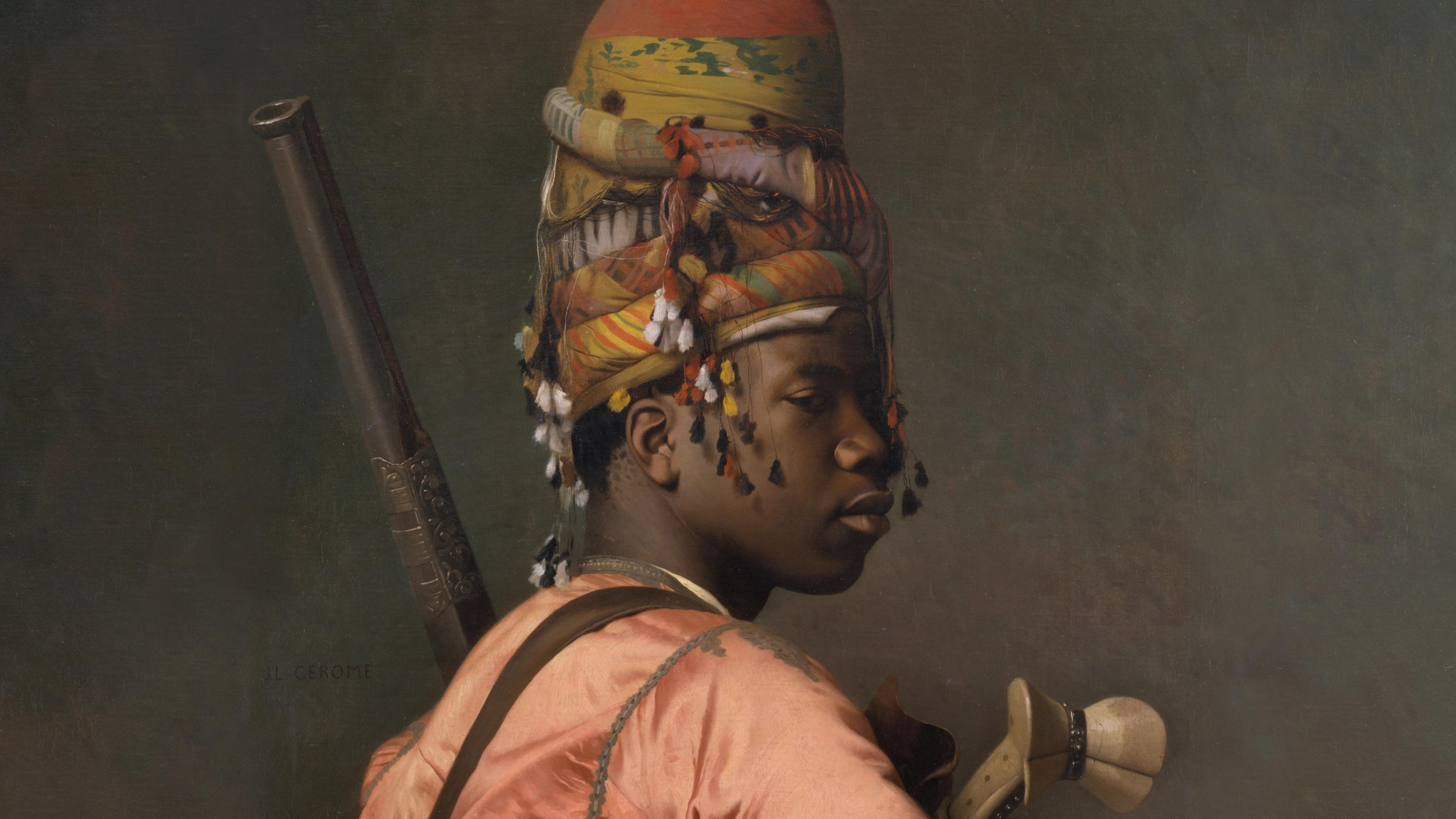
Exhibition co-curator Asher Miller, Eugene V. Thaw Curator of European Paintings, said: “One of the most interesting aspects of this exhibition will be the new light it sheds on Gérôme’s Bashi-Bazouk, the life-size painting of an Ottoman mercenary long favored by Met visitors, by presenting it alongside exceptional artworks that reveal untold stories about Orientalist portraits, likenesses, and types—and the fluid boundaries between those categories.”
Exhibition co-curator Maryam Ekhtiar, Patti Cadby Birch Curator of Islamic Art, said, “In the 19th century, Persian art and culture held a mesmerizing sway over the imaginations of Europeans and Americans, including writers, translators, poets, artists, craftsmen, architects, designers, and even composers, who regarded Persia (present-day Iran) as an unmatched wellspring of creativity and refinement, inspiring a vast body of literature, visual art, and music. Visitors to the exhibition will learn that this tendency was so pervasive that many designers and manufacturers marketed their creations as ‘Persian,’ regardless of where they were actually made.”
Exhibition co-curator Deniz Beyazit, Curator of Islamic Art, said: “A critical component of the exhibition is balancing Western perspectives with those from the Islamic world. One of the true discoveries for most visitors to the exhibition will be the section on Osman Hamdi Bey, one of the 19th century’s most intriguing and complex figures. For the first time, a significant group of his rarely seen paintings will be displayed alongside those by Gérôme and other painters who were his contemporaries. Such novel juxtaposition will reveal that, more than any artist of the 19th century, Hamdi represented modern cosmopolitan life in the Ottoman Empire from an insider’s perspective. His pictures offer an eye-opening response to the exoticized and stereotyped portrayals of ‘the East’ created by generations of European Orientalist painters.”
Orientalism: Between Fact and Fantasy will demonstrate how, during a period of profound transformation and modernization, Islamic works of art made their way to European dealers, collectors, international expositions, and museums, sparking a new design grammar in Europe and the broader Atlantic world. During the same period, artists such as Jean Auguste Dominique Ingres (1780–1867), Eugène Delacroix (1798–1863), John Frederick Lewis (1804–1876), Jean-Léon Gérôme (1824–1904), and John Singer Sargent (1856–1925) visited the lands and people across the Mediterranean or imagined them from afar. They sometimes depicted what they saw and at other times conjured distant places through memory and imagination, often using Islamic objects to stage paintings in their studios. The parameters of the exhibition expand beyond easel painting to focus on reformers such as architect Owen Jones (1809–1874) and leading designers Edward C. Moore (1827–1891) and Philippe-Joseph Brocard (1831–1896), who admired and experimented with motifs, designs, materials, forms, and techniques mastered in the Islamic world for centuries. The exhibition brings to light artistic dialogues across media, revealing that Europeans, Americans, Ottomans, and other Middle Easterners all contributed to framing an increasingly interconnected world.
Credits and Related Content
A fully illustrated catalogue will accompany the exhibition and be available for purchase from The Met Store.
The catalogue is made possible by the Janice H. Levin Fund.
Additional support is provided by the Diane W. and James E. Burke Fund and Eric Weider.
The Met will host a variety of exhibition-related educational and public programs to be announced at a later date.
The exhibition is featured on The Met website and social media.
##
May 13, 2026
Image Credit: Jean-Léon Gérôme, Bashi-Bazouk (detail), 1868–69. Oil on canvas. The Metropolitan Museum of Art, New York, Gift of Mrs. Charles Wrightsman, 2008
Met Exhibition to Explore 19th-Century Notions of “the East” in Art of the Mediterranean and Atlantic Worlds
Orientalism: Between Fact and Fantasy will illuminate artistic encounters and exchanges between distant regions and different cultures at a time of accelerated travel, rapid technological change, and shifting geopolitics.
Contact: Margaret-Anne Logan
Communications@metmuseum.org