Box
The containers were usually of such luxurious nature that they were the ultimate fashion accessories in eighteenth-century Europe and were frequently given as presents. Beginning in the 1720s and continuing up to the French Revolution, snuff boxes were produced in significant quantities.
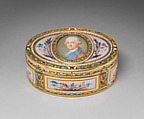
An unusually large number of boxes by Jean-Joseph Barrière have survived. Whereas most box makers tended to submerge individuality to the demands of fashion, Barrière’s style is remarkably homogenous, characterized by a distinct grace and careful balance between gold work and enameling.
Here, borders of translucent enamel green, yellow, brown and eggplant-colored insects frame panels of engine-turned decoration. The corners are defined by abstract designs which subtly create the effect of classical columns.
Within a few years, Parisian goldsmiths would use the engine-turned patterns as seen on this box as a ground for translucent enamel. (see, for example, 17.190.1163)
Daughter of one of the founders of the Weyerhaeuser Timber Company, Catherine D. Wentworth (1865–1948) was an art student and painter who lived in France for thirty years. She became one of the most important American collectors of eighteenth-century French silver and on her death in 1948 bequeathed part of her significant collection of silver, gold boxes, French furniture and textiles to the Metropolitan Museum.
Artwork Details
- Title: Box
- Maker: Jean-Joseph Barrière (French, apprenticed 1750, master 1763, active 1793)
- Date: 1765–66
- Culture: French, Paris
- Medium: Gold, enamel
- Dimensions: 1 1/2 x 3 x 1 7/16 in. (3.8 x 7.6 x 3.7cm)
- Classification: Metalwork-Gold and Platinum
- Credit Line: Bequest of Catherine D. Wentworth, 1948
- Object Number: 48.187.442
- Curatorial Department: European Sculpture and Decorative Arts
More Artwork
Research Resources
The Met provides unparalleled resources for research and welcomes an international community of students and scholars. The Met's Open Access API is where creators and researchers can connect to the The Met collection. Open Access data and public domain images are available for unrestricted commercial and noncommercial use without permission or fee.
To request images under copyright and other restrictions, please use this Image Request form.
Feedback
We continue to research and examine historical and cultural context for objects in The Met collection. If you have comments or questions about this object record, please contact us using the form below. The Museum looks forward to receiving your comments.
Content Notice
The Metropolitan Museum of Art presents over 5,000 years of art from around the world, and our online collection reflects ongoing work conducted over the course of our more than 150-year history. You may encounter objects or images that may be inappropriate for some viewers or information that may be outdated.