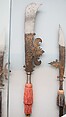
Glaive of Emperor Rudolf II (reigned 1576–1612)
This glaive is one of a number of identical weapons carried by the bodyguard of Hartschiere of Emperor Rudolf II (reigned 1576–1612) and documented as having been made in Augsburg by the cutler Oswald Salzhuber and etched by Hans Stromaier. A full-scale color-washed pen and ink drawing of one of these glaives, presumably made by Stromaier himself, is preserved in the Vienna Archives, and probably served as a presentation design sent to the emperor in Prague for his approval. Six of these glaives are preserved in the Vienna Waffensammlung, each of them etched with a number, the highest being 74; which indicates that at least seventy-four similar arms were made. The Metropolitan Museum's glaive is the twenty-fourth of the series.
In the same year, 1577, Hans Stromaier is also known to have etched 110 halberds for the Trabanten bodyguards of the emperor. The hapsburg court had two types of bodyguards: the Hartschiere (from French archiers, archers), who carried glaives, were noblemen; the Trabanten, who carried halberds, were commoners.
Artwork Details
- Title: Glaive of Emperor Rudolf II (reigned 1576–1612)
- Etcher: Hans Stromair (German, Augsburg, 1524 or 1525–ca. 1583)
- Date: dated 1577
- Geography: Augsburg
- Culture: German, Augsburg
- Medium: Steel, wood, textile, gold
- Dimensions: L. 100 1/2 in. (255.27 cm); blade L. 23 in. (58.42 cm)
- Classification: Shafted Weapons
- Credit Line: Gift of George D. Pratt, 1925
- Object Number: 25.188.18
- Curatorial Department: Arms and Armor
More Artwork
Related Content
 Free to download
Research Resources
The Met provides unparalleled resources for research and welcomes an international community of students and scholars. The Met's Open Access API is where creators and researchers can connect to the The Met collection. Open Access data and public domain images are available for unrestricted commercial and noncommercial use without permission or fee.
To request images under copyright and other restrictions, please use this Image Request form.
Feedback
We continue to research and examine historical and cultural context for objects in The Met collection. If you have comments or questions about this object record, please contact us using the form below. The Museum looks forward to receiving your comments.
Content Notice
The Metropolitan Museum of Art presents over 5,000 years of art from around the world, and our online collection reflects ongoing work conducted over the course of our more than 150-year history. You may encounter objects or images that may be inappropriate for some viewers or information that may be outdated.