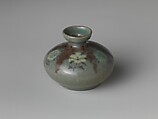
Glass aryballos (oil bottle)
Thick everted rim, folded over, in, and down, forming restriction to mouth; cylindrical neck; narrow horizontal shoulder; globular body; slightly concave bottom with small pontil mark off-center; two ring handles attached in a large, thick pad to top of body, across shoulder, and up neck. Two mold seams visible on sides of body.
The underside of the rim is decorated with radiating tooled indents; on body, thirteen rows of small hollow lozenges and a series of vertical raised lines, extending from bottom row of lozenges on undercurve.
Broken, with one third of rim and part of neck and one handle missing, cracks in body, and one deep chip in lower side; some bubbles and striations; dulling, faint iridescence, and slight soil encrustation on exterior, iridescent weathering on interior, which is largely filled with a loose ball of soil.
Artwork Details
- Title: Glass aryballos (oil bottle)
- Period: Late Imperial
- Date: 3rd century CE
- Culture: Roman
- Medium: Glass; blown in a two-part mold
- Dimensions: H.: 3 3/4 x 3 1/4 in. (9.5 x 8.3 cm)
- Classification: Glass
- Credit Line: Gift of J. Pierpont Morgan, 1917
- Object Number: 17.194.236
- Curatorial Department: Greek and Roman Art
More Artwork
Research Resources
The Met provides unparalleled resources for research and welcomes an international community of students and scholars. The Met's Open Access API is where creators and researchers can connect to the The Met collection. Open Access data and public domain images are available for unrestricted commercial and noncommercial use without permission or fee.
To request images under copyright and other restrictions, please use this Image Request form.
Feedback
We continue to research and examine historical and cultural context for objects in The Met collection. If you have comments or questions about this object record, please contact us using the form below. The Museum looks forward to receiving your comments.
Content Notice
The Metropolitan Museum of Art presents over 5,000 years of art from around the world, and our online collection reflects ongoing work conducted over the course of our more than 150-year history. You may encounter objects or images that may be inappropriate for some viewers or information that may be outdated.