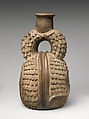
Bottle with leaf-nosed bat head
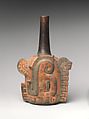
This piece is said to have been found at the archaeological site of Tembladera (1200–800 BCE) in the Jequetepeque Valley, where it was likely one of several prestigious objects placed in a grave. Typical features of the Tembladera style are the combination of motifs and modelled crests such as the three-dimensional and symmetrically placed ridges at the top of the figure’s head. Polychromed zones enclosed by incised lines are considered a defining characteristic of Tembladera ceramics (Burtenshaw-Zumstein 2014:102–103). On this vessel, traces of post-fire orange pigment can be found on the mouth, crests, back of the head, and outlining of the eyes. Tan and white pigment remain on the teeth and in incisions around the bottom of the vessel that border the base in a thick, undulating line. The orange color on a dark brownware surface creates the effect of the dark brown to orange fur typical of some bat sub-species.
To drain the contents contained within the vessel, the centrally placed spout demands the bottle be turned almost completely upside down. The inversion of the figure’s head may have been an intentional, playful reference to the bat’s ability to sleep and eat upside down. When inverted, the vessel reveals a burnished bottom that mimics the finish on the creature’s eyes. Although this object may be the earliest example of bat iconography in the museum’s ancient Andean collection, the subject matter is present in later traditions from this area, notably in the Moche culture of Peru’s north coast (such as 1987.394.47 and 1983.546.6).
Patricia A. Lagarde, Andrew W. Mellon Fellow, 2021
References and Further Reading
Benson, Elizabeth P. Birds and Beasts of Ancient Latin America. Gainesville: University Press of Florida, 1997.
Burger, Richard. Chavín and the Origins of Andean Civilization. London: Thames and Hudson, 1992.
Burtenshaw-Zumstein, Julia. “Cupisnique, Tembladera, Chongoyape, Chavín?: A Typology of Ceramic Styles from Formative Period Northern Peru, 1800-200 BC.” Ph.D. Dissertation, University of East Anglia, 2014.
Castillo, Luis Jamie and Cecilia Pardo (eds.). De Cupisnique a los Incas. El arte del valle de Jequetepeque. Lima: Asociación Museo de Arte de Lima, 2009.
Fux, Peter (ed.). Chavín: Peru’s Enigmatic Temple in the Andes. Zurich: Museum Rietberg; Scheidegger & Spiess, 2013.
Medina, César E., Alexander Pari, Hugo T. Zamora, and Darwin R. Díaz. “Muriciélagos del Perú,” https://fieldguides.fieldmuseum.org/sites/default/files/rapid-color-guides-pdfs/808_peru_murcielagos_de_peru.pdf. Arequipa: Colección Científica, Museo de Historia Natural, Universidad Nacional San Agustín, 2016.
Toshiara, Kayoko. “Cupisnique Iconography: Ideology and its Manifestations in an Ancient Andean Culture.” Journal of Latin American Lore 22(1) (2004), pp. 39-83.
Artwork Details
- Title: Bottle with leaf-nosed bat head
- Artist: Cupisnique artist(s)
- Date: 1200–800 BCE
- Geography: Peru, Tembladera
- Culture: Cupisnique
- Medium: Ceramic, post-fire paint (cinnabar)
- Dimensions: H. 8 1/2 x W. 5 7/8 x D. 6 5/8 in. (21.6 x 14.9 x 16.9 cm)
- Classification: Ceramics-Containers
- Credit Line: The Michael C. Rockefeller Memorial Collection, Purchase, Nelson A. Rockefeller Gift, 1968
- Object Number: 1978.412.210
- Curatorial Department: The Michael C. Rockefeller Wing
More Artwork
Research Resources
The Met provides unparalleled resources for research and welcomes an international community of students and scholars. The Met's Open Access API is where creators and researchers can connect to the The Met collection. Open Access data and public domain images are available for unrestricted commercial and noncommercial use without permission or fee.
To request images under copyright and other restrictions, please use this Image Request form.
Feedback
We continue to research and examine historical and cultural context for objects in The Met collection. If you have comments or questions about this object record, please contact us using the form below. The Museum looks forward to receiving your comments.
Content Notice
The Metropolitan Museum of Art presents over 5,000 years of art from around the world, and our online collection reflects ongoing work conducted over the course of our more than 150-year history. You may encounter objects or images that may be inappropriate for some viewers or information that may be outdated.