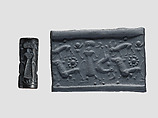
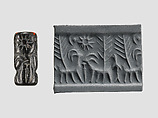
Cylinder seal and modern impression: demons and animals
The modern impression of the seal is shown so that the entire design can be seen. This seal shows an elaborate multifigured design. Two demonic lion-headed creatures, known as Minoan Genii, face one another. Holding vessels by the handle, they appear to stand on the backs of confronted lions, with heads of horned animals in the field. Above them, between a small leaping ibex and crossed lions, signs of the Cypro-Minoan script flank a central rosette over a winged sun disc. A second group is composed of two figures grasping a lion suspended between them, one by the tail and the other by the hind leg. One figure wears a knobbed cap and a belted flounced garment, while the other is a bull-headed demon. Approaching the scene is an upright human-headed lion. A head of a human and of a lion also appear.
Artwork Details
- Title: Cylinder seal and modern impression: demons and animals
- Period: Late Cypriot II
- Date: ca. 14th century BC
- Geography: Cyprus
- Medium: Hematite
- Dimensions: 2.8 cm, 1/2 in. (1 1/8 in., 1.3 cm)
- Credit Line: Purchase, Friends of Inanna Gifts, 2008
- Object Number: 2008.27
- Curatorial Department: Ancient West Asian Art
More Artwork
Related Content
 Free to download
Research Resources
The Met provides unparalleled resources for research and welcomes an international community of students and scholars. The Met's Open Access API is where creators and researchers can connect to the The Met collection. Open Access data and public domain images are available for unrestricted commercial and noncommercial use without permission or fee.
To request images under copyright and other restrictions, please use this Image Request form.
Feedback
We continue to research and examine historical and cultural context for objects in The Met collection. If you have comments or questions about this object record, please contact us using the form below. The Museum looks forward to receiving your comments.
Content Notice
The Metropolitan Museum of Art presents over 5,000 years of art from around the world, and our online collection reflects ongoing work conducted over the course of our more than 150-year history. You may encounter objects or images that may be inappropriate for some viewers or information that may be outdated.