The Express Train
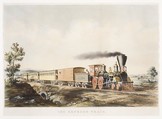
Starting in 1853, Nathaniel Currier (and later Currier & Ives) published thirty prints featuring trains for those Americans wanting pictures of the then-modern mode of transportation that provided a convenient way to travel and ship goods around the country. In this railroad scene by Charles Parsons, a locomotive (with a puff of black smoke trailing from its black smokestack) pulls a tender trimmed with red-and-gold ornamentation, a light brown cargo car and four yellow passenger cars as it heads from left to right across the image. The engineer, stoker and conductor (who stands between passenger and baggage cars) are clearly visible. In the far right distance, there is a town with a church steeple. For nineteenth-century viewers, this print showed how trains were transforming rural America.
Artwork Details
- Title: The Express Train
- Artist: Charles Parsons (American (born England), Hampshire 1821–1910 New York)
- Publisher: Lithographed and published by Currier & Ives (American, active New York, 1857–1907)
- Date: 1859
- Medium: Hand-colored lithograph
- Dimensions: Image: 17 3/4 × 26 5/8 in. (45.1 × 67.6 cm)
Image and text: 19 3/8 × 26 5/8 in. (49.2 × 67.6 cm)
Sheet: 22 9/16 × 30 7/8 in. (57.3 × 78.4 cm) - Classification: Prints
- Credit Line: Bequest of Adele S. Colgate, 1962
- Object Number: 63.550.62
- Curatorial Department: Drawings and Prints
More Artwork


Research Resources
The Met provides unparalleled resources for research and welcomes an international community of students and scholars. The Met's Open Access API is where creators and researchers can connect to the The Met collection. Open Access data and public domain images are available for unrestricted commercial and noncommercial use without permission or fee.
To request images under copyright and other restrictions, please use this Image Request form.
Feedback
We continue to research and examine historical and cultural context for objects in The Met collection. If you have comments or questions about this object record, please contact us using the form below. The Museum looks forward to receiving your comments.
Content Notice
The Metropolitan Museum of Art presents over 5,000 years of art from around the world, and our online collection reflects ongoing work conducted over the course of our more than 150-year history. You may encounter objects or images that may be inappropriate for some viewers or information that may be outdated.