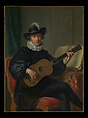
Lute Player
The greatest French follower of Caravaggio, Valentin was one of the most outstanding foreign artists working in seventeenth‑century Rome. He frequently depicted scenes of music‑making, drinking, and fortune‑telling in the characteristically direct, vivid manner seen here. This image of a young soldier singing a love madrigal is unique in Valentin’s career and is perhaps emblematic of the sobriquet he took in Rome: Amador, a Spanish word for "lover boy." In the 1650s, this painting was in the collection of Cardinal Mazarin, Louis XIV’s powerful chief minister.
Artwork Details
- Title: Lute Player
- Artist: Valentin de Boulogne (French, Coulommiers-en-Brie 1591–1632 Rome)
- Date: ca. 1625–26
- Medium: Oil on canvas
- Dimensions: 50 1/2 x 39 in. (128.3 x 99.1 cm)
- Classification: Paintings
- Credit Line: Purchase, Walter and Leonore Annenberg Acquisitions Endowment Fund; Director's Fund; Acquisitions Fund; James and Diane Burke and Mark Fisch and Rachel Davidson Gifts; Louis V. Bell, Harris Brisbane Dick, Fletcher, and Rogers Funds and Joseph Pulitzer Bequest, 2008
- Object Number: 2008.459
- Curatorial Department: European Paintings
Audio
5200. The Lute Player
More Artwork
Related Content
Research Resources
The Met provides unparalleled resources for research and welcomes an international community of students and scholars. The Met's Open Access API is where creators and researchers can connect to the The Met collection. Open Access data and public domain images are available for unrestricted commercial and noncommercial use without permission or fee.
To request images under copyright and other restrictions, please use this Image Request form.
Feedback
We continue to research and examine historical and cultural context for objects in The Met collection. If you have comments or questions about this object record, please contact us using the form below. The Museum looks forward to receiving your comments.
Content Notice
The Metropolitan Museum of Art presents over 5,000 years of art from around the world, and our online collection reflects ongoing work conducted over the course of our more than 150-year history. You may encounter objects or images that may be inappropriate for some viewers or information that may be outdated.