English
DonateMembershipTickets

Triumph of Bacchus

ca. 1890
On view at The Met Fifth Avenue in Gallery 556
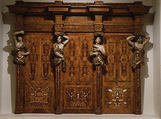
The central scene of this relief shows the Triumph of Bacchus. The wine god symbolizes the unrestrained life force that is also made manifest in the spiraling fruit and flowering branches. The presence of hounds, hare, and stag, refers to the hunt symbolizing a darker side of nature and death. Called the Donatello of wood-carvers, the Florentine Luigi Frullini was celebrated for his virtuoso Renaissance revival carvings that often combined naturalism and fantasy. A frequent participant in international exhibitions, the artist’s work was celebrated throughout Europe and the United States. Given the prominent place of Frullini’s signature, it is possible that this panel was exhibited at one of these expositions.

Artwork Details

Object Information
  • Title: Triumph of Bacchus
  • Maker: Luigi Frullini (Italian, 1839–1897)
  • Date: ca. 1890
  • Culture: Italian, Florence
  • Medium: Walnut
  • Dimensions: Framed (confirmed): 27 9/16 × 57 5/16 × 2 1/8 in. (70 × 145.6 × 5.4 cm)
  • Classification: Woodwork
  • Credit Line: Purchase, Friends of European Sculpture and Decorative Arts Gifts and funds from various donors, 2019
  • Object Number: 2019.205
  • Curatorial Department: European Sculpture and Decorative Arts
More Artwork
Baton, Wood, Italian, Tuscany
Italian, Tuscany
18th century
Pair of mirrored double doors, Lorenzo de Ferrari, Lindenwood, carved and gilded; mirrored glass panels, walnut, pine, Italian, Genoa
Designer Lorenzo de Ferrari
ca. 1743–44
Cabinet, Jean Brandely  French, Oak veneered with cedar, walnut, ebony and ivory; silvered-bronze mounts, French, Paris
Designer Designed by Jean Brandely
Woodwork by Charles-Guillaume Diehl
Mounts and large central plaque by Emmanuel Frémiet
1867
Shield (<i>Targone</i>), Wood, gesso, pigment, Italian, Pisa
Italian, Pisa
dated 1807
Choir stall panels, Johann Justus Schacht with collaborators, Panel: oak veneered with walnut, boxwod, rosewood, ebony, maple, and other woods, ivory, green-stained horn, and pewter; figures: carved and painted limewood, German, Mainz
Johann Justus Schacht
ca. 1723–26, figures 1787

Research Resources

The Met provides unparalleled resources for research and welcomes an international community of students and scholars. The Met's Open Access API is where creators and researchers can connect to the The Met collection. Open Access data and public domain images are available for unrestricted commercial and noncommercial use without permission or fee.

To request images under copyright and other restrictions, please use this Image Request form.

Feedback

We continue to research and examine historical and cultural context for objects in The Met collection. If you have comments or questions about this object record, please contact us using the form below. The Museum looks forward to receiving your comments.

Send feedback

Content Notice

The Metropolitan Museum of Art presents over 5,000 years of art from around the world, and our online collection reflects ongoing work conducted over the course of our more than 150-year history. You may encounter objects or images that may be inappropriate for some viewers or information that may be outdated.