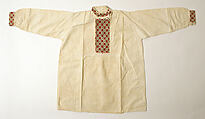
Blouse
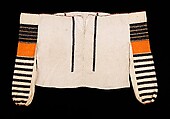
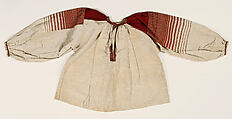
In its most basic form, the blouse is constructed from two pieces of cloth for the front and back of the bodice, gussets, and sleeves. [5] The garment was made with bleached natural fiber such as hemp, linen, or cotton and adorned with intricate wool, silk, and cotton embroidery, the colors of which were specific to the wearer’s geographical area, age, and social status. [6] Although black, dark blue, and yellow—along with the natural colors of the fibers—were colors often used for ornamentation, red is most closely associated with the blouse. Worn mostly by young women, it was believed to ward off evil. [7] The dyeing of the embroidery threads was itself a ritual event and one that recalled the prehistoric Cucuteni-Trypillia culture, in which the Bird Goddess presided over domestic arts such as spinning and weaving. [8]
Although the blouse is rooted in tradition, its popularity surged in the late nineteenth century during a time when mass-produced garments were becoming widely available. The queens of Romania played an important role in championing traditional garbs, most notably the country’s first queen Elisabeta of Wied. After receiving the blouse as a wedding present from her husband in 1869, she frequently wore Romanian folk costume in public and was often photographed in it. When their only child died at a young age, the blouse took on funerary and elegiac connotations as it became associated with the image of a grieving mother. [9]
Through its system of representation, the blouse maps out an entire cosmological worldview that places the wearer at the center of its universe. [10] Embroidery appears only on certain areas of the blouse following set schematics, and its geometric motifs draw on traditional symbols depicting nature and the celestial bodies. [11] The blouse is divided into three registers, each with its own ornamental motifs, structures, and proportions: altiță, embroidery on the shoulder; încrețul, smocking; and râurile, rivers. [12]
Within this system, the altiță occupies the most privileged position. Placed on the shoulders, it is the part of the blouse that is the closest to the heavens. [13] Several horizontal rows of geometric motifs combine harmoniously and rhythmically to form a rectangle. [14] The motifs on this register include the sun, shooting stars, birds, and variants of the "S" motif, which is a stylized solar symbol. Considered sacred, these motifs were not repeated in any other ornamental field of the blouse. [15] The word altiță also contains a second meaning that refers to the white mortuary cloth on the eaves of the house of the deceased, a practice especially observed in Bucovina. It was believed that the soul remained on the altiță for forty days, after which the cloth became the wings with which the soul ascended to the other world. [16]
Below the altiță on the sleeve lies the încrețul, an ornamental band about three times narrower than the altiță, whose motifs speak to the life on earth. [17] They include the diamond shape associated with fertility, and protective symbols against evil such as the evil eye, wolf’s fang, and rooster. On the chest flow the râurile, or rivers, a register concerned with life and abundance, whose motifs take the form of stylized plants and animals. [18]
Today, the tradition of the cămașa cu altiță is kept alive by members of the Sezătoarea Basarabiei, who make replicas of blouses preserved in museum collections. [19]
[Sojeong Lim 2026]
[1] Tatiana Bîzgu. "Teoria şi metodele de predare ale artei cămăşii tradiţionale cu altiţă/ The Theory and Methods of Teaching the Art of the Traditional Blouse with Altiţă" in Studiul artelor şi culturologie: istorie, teorie, practică. 2022, nr. 1(42), pp. 129-133.
[2] Simona Bortiş-Schultz. To Hold Your Heart in Your Teeth. Women’s Work: The Visual Language of the Romanian Blouse. Eindhoven: Set Margins’, 2023, p. 66.
[3] Varvara Buzilă. Retorică Vestimentară : Cămașa Cu Altiță : (Valorificând Colecțiile Muzeului Național de Etnografie Și Istorie Naturală Și Contextul Realităților Culturale)/ Rhetoric of Dress: The Blouse with Altiţă. Chişinau, Moldova: Lexon Prim, 2022, p. 19.
[4] UNESCO Intergovernmental Committee for the Safeguarding of the Intangible Cultural Heritage. "Decision 17.COM 7.B.23: The Art of the Traditional Blouse with Embroidery on the Shoulder (Altiță), an Element of Cultural Identity in Romania and the Republic of Moldova."
[5] Stela Draguțan. "Cămașa femeiască tradițională din patrimoniul Muzeului de Istorie și Etnografie al municipiului Bălți" in Bălți: Cultura promovării imaginii orașului. Chișinău, Moldova: 2023, pp. 160-164.
[6] Bîzgu, "Teoria şi metodele de predare ale artei cămăşii tradiţionale cu altiţă," p. 131.
[7] Bortiş-Schultz, To Hold Your Heart in Your Teeth, p. 72.
[8] Bîzgu, “Teoria şi metodele de predare ale artei cămăşii tradiţionale cu altiţă,” p. 131.
[9] Bortiş-Schultz, To Hold Your Heart in Your Teeth, p. 36.
[10] Buzilă, Rhetoric of Dress: The Blouse with Altiţă, p. 89.
[11] Paul Petrescu and Elena Secoşan. Romanian Folk Costume. Bucharest: Meridiane Publishing House, 1985, p. 77.
[12] Buzilă, Rhetoric of Dress: The Blouse with Altiţă, p. 73.
[13] Bortiş-Schultz, To Hold Your Heart in Your Teeth, p. 66.
[14] Buzilă, Rhetoric of Dress: The Blouse with Altiţă, p. 73.
[15] Bîzgu, “Teoria şi metodele de predare ale artei cămăşii tradiţionale cu altiţă,” pp. 130-131.
[16] Buzilă, Rhetoric of Dress: The Blouse with Altiţă, p. 89.
[17] Buzilă, Rhetoric of Dress: The Blouse with Altiţă, p. 83.
[18] Bortiş-Schultz, To Hold Your Heart in Your Teeth, p. 67.
[19] Bîzgu, “Teoria şi metodele de predare ale artei cămăşii tradiţionale cu altiţă,” p. 130.
Artwork Details
- Title: Blouse
- Date: early 19th century
- Culture: Romanian
- Medium: cotton
- Dimensions: Length: 21 1/2 x 69 in. (54.6 x 175.3 cm)
- Classification: Main dress
- Credit Line: Gift of Mrs. Morris Hawkes, 1923
- Object Number: 23.123.2
- Curatorial Department: European Sculpture and Decorative Arts
More Artwork
Research Resources
The Met provides unparalleled resources for research and welcomes an international community of students and scholars. The Met's Open Access API is where creators and researchers can connect to the The Met collection. Open Access data and public domain images are available for unrestricted commercial and noncommercial use without permission or fee.
To request images under copyright and other restrictions, please use this Image Request form.
Feedback
We continue to research and examine historical and cultural context for objects in The Met collection. If you have comments or questions about this object record, please contact us using the form below. The Museum looks forward to receiving your comments.
Content Notice
The Metropolitan Museum of Art presents over 5,000 years of art from around the world, and our online collection reflects ongoing work conducted over the course of our more than 150-year history. You may encounter objects or images that may be inappropriate for some viewers or information that may be outdated.