English
DonateMembershipTickets

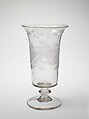
Vase

ca. 1550–1600 (modern foot)
Not on view
In 1468 the first Habsburg Holy Roman Emperor, Frederick III, deliberately dropped a glass vase presented to him by the Venetian government, implying that its humble materials were unworthy of him. Mere decades later, Northern royalty courted Venetian glassmakers as they set up workshops in London, Kassel, and the Tyrol. Threatening Venice’s monopoly and divulging professional secrets, the Italian glassmakers faced exile from their homeland. The rich blue hue of this vase, probably made by Venetians supported by Ferdinand II, Archduke of Austria, was achieved by adding cobalt to the mix; the finely engraved surface decoration was originally picked out in gold-infused paint.

[Elizabeth Cleland, 2017]

Artwork Details

Object Information
  • Title: Vase
  • Date: ca. 1550–1600 (modern foot)
  • Culture: Austrian, Hall
  • Medium: Glass, engraved
  • Dimensions: Height: 9 in. (22.9 cm)
  • Classification: Glass
  • Credit Line: Edward C. Moore Collection, Bequest of Edward C. Moore, 1891
  • Object Number: 91.1.1462
  • Curatorial Department: European Sculpture and Decorative Arts
More Artwork
Shield (Pavise), Wood, leather, gesso, polychromy, Austrian
Austrian
1450–1500
Celery vase, Benjamin Bakewell & Co. or, Blown-molded and engraved glass, American
Possibly Benjamin Bakewell & Co.
Bakewell, Page & Bakewell
1810–20
Cranequin from the Armory of Emperor Maximilan I (reigned 1493/1508–19), Steel, wood (fruitwood, possibly pear), copper alloy, Western or Central European, the Netherlands or Austria
Western or Central European, the Netherlands or Austria
ca. 1505–19
Celery vase, Benjamin Bakewell & Co. or, Blown and engraved glass, American
Benjamin Bakewell & Co.
Bakewell, Page & Bakewell
1810–25
Halberd, Steel, wood (ash), brass, iron, Austrian
Austrian
1580–1600

Research Resources

The Met provides unparalleled resources for research and welcomes an international community of students and scholars. The Met's Open Access API is where creators and researchers can connect to the The Met collection. Open Access data and public domain images are available for unrestricted commercial and noncommercial use without permission or fee.

To request images under copyright and other restrictions, please use this Image Request form.

Feedback

We continue to research and examine historical and cultural context for objects in The Met collection. If you have comments or questions about this object record, please contact us using the form below. The Museum looks forward to receiving your comments.

Send feedback

Content Notice

The Metropolitan Museum of Art presents over 5,000 years of art from around the world, and our online collection reflects ongoing work conducted over the course of our more than 150-year history. You may encounter objects or images that may be inappropriate for some viewers or information that may be outdated.