Tankard
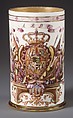
The lotus leaves and flowers on the Museum’s tankard are rendered in the conventional Chinese manner, but here they are populated with chinoiserie figures and snails that have been given equal compositional weight. One of the figures balances on a lotus leaf stem as he fans a seated figure sitting on a bended stem. One of the snails is perched on a leaf; a second snail is ridden by a child. Three additional figures occupy the fantasy landscape dominated by the oversize lotus plants, and all the figures are painted in a manner traditionally described as that associated with the Meissen painter Johann Ehrenfried Stadler (German, 1701–1741). It is not possible to attribute the decoration to a specific painter, but the chinoiserie figures are very much in the style promulgated by Johann Gregorius Horoldt (German, 1696–1775) (see 54.147.75, .76) The tankard’s painting, especially that of the faces and costumes, is of the highest quality, and the richly detailed aquatic landscape is depicted with a level of skill and with a diversity of palette that marks this object as one of the factory’s exceptional works.
The complexity of the composition is particularly evident when the tankard is compared to other Meissen porcelains decorated with lotus plants in the famille verte tradition. The closest comparisons are offered by a vase in the Schneider Collection at Schloss Lustheim near Munich,[5] a tankard in Berlin,[6] and a waste bowl (for used tea leaves) in the Arnhold Collection, New York,[7] all of which follow the Chinese model closely, with few compositional deviations from the famille verte prototypes. A beaker vase with lotus decoration in Berlin includes two chinoiserie figures,[8] yet they are subsidiary to the plant motifs, and hence the vase’s painted composition does not reflect the innovative balance of Chinese-inspired decoration and Horoldt chinoiseries that distinguish the Museum’s tankard.
The tankard is remarkable as well for the two continuous borders painted at the base and below the rim. The border at the top is not only unusually large in scale but also particularly complex in its design and palette, incorporating polychrome four-petaled flowers within a lozenge pattern, with C-scrolls and foliate motifs along the lower edge of the border. Both borders are partially painted in cobalt blue that was applied under the glaze, which indicates that the design of the borders had to have been determined before the glaze and enamel firings. The interplay between the underglaze blue and the gilding is especially elaborate, suggesting that the tankard was intended from the outset to be a particularly ambitious work.[9] This supposition is reinforced by the tankard’s size, which is one of the largest produced by the factory.
The silver-gilt lid and thumb piece are almost certainly original to the tankard, and while mounts such as these are often regilded, the gilding here appears to be original as well. Interestingly, the three-leafed motif of the thumb piece echoes a similar motif found in the decorative painted band at the top of the tankard’s body. While the mark stamped on the cover indicates that it was made in Dresden, the scrolling designs of the engraved decoration reflect the influence of Augsburg goldsmiths whose work set the standards for German metalwork during this period. The cover incorporates in the center a medal depicting the Marriage of Cana, which raises the possibility that the tankard was intended to be presented as a gift to celebrate a wedding.
Footnotes
(For key to shortened references see bibliography in Munger, European Porcelain in the Metropolitan Museum of Art. NY: The Metropolitan Museum of Art, 2018)
1 For the most comprehensive survey of famille verte porcelains, see Jorg 2011.
2 Ibid., p. 9.
3 For example, see Chinese Porcelain 1986, p. 98, no. 117; Strober 2001, p. 72, no. 29; Jorg 2011, pp. 53, 62, 64, nos. 48, 63, 65.
4 Jorg 2011, p. 62, no. 63.
5 Weber 2013, vol. 2, pp. 336–38, no. 322.
6 Bursche 1980, p. 218, no. 204.
7 Cassidy-Geiger 2008, p. 395, no. 155b.
8 Bursche 1980, p. 219, no. 206.
9 Another tankard with unusually prominent borders in underglaze blue with gilding is in the Pauls Collection; Meister 1967, vol. 1, pp. 96–97.
Artwork Details
- Title: Tankard
- Manufactory: Meissen Manufactory (German, 1710–present)
- Decorator: Painted decoration in the style of Johann Ehrenfried Stadler (German, Dresden 1701–41)
- Date: ca. 1725–30
- Culture: German, Meissen
- Medium: Hard-paste porcelain decorated in polychrome enamels, gold; silver-gilt mounts
- Dimensions: Overall (confirmed): 8 7/8 x 7 5/16 x 6 3/16 in. (22.5 x 18.6 x 15.7 cm); Height (without cover): 7 5/8 in. (19.4 cm)
- Classification: Ceramics-Porcelain
- Credit Line: Gift of R. Thornton Wilson, in memory of Florence Ellsworth Wilson, 1954
- Object Number: 54.147.81
- Curatorial Department: European Sculpture and Decorative Arts
More Artwork
Related Content
 Free to download
Research Resources
The Met provides unparalleled resources for research and welcomes an international community of students and scholars. The Met's Open Access API is where creators and researchers can connect to the The Met collection. Open Access data and public domain images are available for unrestricted commercial and noncommercial use without permission or fee.
To request images under copyright and other restrictions, please use this Image Request form.
Feedback
We continue to research and examine historical and cultural context for objects in The Met collection. If you have comments or questions about this object record, please contact us using the form below. The Museum looks forward to receiving your comments.
Content Notice
The Metropolitan Museum of Art presents over 5,000 years of art from around the world, and our online collection reflects ongoing work conducted over the course of our more than 150-year history. You may encounter objects or images that may be inappropriate for some viewers or information that may be outdated.