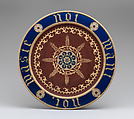
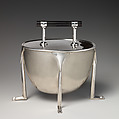
Bread plate
Augustus Welby Northmore Pugin (1812–1852) was the first architect/designer to link a specific style to morals, godliness, and social values. He believed that manufacturers should be truthful in their use of materials; that wood should look like wood instead of being painted to look like marble. This tenet of truth to materials was the crux of the Arts and Crafts movement. Pugin also believed that deceptive construction was inherent to the classical style, whereas honest construction was in accord with the Gothic. Pugin, with the architect Charles Barry, received the commission to rebuild the Houses of Parliament in the Gothic style following a fire in 1834. He designed the interior decoration in the same style, sparking the Gothic Revival in England. Pugin also designed domestic and ecclesiastical objects in ceramic, precious metals, and wood, all in the Gothic style.
Artwork Details
- Title: Bread plate
- Artist: Augustus Welby Northmore Pugin (British, London 1812–1852 Ramsgate)
- Factory: Minton(s) (British, Stoke-on-Trent, 1793–present)
- Date: ca. 1850
- Culture: British, Stoke-on-Trent, Staffordshire
- Medium: Earthenware, made using the encaustic process
- Dimensions: Overall (wt. includes wall mount): 13 1/8 in., 4.7 lb. (33.3 cm, 2.1092 kg)
- Classification: Ceramics-Pottery
- Credit Line: Purchase, Cynthia Hazen Polsky Gift, 1994
- Object Number: 1994.371
- Curatorial Department: European Sculpture and Decorative Arts
More Artwork
Research Resources
The Met provides unparalleled resources for research and welcomes an international community of students and scholars. The Met's Open Access API is where creators and researchers can connect to the The Met collection. Open Access data and public domain images are available for unrestricted commercial and noncommercial use without permission or fee.
To request images under copyright and other restrictions, please use this Image Request form.
Feedback
We continue to research and examine historical and cultural context for objects in The Met collection. If you have comments or questions about this object record, please contact us using the form below. The Museum looks forward to receiving your comments.
Content Notice
The Metropolitan Museum of Art presents over 5,000 years of art from around the world, and our online collection reflects ongoing work conducted over the course of our more than 150-year history. You may encounter objects or images that may be inappropriate for some viewers or information that may be outdated.