Shield in the Classical Style
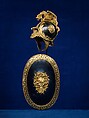
The bronze helmet bowl and shield were silvered and patinated to look like blued steel. Finely crafted ormolu (gilt bronze) mounts were cast separately and attached individually to them. The mounts are equal in quality to the best ormolu furniture mounts made in Paris around 1760, when Neoclassical design was superseding Rococo. Rather than the work of an armorer, this helmet and shield were probably designed by an artist and made by a craftsman or workshop that produced furniture mounts and other decorative bronze objects.
By the eighteenth century, the purpose of armor was chiefly symbolic. Armor based on Classical prototypes invoked the heroic qualities of ancient Greece and Rome. Representations of such armor were widely used in painting, the decorative arts, and the theater.
Artwork Details
- Title: Shield in the Classical Style
- Date: probably ca. 1760–70
- Geography: Paris
- Culture: French, Paris
- Medium: Bronze, silver, gold, silk, metallic yarn
- Dimensions: H. 23 1/8 in. (58.7 cm); W. 15 1/4 in. (38.7 cm); Wt. 13 lb. 11 oz. (6209 g)
- Classification: Shields
- Credit Line: Rogers Fund, 1904
- Object Number: 04.3.260
- Curatorial Department: Arms and Armor
More Artwork
Research Resources
The Met provides unparalleled resources for research and welcomes an international community of students and scholars. The Met's Open Access API is where creators and researchers can connect to the The Met collection. Open Access data and public domain images are available for unrestricted commercial and noncommercial use without permission or fee.
To request images under copyright and other restrictions, please use this Image Request form.
Feedback
We continue to research and examine historical and cultural context for objects in The Met collection. If you have comments or questions about this object record, please contact us using the form below. The Museum looks forward to receiving your comments.
Content Notice
The Metropolitan Museum of Art presents over 5,000 years of art from around the world, and our online collection reflects ongoing work conducted over the course of our more than 150-year history. You may encounter objects or images that may be inappropriate for some viewers or information that may be outdated.