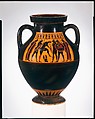
Lekythos con mujeres tejiendo lana y una mujer flanqueada por jóvenes y doncellas
Artwork Details
- Título: Lekythos con mujeres tejiendo lana y una mujer flanqueada por jóvenes y doncellas
- Artista: Atribuido al pintor Amasis
- Fecha: ca. 550–530 a. C.
- Geografía: Grecia, Ática
- Material: Terracota
- Dimensiones: a. 17,1 cm
- Crédito: Fondo Fletcher, 1931
- Número de inventario: 31.11.10
- Curatorial Department: Greek and Roman Art
Audio
1015. Terracotta lekythos (oil flask)
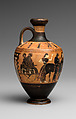
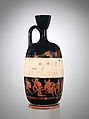
These two small flasks are lekythoi, containers for olive oil. The same artist, the Amasis Painter, decorated both, as well as other ceramic vessels in this case.
The piece on the right shows a wedding procession. The bride sits in a chariot drawn by a donkey. She holds a wreath and pulls her veil forward in a gesture associated with marriage in Greek art. Her bridegroom sits next to her, holding the reins. He has a beard and must be past his first youth. The bride is probably much younger than he is, as was common in ancient Athens.
The procession has almost reached its destination, a brightly painted doorway flanked with columns just under the handle of the vase. This is the bridegroom’s house, the place where the newlyweds are going to live. The bridegroom’s mother is coming out to welcome them, carrying a torch, for Greek wedding processions happened at night.
The wedding was the defining moment in an Athenian girl’s life. The other lekythos shows her most constant occupation, the making of textiles for her family’s use. Here, some women are spinning wool on hand-held spindles. Two shorter figures are working a loom, which textile historians have used to reconstruct Greek weaving techniques.
In ancient Athens, a good weaver was considered an attractive woman and also a good wife. This lekythos seems to link weaving with becoming a wife. Just above the loom on the shoulder of the vessel, you see a seated woman holding out her veil, just like the bride on the other lekythos. The pair of lekythoi might have been a wedding present for an Athenian bride in the sixth century B.C.
More Artwork
Related Content
 Free to download
Research Resources
The Met provides unparalleled resources for research and welcomes an international community of students and scholars. The Met's Open Access API is where creators and researchers can connect to the The Met collection. Open Access data and public domain images are available for unrestricted commercial and noncommercial use without permission or fee.
To request images under copyright and other restrictions, please use this Image Request form.
Feedback
We continue to research and examine historical and cultural context for objects in The Met collection. If you have comments or questions about this object record, please contact us using the form below. The Museum looks forward to receiving your comments.
Content Notice
The Metropolitan Museum of Art presents over 5,000 years of art from around the world, and our online collection reflects ongoing work conducted over the course of our more than 150-year history. You may encounter objects or images that may be inappropriate for some viewers or information that may be outdated.