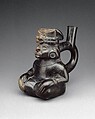
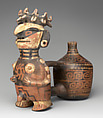
Stirrup Spout Bottle with Seated Figure
The stirrup-spout vessel—the shape of the spout recalls the stirrup on a horse's saddle—was a much favored form on Peru's northern coast for about 2,500 years. Although the importance and symbolism of this distinctive shape is still puzzling to scholars, the double-branch/single-spout configuration may have prevented evaporation of liquids, and/or that it provided a convenient handle. The double-branch may have also held symbolic importance, reflecting a belief in the importance of tinku, a Quechua term for convergence, such as the confluence of two rivers. Early in the first millennium A.D., the Moche elaborated stirrup-spout bottles into sculptural shapes depicting a wide range of subjects, including human figures, animals, and plants worked with a great deal of naturalism. About 500 years later, bottle chambers became predominantly globular, providing large surfaces for painting complex, often multi-figure scenes.
The Moche (also known as the Mochicas) flourished on Peru’s North Coast from 200–850 A.D., centuries before the rise of the Incas. Over the course of some six centuries, the Moche built thriving regional centers from the Nepeña River Valley in the south to perhaps as far north as the Piura River, near the modern border with Ecuador, developing coastal deserts into rich farmlands and drawing upon the abundant maritime resources of the Pacific Ocean’s Humboldt Current. Although the precise nature of Moche political organization is a subject of debate, these centers shared unifying cultural traits such as religious practices (Donnan, 2010).
Published references
Wassermann-San Blás, Bruno John. Céramicas del antiguo Perú de la colección Wassermann-San Blás (Buenos Aires: Bruno John Wassermann-San Blás, 1938), p. 219. no. 386.
Sawyer, Alan. Ancient Peruvian Ceramics: The Nathan Cummings Collection (New York: The Metropolitan Museum of Art, 1966), p. 26. no. 23.
References and additional reading
Donnan, Christopher B. “Moche State Religion,” in New Perspectives on Moche Political Organization, edited by Jeffrey Quilter and Luis Jaime Castillo (Washington D.C.: Dumbarton Oaks Research Library and Collection, 2010), pp. 47-69.
Donnan, Christopher B. and Donna McClelland. Moche Fineline Painting: Its Evolution and Its Artists (Los Angeles: University of California, Los Angeles; Fowler Museum of Cultural History, 1999).
Donnan, Christopher B., and Sharon G. Donnan, “Moche Textiles from Pacatnamu,” in The Pacatnamu Papers, vol. 2, The Moche Occupation, edited by Christopher B. Donnan and Guillermo A. Cock (Los Angeles: The Fowler Museum of Cultural History, University of California, Los Angeles), pp. 215-242.
Golte, Jürgen. Moche cosmología y sociedad (Lima and Cusco: Instituto de Estudios Peruanos-Centro Bartolomé de Las Casas, 2009).
Mujica Barreda, Elías, et al., El Brujo: Huaca Cao, Centro Ceremonial Moche en el Valle de Chicama (Lima: Fundación Wiese, 2007).
Pillsbury, Joanne. “Inka Unku: Strategy and Design in Colonial Peru,” Cleveland Studies in the History of Art 7 (2002):68-103.
Pillsbury, Joanne, Timothy Potts, and Kim N. Richter, editors. Golden Kingdoms: Luxury Arts in the Ancient Americas (Los Angeles: J. Paul Getty Museum, 2017).
Artwork Details
- Title: Stirrup Spout Bottle with Seated Figure
- Date: 200–600 CE
- Geography: Peru
- Culture: Moche
- Medium: Ceramic, slip
- Dimensions: H. 7 1/4 × W. 4 3/4 in. (18.4 × 12.1 cm)
- Classification: Ceramics-Containers
- Credit Line: Gift of Mr. and Mrs. Nathan Cummings, 1964
- Object Number: 64.228.34
- Curatorial Department: The Michael C. Rockefeller Wing
More Artwork
Related Content
 Free to download
Research Resources
The Met provides unparalleled resources for research and welcomes an international community of students and scholars. The Met's Open Access API is where creators and researchers can connect to the The Met collection. Open Access data and public domain images are available for unrestricted commercial and noncommercial use without permission or fee.
To request images under copyright and other restrictions, please use this Image Request form.
Feedback
We continue to research and examine historical and cultural context for objects in The Met collection. If you have comments or questions about this object record, please contact us using the form below. The Museum looks forward to receiving your comments.
Content Notice
The Metropolitan Museum of Art presents over 5,000 years of art from around the world, and our online collection reflects ongoing work conducted over the course of our more than 150-year history. You may encounter objects or images that may be inappropriate for some viewers or information that may be outdated.