Prestige vessel
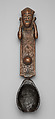
One way in which Kuba titleholders displayed their wealth and generosity was through the distribution of large quantities of palm wine to their friends and associates. At the court, drinking vessels were a vital accessory of great symbolic value. This ornately carved wooden cup combines human and animal forms to communicate ideals of refinement and power. Its elegant facial features are well formed and symmetrically arranged, while the mouth is small and closed, reflecting the belief that careful thought should always precede speech. The cup also depicts the Kuba aesthetic practice of shaving the hairline to frame and offset the forehead, considered the seat of wisdom and insight, and draw attention to the raised cicatrizes on the temples, another sign of cultural refinement. Large, curving horns are juxtaposed with these anthropomorphic elements. They evoke the ram, a dominant, aggressive animal that does not tolerate rivals. In the competitive atmosphere of Kuba political life, a man who embodied the dual qualities of cultivation and ambition could expect to attain impressive titles and awards.
Artwork Details
- Title: Prestige vessel
- Artist: Kuba artist
- Date: 19th–first half of 20th century
- Geography: Democratic Republic of the Congo, Sankuru River region
- Culture: Kuba peoples
- Medium: Wood
- Dimensions: H. 9 3/8 × W. 5 3/8 × D. 5 1/8 in. (23.8 × 13.6 × 13 cm)
- Classification: Wood-Containers
- Credit Line: The Michael C. Rockefeller Memorial Collection, Purchase, Nelson A. Rockefeller Gift, 1967
- Object Number: 1978.412.541
- Curatorial Department: The Michael C. Rockefeller Wing
More Artwork

Related Content
Research Resources
The Met provides unparalleled resources for research and welcomes an international community of students and scholars. The Met's Open Access API is where creators and researchers can connect to the The Met collection. Open Access data and public domain images are available for unrestricted commercial and noncommercial use without permission or fee.
To request images under copyright and other restrictions, please use this Image Request form.
Feedback
We continue to research and examine historical and cultural context for objects in The Met collection. If you have comments or questions about this object record, please contact us using the form below. The Museum looks forward to receiving your comments.
Content Notice
The Metropolitan Museum of Art presents over 5,000 years of art from around the world, and our online collection reflects ongoing work conducted over the course of our more than 150-year history. You may encounter objects or images that may be inappropriate for some viewers or information that may be outdated.