English
DonateMembershipTickets

Prestige Stool: Figures

15th–19th century
Not on view
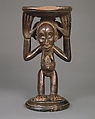
Elaborate ceremonial stools of this kind were owned by the hogon, the supreme religious and political leader in each Dogon community. The design and elaboration of such works draw inspiration from Dogon cosmology. It has been proposed that the very structure of the dual disks of the seat and base may echo the arrangement of heaven and earth. Some sources have identified the four figurative supports as protagonists from the Dogon account of Creation. According to this reading of the imagery, the following characters are visually evoked: a set of twins, direct descendants of Nommo, the first living being; a crocodile, Nommo’s saurian messenger; and two figures framed by two snakes that recall the origins of mortality.

Artwork Details

Object Information
  • Title: Prestige Stool: Figures
  • Date: 15th–19th century
  • Geography: Mali
  • Culture: Dogon or Tellem peoples (?)
  • Medium: Wood, sacrificial patina
  • Dimensions: H. 15 3/16 × Diam. 14 in. (38.6 × 35.6 cm)
  • Classification: Wood-Furniture
  • Credit Line: The Michael C. Rockefeller Memorial Collection, Bequest of Nelson A. Rockefeller, 1979
  • Object Number: 1979.206.110
  • Curatorial Department: The Michael C. Rockefeller Wing
More Artwork
Suruku koun (hyena) mask, Malinke numu (blacksmith), Wood, Malinke peoples
Malinke numu (blacksmith)
19th–mid-20th century
Lupona (royal seat), Ngongo ya Chintu, formerly known as the "Buli Master"  Democratic Republic of Congo, Wood, metal studs, Luba or Hemba peoples
Ngongo ya Chintu, formerly known as the "Buli Master"
ca. 1840–1870
Kneeling female figure with three children, Tellem or Dogon blacksmith, Wood, applied organic materials, Dogon or Tellem  peoples (?)
Tellem or Dogon blacksmith
15th–19th century
Folding stool, Oak decorated with marquetry including walnut, bog oak, maple, green-stained poplar, and other woods, Northern German or Polish
Northern German or Polish
early 17th century
Staff with seated male leader, Dogon or Bozo blacksmith, Copper alloy, iron, Dogon or Bozo
Dogon or Bozo blacksmith
16th–17th century

Research Resources

The Met provides unparalleled resources for research and welcomes an international community of students and scholars. The Met's Open Access API is where creators and researchers can connect to the The Met collection. Open Access data and public domain images are available for unrestricted commercial and noncommercial use without permission or fee.

To request images under copyright and other restrictions, please use this Image Request form.

Feedback

We continue to research and examine historical and cultural context for objects in The Met collection. If you have comments or questions about this object record, please contact us using the form below. The Museum looks forward to receiving your comments.

Send feedback

Content Notice

The Metropolitan Museum of Art presents over 5,000 years of art from around the world, and our online collection reflects ongoing work conducted over the course of our more than 150-year history. You may encounter objects or images that may be inappropriate for some viewers or information that may be outdated.