Shepherd with His Flock in a Clearing
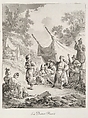
This drawing also demonstrates a particularly sophisticated use of tone, which spans from the most delicate and diaphanous shade of ink in the trees receding into the distance to the saturated shadows in the bottom right. In a particularly dramatic passage, Le Prince captures the humid, lush foliage with a heavily applied ink that seems still liquid in the eddies of the stream beneath the reeds. Le Prince’s sophisticated approach to brown wash in this drawing arguably reflects his work in aquatint, a tonal intaglio print technique, for which he developed a unique approach in 1768 (2). In aquatints such as The Washerwomen (2010.543) from 1771, Le Prince translates complex scenes into a sequence of tones, an artistic practice which encouraged a heightened awareness of how tone structures a composition. After working in aquatint for eight years, this drawing reflects his practiced adeptness at wielding subtle variations in tone to produce a sense of light and space.
(1) Charlotte Guichard, "Les ‘livres à dessiner’ à l’usage des amateurs à Paris au XVIIIe siècle," Revue de l’Art 143, no. 1 (2004): 49-58.
(2) Antony Griffiths, "Notes on Early Aquatint in England and France," Print Quarterly 4, no. 3 (1987): 255-270; and Rena Hoisington, "Etching as a Vehicle for Innovation: Four Exceptional Peintres-Gravures," in Arts and Amateurs, Etching in Eighteenth-Century France, ed. Perrin Stein (New York: Metropolitan Museum of Art, 2014), 68-101.
(Thea Goldring, May 2021)
Artwork Details
- Title: Shepherd with His Flock in a Clearing
- Artist: Jean-Baptiste Le Prince (French, Metz 1734–1781 Saint-Denis-du-Port)
- Date: 1776
- Medium: Brush and brown wash, over black chalk; framing lines in pen and brown ink
- Dimensions: 10 9/16 x 13 5/16 in. (26.8 x 33.8 cm)
- Classification: Drawings
- Credit Line: Rogers Fund, 1961
- Object Number: 61.164
- Curatorial Department: Drawings and Prints
More Artwork

Related Content
 Free to download
Research Resources
The Met provides unparalleled resources for research and welcomes an international community of students and scholars. The Met's Open Access API is where creators and researchers can connect to the The Met collection. Open Access data and public domain images are available for unrestricted commercial and noncommercial use without permission or fee.
To request images under copyright and other restrictions, please use this Image Request form.
Feedback
We continue to research and examine historical and cultural context for objects in The Met collection. If you have comments or questions about this object record, please contact us using the form below. The Museum looks forward to receiving your comments.
Content Notice
The Metropolitan Museum of Art presents over 5,000 years of art from around the world, and our online collection reflects ongoing work conducted over the course of our more than 150-year history. You may encounter objects or images that may be inappropriate for some viewers or information that may be outdated.