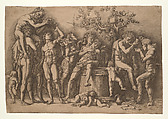
Mars and Venus
Goltzius was first introduced to Spranger’s works in 1583, and by 1588, the date of this engraving, had fully absorbed his style, not only in the extravagant poses and exaggerated musculature, but in his very handling of the print medium. Goltzius uses the diamond-shaped head of the burin (the engraver’s tool) to create lines that swell and taper, curving around and defining the figures. In some places, they seem to take on a life of their own, as in the patterning on Cupid’s thighs and buttocks. Goltzius sets the pale bodies of the lovers against the dark, tented background of their bed so they shine out at us. The overall effect is of a glittering display of light and shade that flickers across the surface of the print.
Artwork Details
- Title: Mars and Venus
- Artist: Hendrick Goltzius (Netherlandish, Mühlbracht 1558–1617 Haarlem)
- Artist: After Bartholomeus Spranger (Netherlandish, Antwerp 1546–1611 Prague)
- Date: 1588
- Medium: Engraving
- Dimensions: Sheet: 17 1/8 × 12 7/8 in. (43.5 × 32.7 cm)
- Classification: Prints
- Credit Line: The Elisha Whittelsey Collection, The Elisha Whittelsey Fund, 1949
- Object Number: 49.97.681
- Curatorial Department: Drawings and Prints
More Artwork
Related Content

Research Resources
The Met provides unparalleled resources for research and welcomes an international community of students and scholars. The Met's Open Access API is where creators and researchers can connect to the The Met collection. Open Access data and public domain images are available for unrestricted commercial and noncommercial use without permission or fee.
To request images under copyright and other restrictions, please use this Image Request form.
Feedback
We continue to research and examine historical and cultural context for objects in The Met collection. If you have comments or questions about this object record, please contact us using the form below. The Museum looks forward to receiving your comments.
Content Notice
The Metropolitan Museum of Art presents over 5,000 years of art from around the world, and our online collection reflects ongoing work conducted over the course of our more than 150-year history. You may encounter objects or images that may be inappropriate for some viewers or information that may be outdated.