La scène des deux carrosses
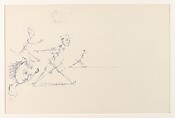
The irreverence of the commedia dell'arte provided many of Gillot's most memorable subjects. This drawing relates to his best-known painting, Les deux carrosses (Musée du Louvre, Paris). It was directly inspired by a short sketch appended to a three-act comedy, Foire Saint Germain, which was first performed in 1695. An altercation breaks out between two cabmen and their passengers (commedia dell'arte characters Arlequin and Scaramouche, both dressed in women's clothing) when the carriages meet in a narrow alley and each refuses to back up and let the other pass. The sketch concludes when a passing judge attempts to mediate the conflict but instead becomes the focus of the collective ire and is chased offstage.
Artwork Details
- Title: La scène des deux carrosses
- Artist: Claude Gillot (French, Langres 1673–1722 Paris)
- Date: ca. 1712–16
- Medium: Pen and black ink, brush and red wash
- Dimensions: Sheet: 6 1/4 x 8 3/8 in. (15.9 x 21.3 cm)
- Classification: Drawings
- Credit Line: Purchase, David T. Schiff and Oscar de la Renta Ltd. Gifts, 2006
- Object Number: 2006.93
- Curatorial Department: Drawings and Prints
More Artwork

Related Content
 Free to download
Research Resources
The Met provides unparalleled resources for research and welcomes an international community of students and scholars. The Met's Open Access API is where creators and researchers can connect to the The Met collection. Open Access data and public domain images are available for unrestricted commercial and noncommercial use without permission or fee.
To request images under copyright and other restrictions, please use this Image Request form.
Feedback
We continue to research and examine historical and cultural context for objects in The Met collection. If you have comments or questions about this object record, please contact us using the form below. The Museum looks forward to receiving your comments.
Content Notice
The Metropolitan Museum of Art presents over 5,000 years of art from around the world, and our online collection reflects ongoing work conducted over the course of our more than 150-year history. You may encounter objects or images that may be inappropriate for some viewers or information that may be outdated.