Anthropomorphic Lime Container
It is not known precisely when the practice of chewing betel began. An intriguing early reference, however, is found in the Chinese Shiji (Historical Records) written by Sima Qian during the first century B.C. Chapter 116 of this monumental work describes the appearance and activities of the non-Han people living in southwestern and southeastern China. It includes a discussion of a substance known as jujiang, thought to be betel nuts, which was transported from the southwestern province of Sichuan to the southeast. Recent reasearch in Vietnam also points to the early use of betel in mainland Southeast Asia.
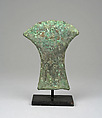
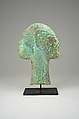
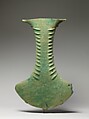
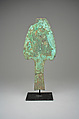
This container has a cylindrical body ornamented at the foot and shoulder and a lid with a handle fashioned as a humanoid head. Suggestions of ears and hair depicted as a series of vertical lines are part of the design.
Artwork Details
- Title: Anthropomorphic Lime Container
- Period: Bronze and Iron Age period
- Date: ca. 500 BCE–300 CE
- Culture: Indonesia (Java, Lumajang, Pasiran)
- Medium: Bronze
- Dimensions: H. 6 1/2 in. (16.5 cm)
- Classification: Metalwork
- Credit Line: Samuel Eilenberg Collection, Bequest of Samuel Eilenberg, 1998
- Object Number: 2000.284.44
- Curatorial Department: Asian Art
More Artwork

Related Content
Publications
Books, guides, and catalogues published by The Met.
 Free to download
Research Resources
The Met provides unparalleled resources for research and welcomes an international community of students and scholars. The Met's Open Access API is where creators and researchers can connect to the The Met collection. Open Access data and public domain images are available for unrestricted commercial and noncommercial use without permission or fee.
To request images under copyright and other restrictions, please use this Image Request form.
Feedback
We continue to research and examine historical and cultural context for objects in The Met collection. If you have comments or questions about this object record, please contact us using the form below. The Museum looks forward to receiving your comments.
Content Notice
The Metropolitan Museum of Art presents over 5,000 years of art from around the world, and our online collection reflects ongoing work conducted over the course of our more than 150-year history. You may encounter objects or images that may be inappropriate for some viewers or information that may be outdated.