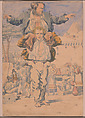
Sketch to Illustrate the Passions—Senility or Peevishness
After demonstrating early artistic promise, and travelling to Greece and the Near East as draftsman to Sir Thomas Phillips in 1842, Dadd succumbed to paranoid schizophrenia and murdered his father. Confined to psychiatric institutions from 1843, he continued painting and left a large oeuvre that escaped significant notice until the 1960s. Today Dadd is regarded as a Victorian master whose enforced withdrawal from society allowed him to refine a unique talent. "Sketches to Illustrate the Passions" belongs to a long tradition of imagery devoted to human folly, even as its unsettling details, and reliance on memory and imagination anticipate modern sensibilities.
Artwork Details
- Title: Sketch to Illustrate the Passions—Senility or Peevishness
- Artist: Richard Dadd (British, Chatham, Kent 1817–1886 Crowthorne, Berkshire)
- Date: 1855
- Medium: Watercolor
- Dimensions: sheet: 14 1/8 x 10 3/16 in. (35.9 x 25.8 cm)
- Classification: Drawings
- Credit Line: Van Day Truex and Harry G. Sperling Funds, 2007
- Object Number: 2007.364
- Curatorial Department: Drawings and Prints
More Artwork
Research Resources
The Met provides unparalleled resources for research and welcomes an international community of students and scholars. The Met's Open Access API is where creators and researchers can connect to the The Met collection. Open Access data and public domain images are available for unrestricted commercial and noncommercial use without permission or fee.
To request images under copyright and other restrictions, please use this Image Request form.
Feedback
We continue to research and examine historical and cultural context for objects in The Met collection. If you have comments or questions about this object record, please contact us using the form below. The Museum looks forward to receiving your comments.
Content Notice
The Metropolitan Museum of Art presents over 5,000 years of art from around the world, and our online collection reflects ongoing work conducted over the course of our more than 150-year history. You may encounter objects or images that may be inappropriate for some viewers or information that may be outdated.