English
DonateMembershipTickets

Four-Armed Ganesha Dancing

16th–17th century
Not on view
This plaque depicts the popular Hindu god Ganesha. Ganesha is popularly thought of as the son of Shiva and Parvati and is worshipped for his ability to remove obstacles. He is also the guardian of doorways and the lord of beginnings and his name is invoked before any new undertaking is commenced. Although there are a number of stories describing how he received his elephant head, the most common recounts that Parvati, while Shiva was away, created Ganesha from the dry skin she sloughed off in a bath. She sent him to guard the door to her bath. When Shiva returned home he did not realize that it was his wife's son guarding the door. Denied entry to her chamber, he lopped off Ganesha's head when the two came to blows. When he discovered the truth, Shiva ordered that the head of the first sentient being that came into view be given to Ganesha. Thus, he received the head of an elephant. Ganesha was just a child at the time and he is usually depicted with a chubby body and holding a bowl of sweetmeats, shown here in his lower left hand. His other three hold a rosary, an ax, and a broken tusk. The last object alludes to a well-known tale in which the portly Ganesha hurled a tusk at the moon in embarrassment after the moon saw his stomach burst from overeating.

Artwork Details

Object Information
  • Title: Four-Armed Ganesha Dancing
  • Date: 16th–17th century
  • Culture: Nepal (Kathmandu Valley)
  • Medium: Gilt-copper alloy
  • Dimensions: H. 6 7/16 (16.4 cm); W. 4 7/16 in. (11.3 cm)
  • Classification: Sculpture
  • Credit Line: Gift of Dr. and Mrs. Wesley Halpert, 1992
  • Object Number: 1992.384
  • Curatorial Department: Asian Art
More Artwork
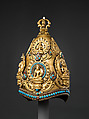
Vajracarya Priest's Crown, Copper, gold, turquoise, semi-precious stones, silver foil, Nepalese
Nepalese
ca. 15th–16th century
Surya, the Hindu Solar Deity, Gilt-copper alloy, Nepal (Kathmandu Valley)
Nepal (Kathmandu Valley)
11th–12th century
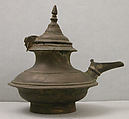
Ewer, Bronze (?)
17th–18th century
Watch, Suzanne de Court and French, Case of brass with plaques of painted enamel on copper, partly gilt and partly silvered, and silver-gilt mounts. Dial of brass with traces of gilding and with a silver chapter of hours; in the center a disk of painted enamel on copper and a gilt-brass hand.
Suzanne de Court
Bernard of Paris
first quarter of 17th century
Orpheus Attacked by the Maenads, Suzanne de Court  French, Painted enamel on copper, partly gilt; gilt brass, French, Limoges
Enameler Suzanne de Court
first quarter 17th century

Research Resources

The Met provides unparalleled resources for research and welcomes an international community of students and scholars. The Met's Open Access API is where creators and researchers can connect to the The Met collection. Open Access data and public domain images are available for unrestricted commercial and noncommercial use without permission or fee.

To request images under copyright and other restrictions, please use this Image Request form.

Feedback

We continue to research and examine historical and cultural context for objects in The Met collection. If you have comments or questions about this object record, please contact us using the form below. The Museum looks forward to receiving your comments.

Send feedback

Content Notice

The Metropolitan Museum of Art presents over 5,000 years of art from around the world, and our online collection reflects ongoing work conducted over the course of our more than 150-year history. You may encounter objects or images that may be inappropriate for some viewers or information that may be outdated.